Many people confuse “principal” and “principle” because they look and sound almost the same. This confusion often appears in school exams, job writing, emails, and even professional reports.
A small spelling mistake can completely change the meaning of a sentence. That is why people search for “principal vs principle” online—to understand the clear difference in simple words.
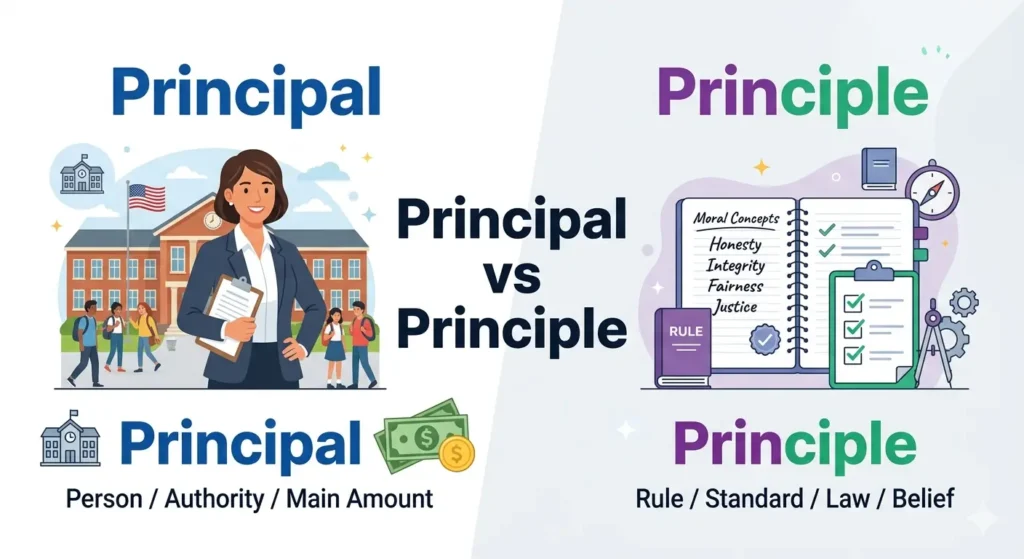
Both words are correct in English, but they are not interchangeable. “Principal” usually refers to a person in charge or something most important, like a school principal or principal reason.
|See more Then vs Than
On the other hand, “principle” means a rule, belief, or basic truth, like moral principles or scientific principles.Learning the difference helps improve writing skills and avoids embarrassing mistakes in formal communication.
It also helps in exams and competitive tests where such words are often asked. In this article, you will get a simple breakdown, real examples, usage tips, and common mistakes. By the end, you will never mix these two words again in your writing or speech.
Principal vs Principle – Quick Answer
“Principal” means the most important person or thing (like a school head or main amount of money).
“Principle” means a rule, belief, or basic truth.
Examples:
- The principal of the school is strict.
- She follows strong moral principles.
The Origin of Principal vs Principle
Both words come from Latin.
- Principal comes from principalis, meaning “first or chief.”
- Principle comes from principium, meaning “beginning or foundation.”
Over time, English kept both words but gave them different meanings. That is why they sound similar but are used in different ways today.
British English vs American English Spelling
There is no spelling difference between British and American English for these words. The confusion is not regional—it is meaning-based.
Comparison Table
| Word | Meaning | Example Sentence |
|---|---|---|
| Principal | Main / leader / most important | The principal reason is cost. |
| Principle | Rule / belief / truth | He follows strong principles. |
Which Spelling Should You Use?
- US English: Same usage (principal/principle)
- UK English: Same usage (principal/principle)
- Global English: No change
👉 The choice depends only on meaning, not country or spelling style.
Common Mistakes with Principal vs Principle
Wrong: He follows strong principals.
✔ He follows strong principles.
❌ The principle of the school is absent.
✔ The principal of the school is absent.
❌ Money principle is high.
✔ Money principal is high (in finance context).
Principal vs Principle in Everyday Examples
- Email: The principal concern is deadline delay.
- News: The company works on ethical principles.
- Social Media: “Stay true to your principles 💯”
- Formal Writing: The principal reason for failure is lack of effort.
Principal vs Principle – Google Trends & Usage Data
Search data shows high confusion worldwide.
- “principal vs principle” is most searched in education-related regions.
- Students and job seekers search it during exams and tests.
- Usage spikes during school exam seasons.
👉 This shows the keyword is mainly used for learning and quick clarification.
Comparison Table (Quick Revision)
| Feature | Principal | Principle |
|---|---|---|
| Type | Noun / adjective | Noun |
| Meaning | Main / leader | Rule / belief |
| Context | School, money, importance | Ethics, science, law |
| Example | School principal | Moral principle |
FAQs
1. Is it principle or principal of money?
It is principal of money, because “principal” means the main amount, not interest. So, you always use principal in finance.
2. Is it principal or principle in a job title?
It is principal in a job title, because “principal” means a person in charge, like a school principal or principal officer.
3. What is the difference between principal and principle place?
“Principal place” means the main or most important location, while “principle” is never used for location. So, use principal place, not principle.
4. What is the difference between principle and principal sum?
“Principal sum” means the original amount of money, whereas “principle” means a rule or belief. Therefore, financial terms use principal.
5. How to use principal and principle?
First, use principal for main person or money; however, use principle for rules or beliefs. For example, school principal vs moral principle.
6. What are the 4 principles of money?
Generally, the four principles include saving, spending wisely, investing, and budgeting. In addition, these principles help manage money effectively.
Conclusion
Understanding the difference between principal and principle is simple once you remember their meanings. Principal refers to a person in charge or something most important. Principle refers to a rule, belief, or basic truth. Many mistakes happen because both words sound the same, but their usage is very different.
If you are talking about a school leader, use principal. If you are talking about moral rules or ideas, use principle. This small trick can help you avoid confusion in writing, exams, and professional communication.
Both words are important in English vocabulary and are widely used in daily life, education, and business writing. Learning them improves clarity and makes your writing more accurate.
Practice using both words in sentences to build confidence. The more you use them correctly, the easier it becomes to remember the difference. Keep this guide for quick revision whenever you feel confused. Always double-check your usage before submitting any formal writing.