Many people search for “further vs farther” because the two words look similar and sound almost the same. This makes them easy to mix up in writing and speech. You may have seen both used in books, emails, or online posts and wondered: Which one is correct?
The confusion comes from their shared meaning related to distance. But here’s the key point—they are not always interchangeable. One is often used for physical distance, while the other is used for abstract ideas. Still, modern usage has blurred the lines, making it even harder to decide.
|RELATED Principal vs Principle
This article clears up that confusion in a simple way. You’ll get a quick answer, learn the history, see real-life examples, and understand which word to use in different situations. By the end, you’ll feel confident using both “further” and “farther” correctly.
Further vs Farther – Quick Answer
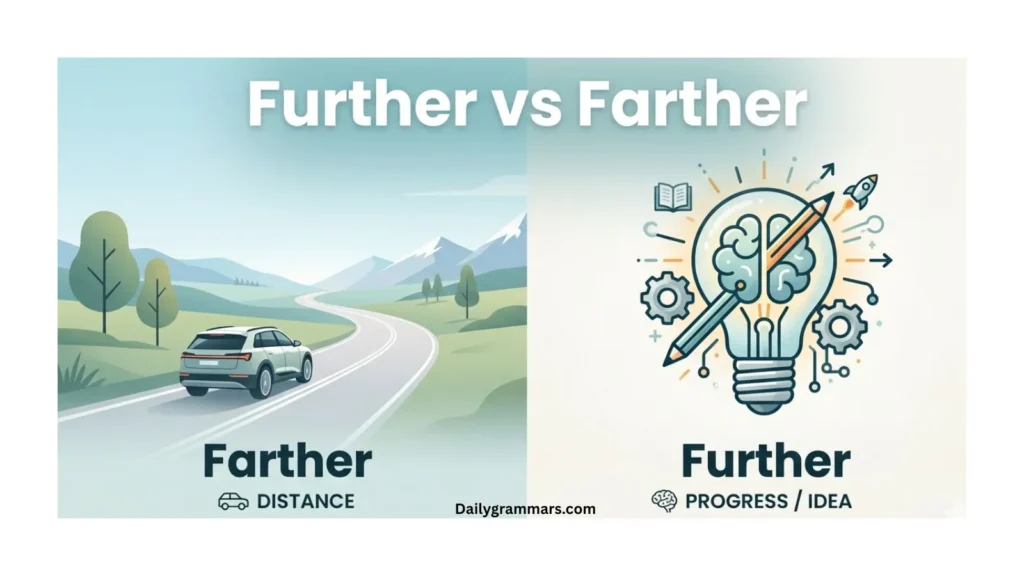
Farther = physical distance
- Example: He ran farther than me.
Further = abstract or figurative distance
- Example: Let’s discuss this further.
Simple rule:
- Use farther for measurable distance.
- Use further for ideas, time, or degree.
The Origin of Further vs Farther
Both words come from Old English. They share the root word “far.”
- Farther developed to describe actual, physical distance.
- Further evolved to include broader meanings like “more” or “in addition.”
Over time, English speakers began using “further” in many contexts. This made it more flexible. Today, some people even use “further” for distance, especially in British English.
That’s why the difference exists—but also why it can feel confusing.
British English vs American English Spelling
There is a small difference in how these words are used across regions.
| Usage Type | American English | British English |
|---|---|---|
| Physical distance | Prefer farther | Often use further |
| Abstract meaning | Use further | Use further |
| Flexibility | More strict distinction | More flexible usage |
Example:
- US: The store is farther away.
- UK: The store is further away.
Which Spelling Should You Use?
It depends on your audience:
- For US readers:
Use the rule strictly.- Farther = distance
- Further = abstract
- For UK/Commonwealth readers:
You can often use further in both cases. - For global audiences:
Follow the simple rule for clarity. It avoids confusion everywhere.
Best advice:
If unsure, use further—it is more widely accepted.
Common Mistakes with Further vs Farther
Here are common errors and how to fix them:
Wrong: He walked further down the road.
✅ He walked farther down the road.
❌ We need to look farther into this issue.
✅ We need to look further into this issue.
❌ She moved further than I expected (physical distance).
✅ She moved farther than I expected.
Tip:
Ask yourself: Can I measure it?
- Yes → farther
- No → further
Further vs Farther in Everyday Examples
Emails:
- Please contact me for further details.
News:
- The storm moved farther inland.
Social Media:
- I can’t go any further with this topic.
Formal Writing:
- Further research is required.
- The object was placed farther from the center.
Further vs Farther – Google Trends & Usage Data
- Further is used more often worldwide.
- Farther is more common in the United States.
- In the UK and other regions, further dominates both meanings.
Why?
Because “further” has more uses. It works in both literal and figurative contexts.
Key insight:
- “Further” = more popular and flexible
- “Farther” = more precise for distance
Comparison Table: Further vs Farther
| Feature | Further | Farther |
|---|---|---|
| Meaning | Abstract distance, degree | Physical distance |
| Usage | Ideas, time, discussion | Measurable space |
| Flexibility | Very flexible | Limited |
| Popularity | More common globally | More common in US |
| Example | Further explanation needed | Farther down the road |
FAQs:
When should I use farther and further?
Use farther for physical distance; however, use further for ideas, time, or degree.
Why do Americans say farther instead of further?
In American English, people prefer farther for distance; meanwhile, further is used for abstract meanings.
Is it further or farther in British English?
In British English, further is often used for both meanings; however, farther is less common.
Is it getting further away or farther away?
If it’s physical distance, say farther away; otherwise, further away can be used more generally.
What is the rule for further and farther?
The rule is simple: use farther for measurable distance; on the other hand, use further for non-physical ideas.
Is it correct to say “further”?
Yes, further is correct; in fact, it’s widely used for abstract meanings and even sometimes for distance.
Conclusion
Understanding further vs farther does not have to be hard. The main difference is simple: use farther for physical distance and further for everything else. This rule works well, especially in American English.
However, language changes over time. People in British English often use “further” for both meanings.
That is why you may see both words used in similar ways. Still, using them correctly shows strong writing skills and attention to detail.
If your goal is clear and professional writing, stick to the simple rule. When in doubt, “further” is usually safe. But when talking about measurable distance, “farther” is the better choice.
By practicing these small differences, you can improve your English and avoid common mistakes. Over time, choosing between “further” and “farther” will feel natural.