The confusion between “lay” vs “lie” is one of the most common grammar problems in English. Many people search this keyword because both words look similar, but their meanings and usage are very different. This often leads to mistakes in writing emails, essays, social media posts, and even professional documents.
|See also Who vs Whom
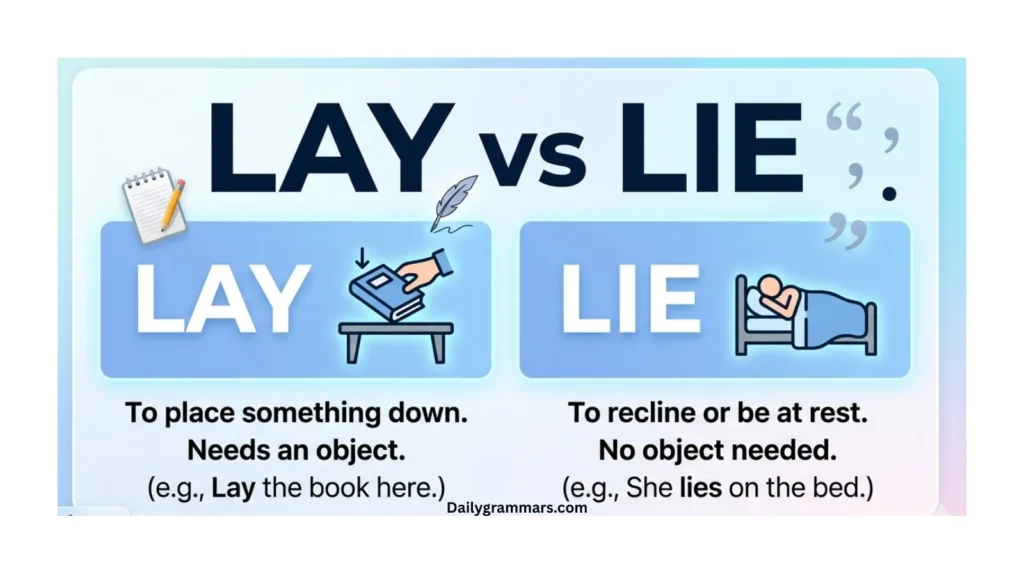
The main reason for confusion is that both words relate to placing something down or resting, but they follow different grammar rules. “Lay” usually needs an object, while “lie” does not. On top of that, their past tense forms are also tricky—“lay” becomes “laid,” but “lie” becomes “lay,” which adds even more confusion.
This article will clearly explain lay vs lie in the simplest way possible. You will learn quick rules, history, spelling differences, common mistakes, and real-life examples. By the end, you will confidently know when to use each word without hesitation.
Whether you are a student, writer, or English learner, this guide will help you master one of the most confusing grammar topics in English.
Lay vs Lie – Quick Answer
Simple rule:
- Lay = to put something down (needs an object)
- Lie = to rest or recline (no object needed)
Examples:
- I lay the book on the table. (correct)
- I lie on the bed every night. (correct)
Past tense confusion:
- Present: lay / lie
- Past: laid / lay
- Past participle: laid / lain
Example:
- Yesterday, I laid the phone on the desk.
- He lay on the sofa all day.
The Origin of Lay vs Lie
The confusion comes from Old English roots.
- Lay comes from Old English lecgan, meaning “to place down.”
- Lie comes from Old English licgan, meaning “to rest.”
Over time, English kept both words but changed their forms. Their past tenses also shifted in unusual ways, which is why modern learners struggle today.
The irregular verb patterns survived through history, making lay vs lie one of the hardest grammar pairs in English.
British English vs American English Usage
Good news: both British and American English use the same rules for lay vs lie.
However, differences appear in usage style and frequency.
| Feature | British English | American English |
|---|---|---|
| Usage style | More formal in writing | More casual in speech |
| “Lie” usage | Very common | Very common |
| “Lay” confusion | Often corrected in schools | Also commonly confused |
| Grammar teaching | Strict focus on rules | Practical usage focus |
Which Spelling Should You Use?
- US English:
- Use standard grammar rules (lay vs lie) in formal writing.
- UK/Commonwealth English:
- Same rules, but more attention to traditional grammar.
- Global English:
- Follow standard grammar (object vs no object rule).
👉 Best advice: Focus on meaning, not spelling style.
Common Mistakes with Lay vs Lie
Incorrect: I will lie the book on the table.
✔ Correct: I will lay the book on the table.
❌ Incorrect: I am laying on the bed.
✔ Correct: I am lying on the bed.
❌ Incorrect: Yesterday I lied on the sofa.
✔ Correct: Yesterday I lay on the sofa.
👉 Tip: If there is an object, use lay. If not, use lie.
Lay vs Lie in Everyday Examples
Emails:
- Please lay the documents on my desk.
News writing:
- The workers laid the foundation yesterday.
Social media:
- I just want to lie in bed all day 😴
Formal writing:
- The book was laid on the table by the assistant.
Lay vs Lie – Google Trends & Usage Data
Search data shows:
- High confusion in India, Pakistan, and Southeast Asia
- Steady search volume in USA and UK during exams
- Most searches happen during:
- English exams
- IELTS preparation
- Writing improvement
👉 This shows learners worldwide struggle with this grammar pair, especially in academic contexts.
Comparison Table: Lay vs Lie
| Base Form | Meaning | Requires Object? | Past Tense | Example |
|---|---|---|---|---|
| Lay | To place something | Yes | Laid | I laid the book down |
| Lie | To rest/recline | No | Lay | I lay on the bed |
FAQs:
- Do you lie in bed or lay in bed?
You lie in bed (rest yourself). “Lay in bed” is incorrect unless you are placing something in the bed. - When to use lay or lie?
Use lay when you put something down (needs an object). Use lie when you rest yourself (no object). - Do you lay or lie on the couch?
You lie on the couch. - Is it lay with me or lie with me?
Correct is lie with me (to rest together). “Lay with me” usually means placing something and is often incorrect in this context. - Where do I lie or lay?
You lie (rest). Example: “I lie on the bed.” - What are the two meanings of lie?
- To rest/recline (I lie down)
- To tell a false statement (He tells a lie / he lies)
Conclusion (150–200 words)
Understanding lay vs lie is important for clear and correct English communication. Many learners get confused because both words look similar and even share past tense forms. However, the rule is simple once you learn it: lay always needs an object, while lie does not.
To master this grammar point, focus on meaning instead of memorizing forms. Think of “lay” as an action you do to something, and “lie” as an action you do yourself. Practice with real-life sentences like emails, conversations, and writing exercises to build confidence.
Even native speakers sometimes make mistakes with these words, so don’t feel discouraged. The key is repetition and understanding patterns.
Once you master lay vs lie, your writing will look more professional and polished. This small grammar rule can make a big difference in exams, job writing, and daily communication.
Keep practicing, and soon you will never confuse lay vs lie again.