Many English learners get confused between “may” and “might.” These two small words can change the meaning of a sentence, but they look very similar. That is why people search for “may vs might” every day. They want a simple answer that tells them when to use each word correctly.
Both words are modal verbs. They are used to show possibility, permission, or uncertainty. But the difference is very small, and even native speakers sometimes mix them up. For example, “It may rain” and “It might rain” look the same, but they are not always equal in meaning.
|RELATED Further vs Farther
This confusion can cause problems in writing emails, exams, or professional messages. Learners often ask: Are they interchangeable? Is one more formal? Which one is correct in British or American English?
In this guide, you will get a clear and simple explanation. You will learn the quick difference, word origin, spelling rules, common mistakes, real-life examples, and usage tips. By the end, you will never confuse “may” and “might” again. Everything is explained in a very easy way so anyone can understand it quickly.
May vs Might – Quick Answer
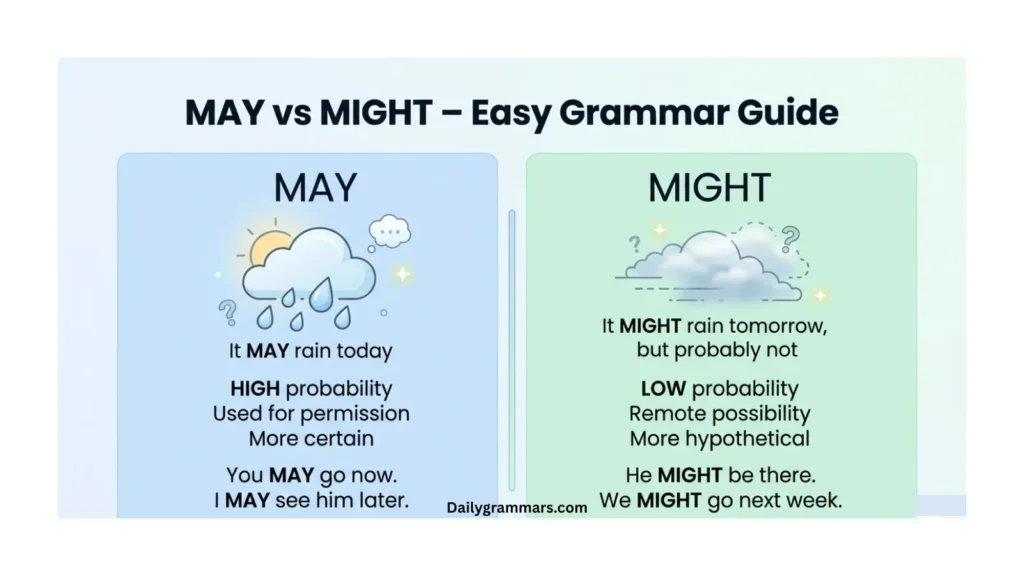
“May” and “might” both show possibility, but “may” is stronger and more certain than “might.”
Examples:
- It may rain today. (More possible)
- It might rain today. (Less certain)
- You may leave now. (Permission)
- I might go to the party. (Uncertain plan)
The Origin of May vs Might
The word “may” comes from Old English magan, meaning “to be able.”
The word “might” is its past form, from meahte or mihte.
Over time, English changed. The meaning of “might” became weaker. It started showing less certainty than “may.” Today, we use both words to show possibility, not past time.
British English vs American English Usage
There is no major spelling difference between British and American English for “may” and “might.”
However, usage style can be slightly different.
| Usage Area | British English | American English |
|---|---|---|
| Formal permission | May I go? | May I go? |
| Possibility | It may rain | It may rain |
| Casual speech | Might be true | Might be true |
| Preference | Slightly more formal “may” | More flexible use |
Which Spelling Should You Use?
Good news: there is no spelling change between UK, US, or global English.
- Use “may” in formal writing, exams, and polite requests.
- Use “might” in casual speech or when you are less sure.
- In professional writing, “may” sounds more confident.
Common Mistakes with May vs Might
Wrong: I may went to school.
✔ I may go to school.
❌ He might goes there.
✔ He might go there.
❌ May you come tomorrow? (wrong in modern English)
✔ Can you come tomorrow? / Will you come tomorrow?
May vs Might in Everyday Examples
Emails:
- I may respond late today due to meetings.
News:
- The company might launch a new product soon.
Social Media:
- I might skip gym today 😅
Formal Writing:
- The results may vary depending on conditions.
May vs Might – Usage Overview Table
| Feature | May | Might |
|---|---|---|
| Strength | Stronger possibility | Weaker possibility |
| Formality | More formal | Less formal |
| Permission | Yes | Rare |
| Certainty | Higher | Lower |
| Example | It may rain | It might rain |
May vs Might – Google Trends & Usage Data
Search data shows that “may vs might” is searched worldwide, especially by English learners in Asia, the Middle East, and Europe.
The confusion is common in school grammar lessons and IELTS preparation.
- “May” is used more in formal writing and education.
- “Might” is more common in casual speech and online content.
Overall, both terms remain highly searched because learners want quick grammar clarity.
FAQs:
1. How do you use may and might?
We use “may” for higher possibility or permission, and “might” for lower possibility or uncertainty.
Example: It may rain (more likely), It might rain (less sure)
2. What are the 10 examples of might and may?
- It may rain today.
- You may leave now.
- She may come late.
- I might go shopping.
- He might be at home.
- They might cancel the trip.
- You may use my phone.
- I may join the class.
- We might watch a movie.
- It might snow tonight.
3. What is stronger, might or may?
“May” is stronger because it shows higher possibility than “might.”
4. Is it may I ask or might I ask?
Both are correct, but “May I ask” is more polite and commonly used in formal English.
5. What is a 5 sentence example of might?
I might go to school tomorrow. He might be busy right now. We might travel next week. She might call you later. It might rain in the evening.
6. What do I might mean?
“I might” means there is a chance something will happen, but you are not sure.
Example: I might go = I am not certain I will go.
Conclusion
Understanding may vs might is simple once you learn the basic rule: both show possibility, but “may” is stronger and more formal, while “might” is weaker and more uncertain. This small difference helps you express ideas clearly in writing, speaking, exams, and professional communication.
Many learners confuse these words because they look similar and often appear in the same context. However, once you practice real examples, the difference becomes very easy. Use “may” when you feel something is more likely or when you want to sound polite. Use “might” when you are unsure or talking casually.
In formal writing like emails, reports, or academic work, “may” is usually the safer choice. In everyday speech or informal messages, “might” feels more natural. Both are correct, but the tone changes slightly.
Now you can confidently use both words without confusion. Practice them in sentences, and soon it will become automatic in your English writing and speaking.