Many English learners confuse “which” with “that.” Both words give extra information about a noun, but they do not always work interchangeably. This small grammar difference can change the meaning of a sentence and even affect how professional your writing looks.
People often search for “which vs that” because they are unsure when to use commas, how to form relative clauses, and whether both words mean the same thing. For example, should you say “The car that I bought” or “The car which I bought”? Both may seem correct, but grammar rules say otherwise in formal writing.
RELATED: May vs Might
This confusion is common in emails, essays, job applications, and even social media posts. Learning the difference helps you write clearly, avoid mistakes, and sound more natural in English.
In this guide, you will learn the simple rules behind which vs that, see real examples, understand common mistakes, and get easy tips to remember the correct usage forever. Everything is explained in a clear, simple way so you can use it right away without stress.
Which vs That – Quick Answer
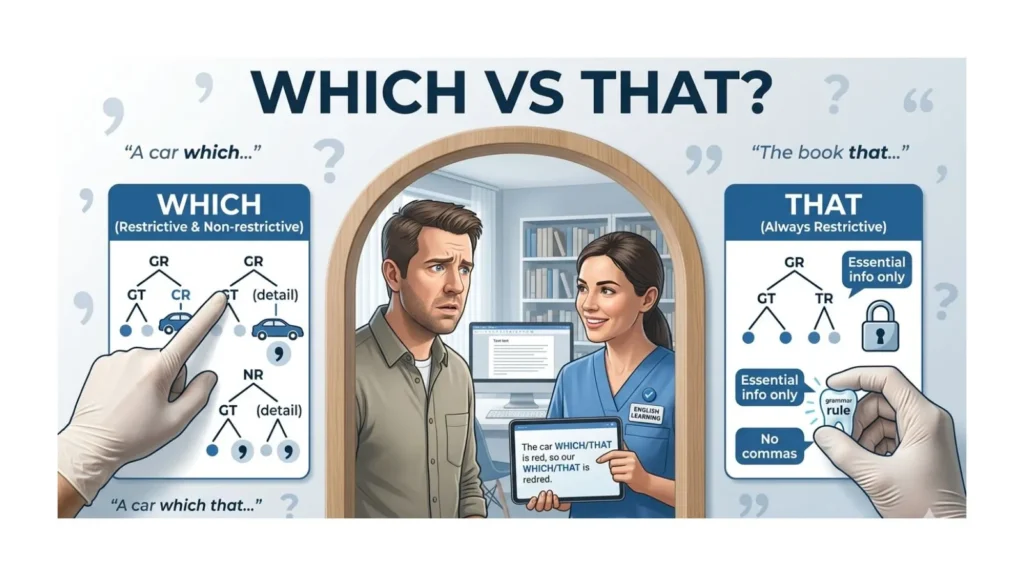
“That” is used for essential information (no commas).
“Which” is used for extra information (with commas).
Examples:
- The book that I borrowed is missing. (Important information)
- The book, which I borrowed yesterday, is missing. (Extra information)
👉 Simple rule:
If you can remove the clause without changing the meaning → use which.
If you cannot remove it → use that.
The Origin of Which vs That
Both words come from Old English.
- That comes from Old English “þæt” meaning “the thing mentioned.”
- Which comes from Old English “hwilc” meaning “what kind of.”
Over time, English grammar developed rules to separate their roles in sentences. Writers needed a clear system to avoid confusion in meaning, so “that” became linked with essential information and “which” with extra details.
British English vs American English Usage
In modern English, the difference is not spelling but grammar preference.
| Feature | American English | British English |
|---|---|---|
| “That” in restrictive clauses | Preferred | Preferred |
| “Which” in restrictive clauses | Less common | More accepted |
| Use of commas | Strict | More flexible |
Examples:
- US: The phone that I bought is new.
- UK: The phone which I bought is new (sometimes accepted in speech/writing).
Which Spelling Should You Use?
- US English: Prefer “that” for essential clauses.
- UK/Commonwealth English: “Which” is sometimes used in both cases, but formal writing still prefers “that.”
- Global English: Use American rule for clarity and simplicity.
👉 Best advice:
Use “that” for important information in all formal writing to stay safe everywhere.
Common Mistakes with Which vs That
Wrong: The bag which I bought is expensive.
✔ Correct: The bag that I bought is expensive.
Wrong: The car that, I love is fast.
✔ Correct: The car that I love is fast.
❌ Wrong: The house, that is big, is mine.
✔ Correct: The house, which is big, is mine.
👉 Mistake rule:
Don’t mix commas with “that.”
Which vs That in Everyday Examples
Emails:
- The document that you sent is correct.
- The report, which you sent yesterday, is approved.
News Writing:
- The law that was passed today will change taxes.
- The law, which was passed today, will change taxes.
Social Media:
- The phone that I love ❤️
- This song, which I can’t stop playing 🎧
Formal Writing:
- The theory that explains gravity is widely accepted.
Which vs That – Google Trends & Usage Data
Search data shows:
- “which vs that” is most searched in USA, India, Pakistan, and UK
- High usage in academic writing seasons (exam time)
- Most searches come from students and ESL learners
- “that vs which grammar” is also a trending variation
👉 This shows people mainly want quick grammar rules and examples.
Comparison Table: Which vs That Variations
| Form | Type | Use | Example |
|---|---|---|---|
| that | Essential clause | No commas | The phone that works is mine |
| which | Extra info | Uses commas | The phone, which is new, is mine |
| restrictive clause | defining info | necessary meaning | The car that broke down |
| non-restrictive clause | extra info | optional meaning | The car, which broke down, is red |
FAQs – Which vs That
How do I remember the that-which rule?
Use “that” for essential info (no commas) and “which” for extra info (with commas).
What are 7 types of pronouns?
Personal, possessive, reflexive, relative, demonstrative, interrogative, indefinite.
Which and that sentence examples?
The book that I bought is new. / The book, which I bought yesterday, is new.
Do I use which or that?
Use “that” for important info and “which” for extra, non-essential details.
What are the 9 grammar rules?
Capitalization, punctuation, subject-verb agreement, tenses, articles, pronouns, prepositions, sentence structure, modifiers.
Conclusion (150–200 words)
Understanding which vs that is one of the simplest ways to improve your English writing. Even though both words look similar, they serve different roles in a sentence. We use ‘that’ when the information is essential and we cannot remove it without changing the meaning. We use ‘which’ when the information is extra and we can remove it without affecting the main idea.
This small difference helps you write clearly, especially in academic writing, business emails, and professional communication. Many learners make mistakes by mixing commas or using both words incorrectly, but once you learn the rule, it becomes very easy.
The best approach is to follow a simple habit: use “that” for important information and “which” for additional details with commas. This rule works in both American and British English and keeps your writing clean and correct.
With practice, you will stop thinking about the rule and start using it naturally. Keep practicing with real sentences, and soon “which vs that” will no longer be confusing for you.