Many people get confused between “begun” and “began.” They look similar and come from the same verb, but they are not used the same way. This confusion is very common, especially for learners of English or writers who want to sound correct and professional.
People search for “begun or began” because they want a quick answer: which word is right in a sentence? The problem usually comes when writing emails, essays, or social media posts. Using the wrong form can make your sentence sound awkward or incorrect.
This guide will clear that confusion in a simple way. You’ll learn the difference, see examples, and know exactly when to use each word. By the end, you won’t mix them up again.
Begun or Began – Quick Answer
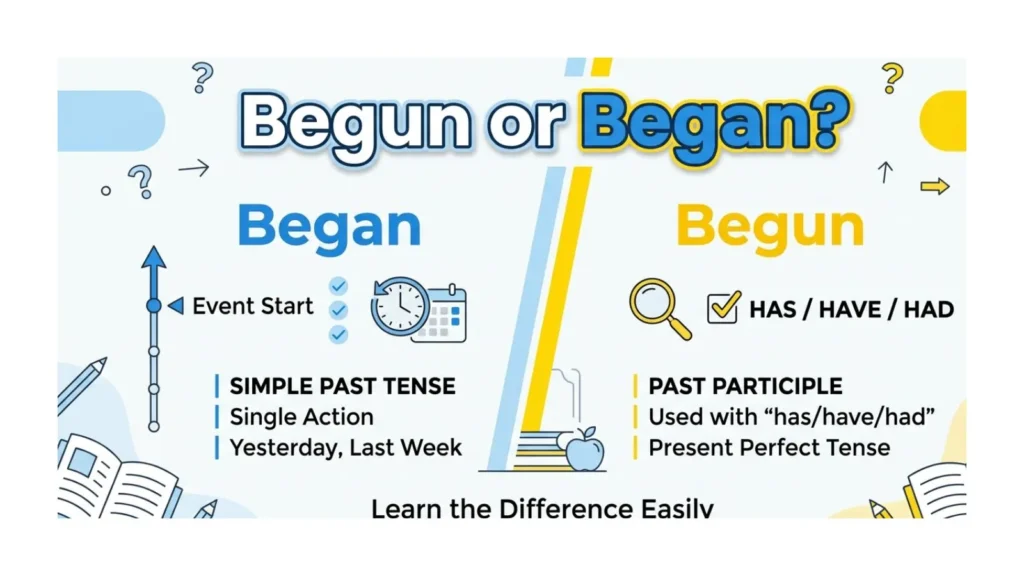
“Began” is the past simple form of “begin.”
“Begun” is the past participle and needs a helping verb (like has, have, had).
Examples:
- I began my work yesterday. ✅
- I have begun my work. ✅
- I have began my work. ❌
The Origin of Begun or Began
Both words come from the verb “begin.” This verb has three forms:
- Base: begin
- Past: began
- Past participle: begun
This pattern is common in English irregular verbs. Over time, English kept these different forms instead of using simple “-ed” endings.
The difference exists because English grammar separates:
- Actions completed in the past (began)
- Actions connected to the present with helping verbs (begun)
British English vs American English Spelling
There is no spelling difference between British and American English for “begun” and “began.” Both use the same forms.
However, usage style may differ slightly in tone and sentence structure.
Comparison Table
| Form | Type | Example (UK & US) |
|---|---|---|
| Began | Past simple | She began the project yesterday |
| Begun | Past participle | She has begun the project |
Which Spelling Should You Use?
Choosing between “began” and “begun” depends on your sentence structure, not location.
- Use “began” for simple past (finished action)
- I began learning English last year.
- Use “begun” with helping verbs
- I have begun learning English.
Advice:
- For US, UK, or global audiences → Follow grammar rules, not region
- If unsure → Check if there is a helping verb
Common Mistakes with Begun or Began
Wrong: I have began my homework
✅ I have begun my homework
❌ She has began cooking
✅ She has begun cooking
❌ We begun the meeting yesterday
✅ We began the meeting yesterday
Tip:
If you see has, have, had → use begun
Begun or Began in Everyday Examples
Emails:
- I began the report yesterday.
- I have begun working on your request.
News:
- The company began a new project.
- The company has begun expansion plans.
Social Media:
- I began my fitness journey today 💪
- I have begun a new chapter in life
Formal Writing:
- The study began in 2020.
- The research has begun successfully.
Begun or Began – Google Trends & Usage Data
Search data shows that many users type “begun or began” because of confusion in grammar.
- “Began” is used more in storytelling and past events
- “Begun” appears more in formal writing and present-perfect sentences
Popularity by context:
- Students → grammar learning
- Writers → editing sentences
- Professionals → emails and reports
Comparison Table: Begun vs Began
| Feature | Began | Begun |
|---|---|---|
| Verb form | Past simple | Past participle |
| Needs helper | No | Yes (has/have/had) |
| Example | I began work | I have begun work |
| Usage | Finished past | Ongoing or connected past |
FAQs
Is it correct to say it has begun?
Yes, “it has begun” is correct because “begun” is used with helping verbs like has.
What does it’s begun mean?
“It’s begun” means “it has begun,” showing something has started already.
Is it summer just begun or began?
Correct: “summer has just begun” (use begun with has).
Has officially began or begun?
Correct: “has officially begun” (not began).
Is begun correct grammar?
Yes, “begun” is correct when used with has, have, or had.
What are 12 types of tenses?
They are Present (simple, continuous, perfect, perfect continuous), Past (same 4), and Future (same 4).
Conclusion
Understanding “begun” and “Started” is simple once you know the rule. “Began” is used for actions that happened in the past and are finished. “Begun” is used with helping verbs like “has,” “have,” or “had.” This is the key difference.
Many learners make mistakes by mixing these forms, especially in writing. But with a small check—looking for a helping verb—you can easily choose the correct word. This makes your English clearer and more professional.
In everyday use, “Started” appears more in storytelling, while “begun” is common in formal and structured sentences. Both are correct when used properly.
Keep practicing with real examples, and soon you won’t even think twice. You’ll naturally know whether to use “begun” or “Started.”