

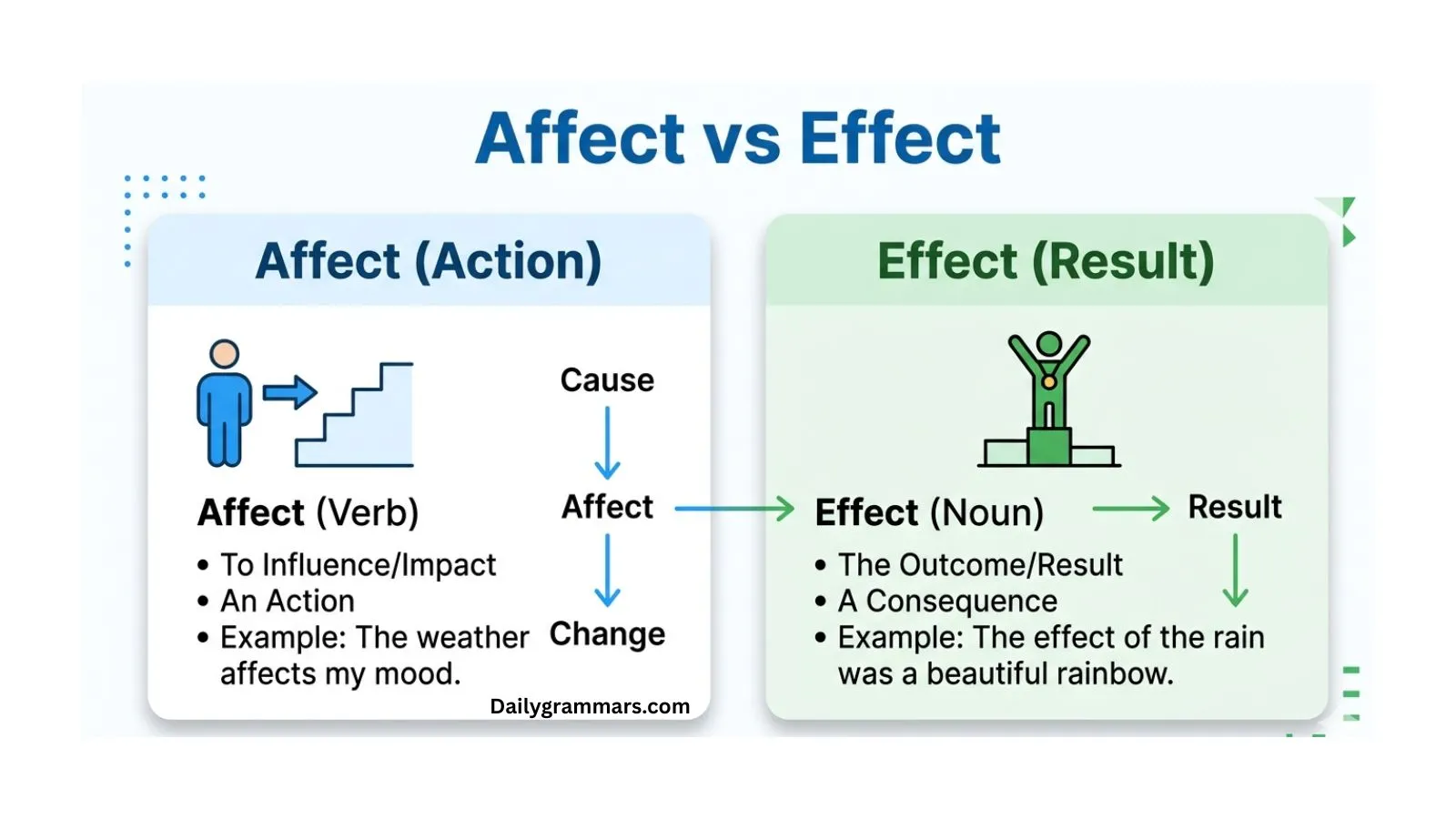
Many writers get confused about Affect vs Effect, especially when both words look and sound similar. In fact, this common grammar issue leads people to search for clear answers about Affect vs Effect in everyday writing.
Whether you are a student or a professional, understanding Affect vs Effect helps you avoid mistakes and write with confidence. Moreover, mixing up Affect vs Effect can change the meaning of your sentence.
|See more Necessary vs Neccessary
Therefore, learning the correct usage of Affect vs Effect is important for clear communication. In this guide, you will quickly understand the difference and use both words correctly without confusion.
Affect vs Effect Psychology
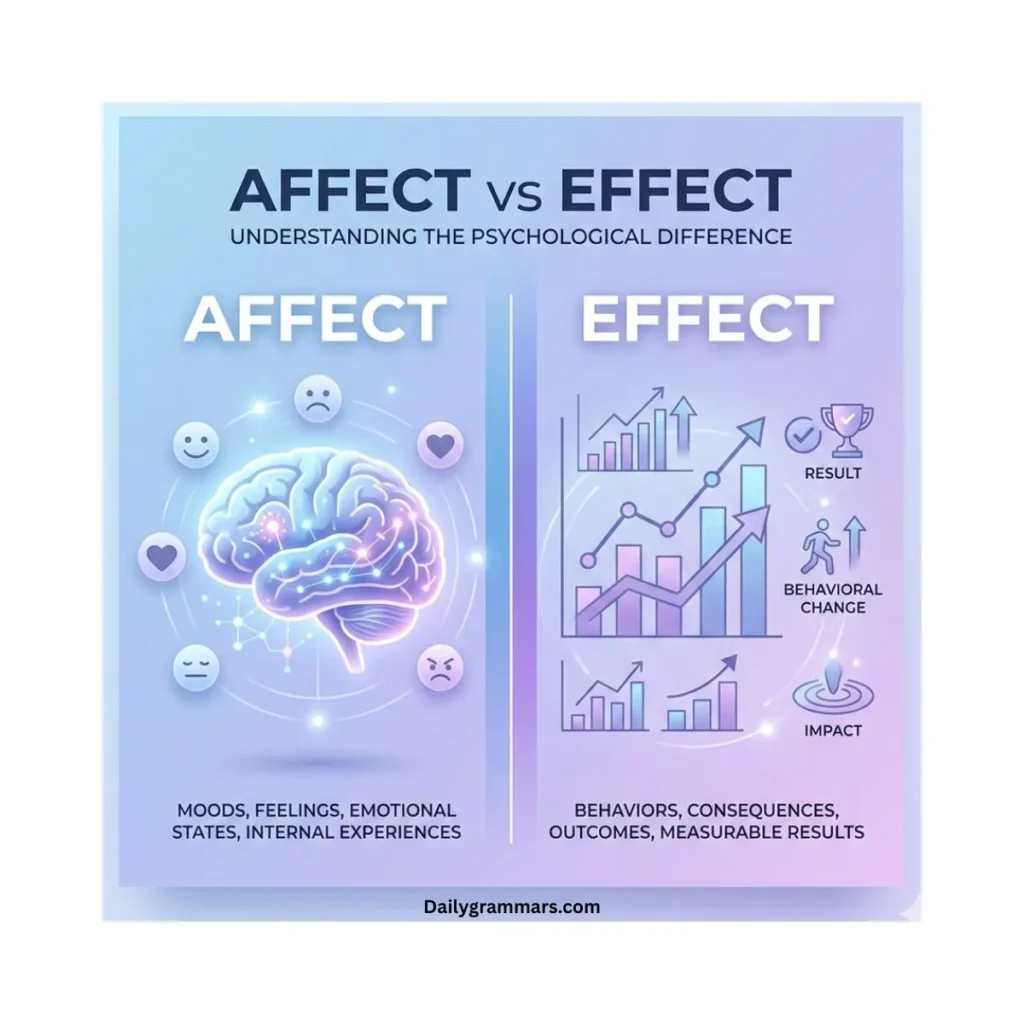
In psychology, affect vs effect has a slightly different meaning. First, affect is often used as a noun, which refers to a person’s emotions or feelings. For example, a psychologist may say someone has a “flat affect,” meaning they show little emotion.
On the other hand, effect still means a result or outcome. For instance, therapy can have a positive effect on mental health. Therefore, in psychology, affect focuses on emotional expression, while effect focuses on the result of actions or treatments.
Understanding this difference helps in both academic study and real-life communication, especially when discussing behavior, mood, and mental health clearly.
Affect vs Effect – Quick Answer
Affect is usually a verb. It means to influence something.
Effect is usually a noun. It means a result or outcome.
Examples:
- The weather can affect your mood.
- The rain had a strong effect on the game.
Quick Trick:
- A = Action → Affect = Verb
- E = End result → Effect = Noun
The Origin of Affect vs Effect
Both words come from Latin, which is why they look similar.
- Affect comes from “afficere”, meaning to influence or act on.
- Effect comes from “efficere”, meaning to bring about or produce.
Over time, English kept both words. Their meanings stayed close, but their roles became different. That is why spelling matters. One small letter change (“a” vs “e”) changes the meaning.
British English vs American English Spelling
Good news: there is no spelling difference between British and American English for these words. Both use “affect” and “effect” the same way.
However, usage and style may vary slightly in writing tone.
Comparison Table
| Feature | Affect | Effect |
|---|---|---|
| Part of Speech | Verb (usually) | Noun (usually) |
| Meaning | To influence | Result or outcome |
| Example (UK/US) | This may affect results | The effect was clear |
| Spelling Difference | None (UK = US) | None (UK = US) |
Which Spelling Should You Use?
Use both words based on meaning, not location.
- US audience: Follow standard rule (affect = verb, effect = noun)
- UK/Commonwealth: Same rule applies
- Global writing: Keep it simple and follow the basic rule
Tip: If unsure, rewrite your sentence:
- Replace with “influence” → use affect
- Replace with “result” → use effect
Common Mistakes with Affect vs Effect
Here are frequent errors:
Wrong: The new law will effect people’s lives.
✅ The new law will affect people’s lives.
❌ The medicine had a bad affect.
Correct: The medicine had a bad effect.
❌ This will effect your grades.
✅ This will affect your grades.
Rare Exceptions:
- “Effect” can be a verb meaning to bring about
- Example: The manager will effect change.
Affect vs Effect in Everyday Examples
Emails:
- Your delay may affect the project timeline.
- The delay had a negative effect.
News:
- Rising prices affect families.
- The policy had a strong effect on the economy.
Social Media:
- Lack of sleep can affect your mood 😴
- Coffee has a quick effect ☕
Formal Writing:
- Stress can affect health outcomes.
- The treatment showed a positive effect.
Affect vs Effect – Google Trends & Usage Data
“Affect vs effect” is a popular search topic worldwide. Many users search for it when writing essays, emails, or reports.
Usage Trends:
- High search volume in the US, UK, India, and Pakistan
- Students and professionals search it often
- Peaks during exam seasons and work deadlines
Context of Use:
- Education (essays, grammar checks)
- Business writing
- Content creation and blogging
Comparison Table: Affect vs Effect Variations
| Word | Type | Meaning | Example Sentence |
|---|---|---|---|
| Affect | Verb | Influence | Noise can affect sleep |
| Effect | Noun | Result | Noise has a bad effect |
| Effect | Verb | Bring about | They will effect change |
| Affect | Noun | Emotion (rare) | His affect was flat |
FAQs
- When to use affect or effect?
First, use affect when you mean “influence”; however, use effect when you mean “result.” - Are you affected or effected by something?
Usually, you are affected by something; however, “effected” is rare and means “caused to happen.” - Is it affects me or effects me?
In most cases, it is affects me; because “affect” is the correct verb for influence. - How do you remember effect vs affect?
Simply, remember A = Action (affect); meanwhile, E = End result (effect). - What is an example of affect?
For example, lack of sleep can affect your mood; therefore, rest is important. - Are you effected or affected by a fire?
Generally, you are affected by a fire; because it influences your life or situation.
Conclusion
“Affect vs effect” is a common grammar problem, but it becomes easy with a simple rule. Remember that “affect” is usually an action, so it works as a verb. “Effect” is usually the result, so it works as a noun. This one idea can solve most confusion.
You also learned their origins, real-life examples, and common mistakes. These help you see how the words work in daily writing. Even though both words look similar, their meanings are different and important.
When in doubt, use the quick trick: affect = influence, effect = result. You can also rewrite your sentence to check which word fits best. With a little practice, you will stop mixing them up. Clear writing builds trust, and using the right word makes your message strong and professional.