

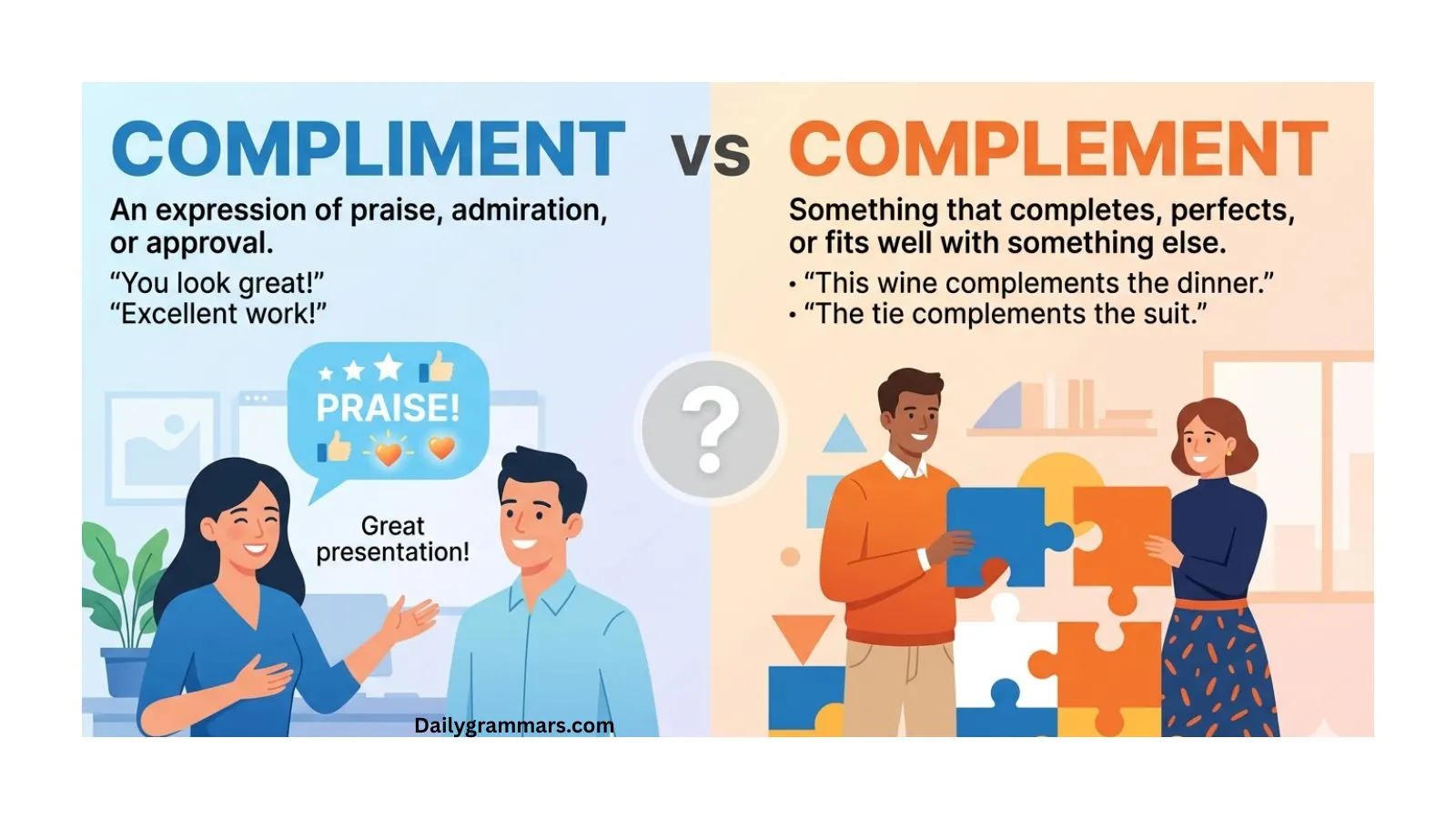
Many learners struggle with Compliment vs Complement because these words look and sound alike but have different meanings. This confusion often leads to mistakes in writing, emails, and daily conversations.
Understanding Compliment vs Complement helps you communicate clearly and avoid embarrassing errors. One word relates to praise, while the other refers to something that completes or improves.
|RELATED Grammar vs Grammer
When you master Compliment vs Complement, your sentences become more accurate and professional. This guide explains Compliment vs Complement in a simple way, so you can easily remember the difference.
By learning Compliment vs Complement, you will gain confidence and improve your English skills in both formal and casual situations.
Compliment vs Complement – Quick Answer
- Compliment = praise or kind words
Example: She gave me a compliment on my work. - Complement = something that completes or matches well
Example: This sauce complements the dish perfectly.
👉 Easy trick:
- Compliment = I (say something nice)
- Complement = E (enhance or complete)
The Origin of Compliment vs Complement
Both words come from Latin but took different paths over time.
- Compliment comes from “complēmentum” through French, meaning polite expression or praise.
- Complement comes from “complēre,” meaning “to fill up” or “complete.”
Even though they sound alike, their meanings split long ago. That’s why spelling matters so much today.
British English vs American English Spelling
Good news: there is no spelling difference between British and American English for these words. The confusion is about meaning—not region.
| Word | Meaning | US English | UK English |
|---|---|---|---|
| Compliment | Praise or admiration | Same | Same |
| Complement | Complete or enhance | Same | Same |
👉 Unlike “color/colour,” both forms stay the same in all English types.
Which Spelling Should You Use?
Choose based on meaning, not location:
- Use compliment when giving praise
- Use complement when something fits or completes
Audience Tips:
- US audience: Use both words correctly (no spelling change)
- UK/Commonwealth: Same rule applies
- Global writing: Focus on meaning clarity
👉 If unsure, ask: Am I praising or completing?
Common Mistakes with Compliment vs Complement
Wrong: She complemented my dress (if you mean praise)
✔ Correct: She complimented my dress
Wrong: This wine compliments the meal
✔ Correct: This wine complements the meal
❌ Wrong: He gave me a nice complement
✔ Correct: He gave me a nice compliment
👉 Tip:
- Praise = compliment
- Match/complete = complement
Compliment vs Complement in Everyday Examples
Emails
- Thank you for the compliment on my presentation.
- This feature complements our product well.
News
- The actor received many compliments.
- The design complements the modern style.
Social Media
- Thanks for the sweet compliment!
- Your shoes complement your outfit.
Formal Writing
- Her skills complement the team’s goals.
- He accepted the compliment politely.
Compliment vs Complement – Google Trends & Usage Data
- Compliment is more common in daily speech and social media
- Complement is used more in formal, academic, or design contexts
Popularity by Context:
- USA & UK: Both words used equally, but compliment appears more in casual writing
- Business & design fields: Complement is more frequent
- Education & grammar searches: High confusion between the two
👉 People search this keyword often because both words sound the same but differ in meaning.
Comparison Table: Compliment vs Complement
| Feature | Compliment | Complement |
|---|---|---|
| Meaning | Praise or admiration | Completes or enhances |
| Usage | Social, personal | Formal, descriptive |
| Example | She gave a compliment | This color complements blue |
| Memory Tip | “I like you” | “Enhance or complete” |
FAQs
- What is the difference between complement and compliment?
First, a compliment means praise; however, a complement means something that completes or improves. - Is free food complimentary or complementary?
Usually, “complimentary” is correct; in other words, it means free or given as a courtesy. - What does complement mean?
Simply, complement means to complete, match, or enhance something. - What is an example of complement?
For example, this tie complements your suit perfectly. - When should I use complement?
Use complement when something improves or completes another thing; therefore, it fits well together. - Are compliments flirting?
Not always; however, compliments can be friendly, polite, or sometimes romantic depending on the situation.
Conclusion
Understanding compliment vs complement is simple once you know the core difference. A compliment is about kind words and praise, while a complement is about completing or improving something. Though they sound the same, their meanings are very different, and using the wrong one can change your message.
The best way to avoid mistakes is to remember the quick trick: compliment has “I” for praise, and complement has “E” for enhance. This small memory tip can help you in emails, social media posts, and professional writing.
No matter where you are in the world, the spelling stays the same—only the meaning changes. With practice and awareness, you can confidently use both words correctly. Mastering this pair will improve your writing clarity and make your communication more professional.