

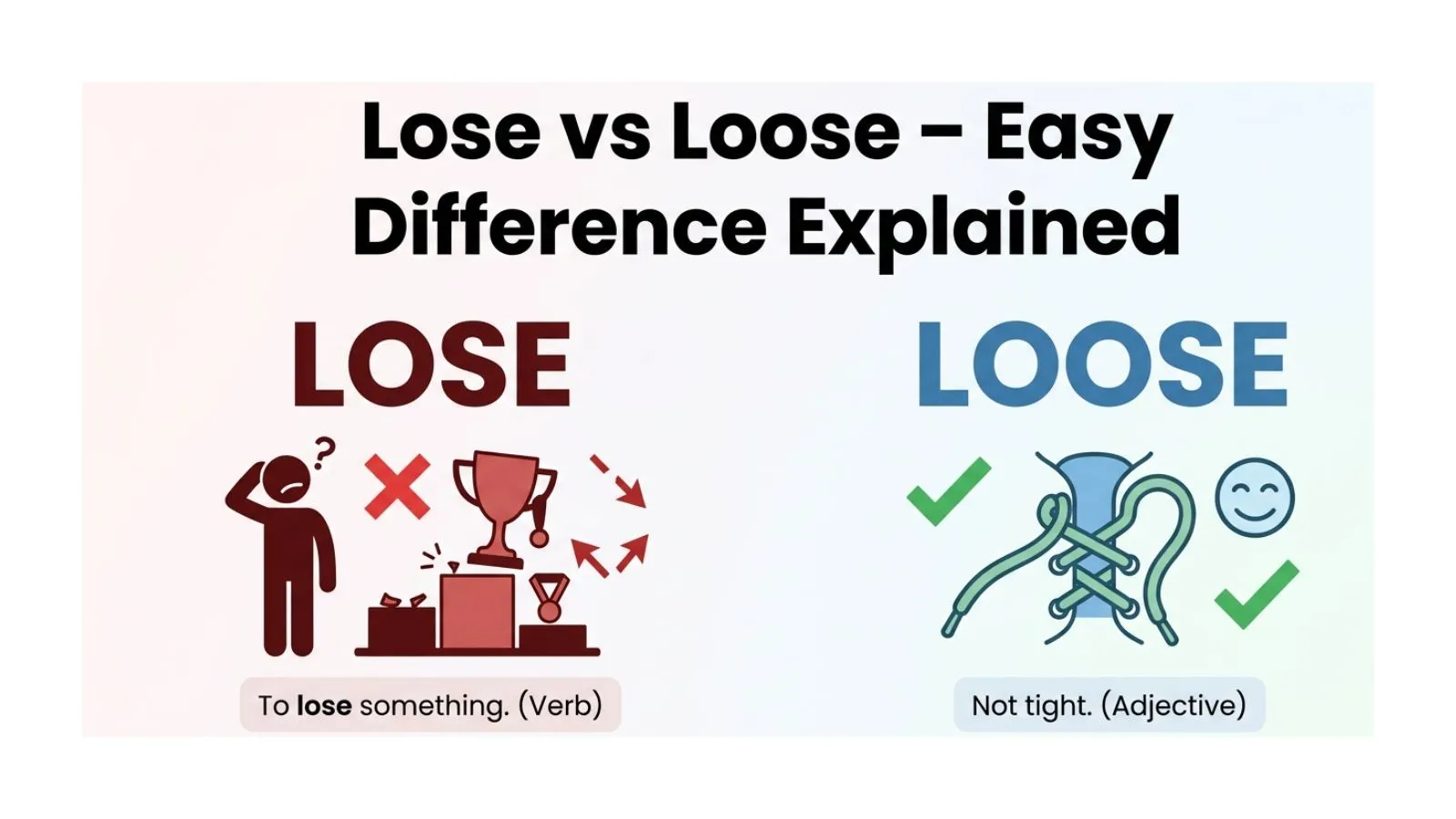
Many people search for “lose vs loose” because these two words look very similar but mean very different things. A small spelling mistake can completely change your sentence. For example, “I don’t want to lose the game” is correct, but “I don’t want to loose the game” is wrong—and confusing.
|RELATED Advice vs Advise
This mistake happens often in emails, social media posts, and even professional writing. It’s easy to mix them up because both words are common in English. But the good news is that the difference is simple once you understand it.
This guide will help you clearly understand lose vs loose, show you examples, and teach you how to avoid mistakes forever.
Lose vs Loose – Quick Answer
- Lose = to not win, or to misplace something
- Example: I don’t want to lose my keys.
- Loose = not tight, or free
- Example: My shirt is too loose.
👉 Easy trick:
- Lose has one “o” → think of “lost”
- Loose has two “o’s” → think of something wide or open
The Origin of Lose vs Loose
The words come from different roots:
- Lose comes from Old English losian, meaning “to perish” or “to be lost.”
- Loose comes from Old Norse lauss, meaning “free” or “not fixed.”
Over time, English kept both words, but their meanings stayed separate. The spelling difference (one “o” vs two “o’s”) helps show that they are not the same.
British English vs American English Spelling
Good news: “lose” and “loose” are spelled the same in both British and American English. There is no difference between regions.
However, confusion still happens everywhere.
Comparison Table
| Word | Meaning | Example (US & UK) |
|---|---|---|
| Lose | To misplace or fail | Don’t lose your phone. |
| Loose | Not tight or free | The screw is loose. |
Which Spelling Should You Use?
Choose based on meaning, not location:
- Use lose if you mean:
- Not winning
- Misplacing something
- Missing an opportunity
- Use loose if you mean:
- Not tight
- Free or relaxed
👉 Tip for global writing:
Always double-check your sentence meaning. That’s more important than country rules.
Common Mistakes with Lose vs Loose
Here are mistakes people often make:
❌ I will loose the game.
✅ I will lose the game.
❌ My dog might lose outside.
✅ My dog might loose outside. (rare use, meaning “release”)
❌ These pants are too lose.
✅ These pants are too loose.
👉 Key rule:
- If it’s about winning or losing → use lose
- If it’s about tightness → use loose
Lose vs Loose in Everyday Examples
Emails
- Please don’t lose this file.
- The wire is loose. Please fix it.
News
- The team may lose the match.
- A loose bolt caused the accident.
Social Media
- I don’t want to lose followers.
- My hoodie feels loose and comfy.
Formal Writing
- The company may lose revenue this year.
- Ensure no parts are loose before use.
Lose vs Loose – Google Trends & Usage Data
- “Lose” is searched more often because people use it in daily life (games, mistakes, business).
- “Loose” is also common but used more in physical descriptions (clothes, objects).
Popularity by Context:
- Lose → sports, finance, general writing
- Loose → fashion, engineering, casual talk
By Country:
- Both words are widely used in:
- United States
- United Kingdom
- India
- Pakistan
The confusion happens globally, not just in one region.
Comparison Table (Side-by-Side)
| Feature | Lose | Loose |
|---|---|---|
| Part of Speech | Verb | Adjective (mostly) |
| Meaning | Fail or misplace | Not tight |
| Example | Don’t lose hope | The rope is loose |
| Spelling Tip | One “o” = lost | Two “o’s” = wide/open |
FAQs
Which is correct lose or loose?
Lose” is correct when you mean fail or misplace; however, “loose” means not tight.
Do you lose or loose weight?
You lose weight, because it means reducing it; therefore, “loose” is incorrect here.
Is it lose or loose money?
You lose money, since it means not keeping it; in contrast, “loose” does not fit.
Is it losing or loosing a person?
It is losing a person, because it means missing someone; meanwhile, “loosing” means releasing.
How to use lose and loose?
Use lose for failure or loss; on the other hand, use loose for something not tight.
Are loosing or are losing?
Correct form is are losing, as it shows ongoing loss; therefore, “loosing” is usually wrong.
Conclusion
Understanding lose vs loose is simple once you focus on meaning. “Lose” is about losing something—like a game, an item, or an opportunity. “Loose” describes something not tight or free. Even though the words look alike, they are not interchangeable.
This mistake is very common, but easy to fix with one trick: remember that “lose” relates to “lost,” while “loose” has extra space—just like something not tight. Practice using both words in sentences, and soon the difference will feel natural.
Clear writing builds trust, whether you’re sending an email, posting online, or writing professionally. So take a second to check your spelling—you’ll avoid confusion and sound more confident.