

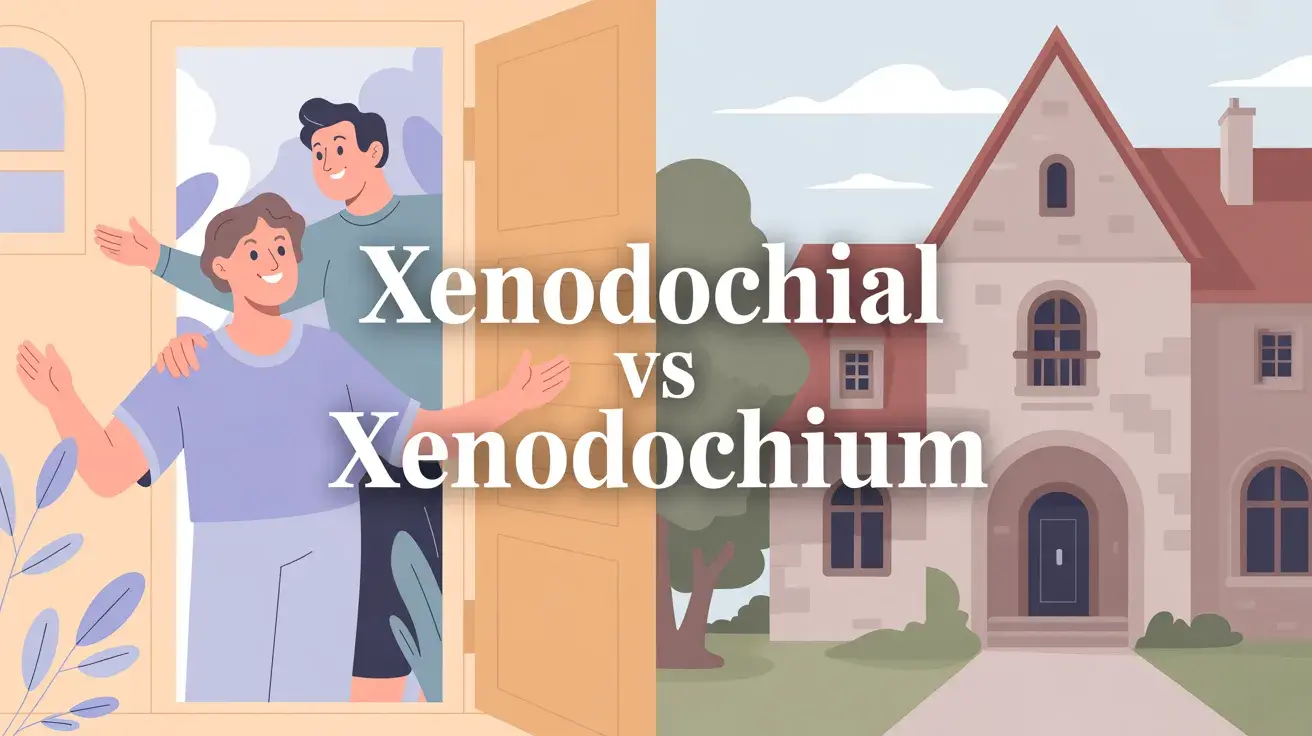
Xenodochium
A xenodochium is an old word for a place where strangers or travelers were given shelter, like a guest house or hospital in ancient times.
Example:
The monastery built a xenodochium for pilgrims.
Xenodochial
Xenodochial means being friendly and welcoming to strangers.
Example:
She is very xenodochial and always helps new visitors.
In short:
Use xenodochial for people, xenodochium for places, and always choose clarity over complexity.
Xenodochial vs Xenodochium – Quick Answer
Xenodochial means friendly and welcoming to strangers.
Xenodochium means an old type of guest house or hospital for strangers.
Examples:
- She is very xenodochial to visitors.
- The old town had a xenodochium for travelers.
The Origin of Xenodochial vs Xenodochium
Both words come from Greek roots:
- “xenos” = stranger or guest
- “docheion” = place to receive
Xenodochium came first. It was used in history to name places where strangers could stay, often linked to churches.
Xenodochial came later. It describes a person who is kind to strangers.
They look similar because they share the same root, but they are not spelling variants—they are different word types.
British English vs American English Spelling
There is no spelling difference between British and American English for these words.
| Word | British English | American English | Meaning |
|---|---|---|---|
| Xenodochial | Same | Same | Friendly to strangers |
| Xenodochium | Same | Same | Place for strangers |
Unlike words like “color/colour,” these remain identical in both systems.
Which Spelling Should You Use?
Choose based on meaning, not region:
- Use “xenodochial” when describing a person
- Use “xenodochium” when talking about a place (usually historical)
Advice:
- For modern writing → use xenodochial
- For historical or academic context → use xenodochium
- For global audience → prefer simple words unless needed
Common Mistakes with Xenodochial vs Xenodochium
Errors:
❌ Using xenodochium for a person
✔️ Correct: She is xenodochial, not xenodochium
Thinking they are spelling variants❌
They are different words✔️
❌ Using them in casual writing
✔️ These words are rare and formal
Xenodochial vs Xenodochium in Everyday Examples
Email:
- We aim to stay xenodochial with all new clients.
News:
- The ancient city had a xenodochium for travelers.
Social Media:
- Be more xenodochial—welcome new people!
Formal Writing:
- Medieval towns often built a xenodochium for pilgrims.
Xenodochial vs Xenodochium – Google Trends & Usage Data
- Xenodochial is searched more often because people like unique descriptive words.
- Xenodochium is rarely searched and mostly appears in academic or historical topics.
Usage by context:
- USA & UK → “xenodochial” used in writing and vocabulary lists
- Academic fields → “xenodochium” appears in history and religion
Simple insight:
Most people only need xenodochial in modern English.
Comparison Table
| Feature | Xenodochial | Xenodochium |
|---|---|---|
| Type | Adjective | Noun |
| Meaning | Friendly to strangers | Place for strangers |
| Usage | Modern | Historical |
| Popularity | Higher | Very low |
FAQs
1. Are xenodochial and xenodochium the same?
No, they have different meanings and uses.
2. Which word is more common?
Xenodochial is more common.
3. Can I use xenodochium today?
Yes, but mainly in historical or academic writing.
4. Is xenodochial a positive word?
Yes, it means being kind and welcoming.
5. Do they have different spellings in US and UK English?
No, both are spelled the same.
6. Should beginners use these words?
Only if needed; they are advanced vocabulary.
7. What is a simple alternative to xenodochial?
“Friendly” or “welcoming.”
Conclusion
Understanding xenodochial vs xenodochium is simple once you know their roles. Xenodochial describes a person who is warm and welcoming to strangers. Xenodochium refers to a place, often from history, where strangers could stay or receive care.
These words share the same root, which is why they look alike, but they are not interchangeable. In modern English, xenodochial is more useful and practical, while xenodochium appears mostly in academic or historical texts.
If your goal is clear communication, use xenodochial carefully and only when it fits the tone. For everyday writing, simple words like “friendly” often work better. Still, knowing these terms can improve your vocabulary and help you understand advanced texts.