Many people get confused between “affect” or “effect”. These two words look similar, sound similar, and are often used in the same sentences. Because of this, writers, students, and even professionals often mix them up.
The confusion usually appears when people are writing essays, emails, or social media posts. One small mistake can change the meaning of a sentence. For example, “The weather affected my mood” is correct, but “The weather effected my mood” is wrong in most cases. This is why people frequently search for “affect or effect”—they want a quick, simple answer.
|See also Zeroes or Zeros
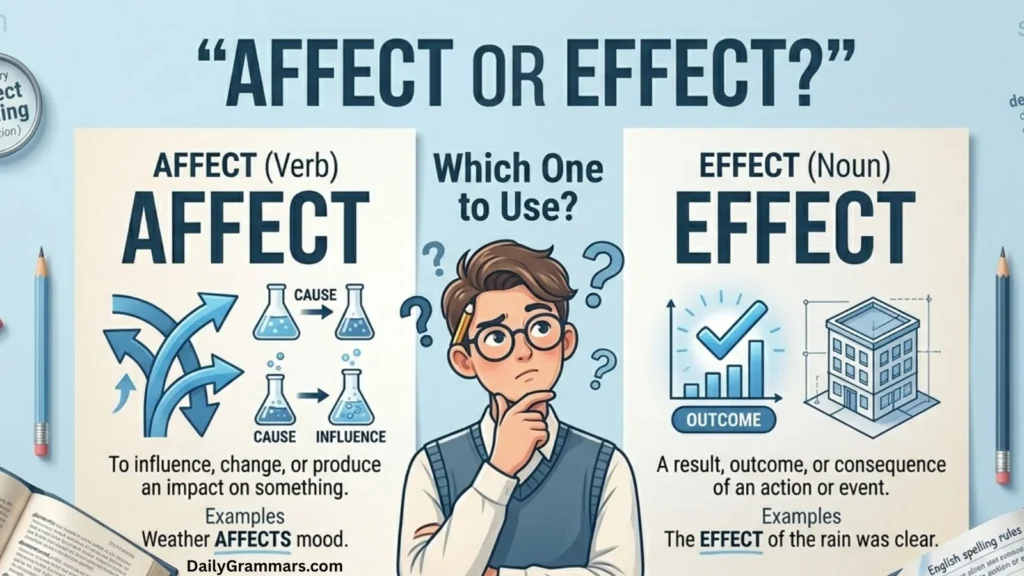
In English grammar, these words have different roles. One is usually a verb (affect) and the other is usually a noun (effect). But there are exceptions that make things harder.
This article will clearly explain the difference in a very simple way. You will learn the correct usage, common mistakes, history, and real-life examples. By the end, you will confidently know when to use “affect” and when to use “effect” without confusion.
Affect or Effect – Quick Answer
- Affect (verb): to influence something
Example: The news affected her mood. - Effect (noun): the result of something
Example: The news had a strong effect on her mood.
👉 Simple rule:
Affect = Action (Verb)
Effect = Result (Noun)
The Origin of Affect or Effect
The words come from Latin:
- Affect comes from afficere, meaning “to influence or act upon.”
- Effect comes from effectus, meaning “something produced or brought about.”
Over time, both words entered English through French and Latin influence. Because they developed side by side, their spelling and pronunciation became very similar. This is why learners often confuse them today.
British English vs American English Spelling
Both British and American English use Influence and effect the same way. There is no spelling difference between regions for these two words. However, usage style can vary slightly in writing patterns.
Comparison Table
| Word | Type in Grammar | Meaning | Example Sentence |
|---|---|---|---|
| Affect | Verb | To influence | Stress can affect sleep. |
| Effect | Noun | Result or outcome | Stress has a negative effect on sleep. |
Which Spelling Should You Use?
- US English: Use standard grammar rules (affect = verb, effect = noun)
- UK English: Same rules apply
- Global English: Follow context-based usage
👉 Best advice: Don’t focus on region. Focus on grammar role (verb vs noun).
Common Mistakes with Affect or Effect
Wrong: The medicine effected me strongly.
✔ The medicine affected me strongly.
❌ The Influence of the storm was severe.
✔ The effect of the storm was severe.
❌ It will effect your health.
✔ It will Influence your health.
👉 Tip: If you can replace the word with “influence,” use affect.
Affect or Effect in Everyday Examples
- Emails:
“This delay will affect the delivery schedule.” - News:
“The policy had a major effect on the economy.” - Social Media:
“Lack of sleep affects your productivity.” - Formal Writing:
“The changes will affect all departments equally.”
Affect or Effect – Google Trends & Usage Data
Search trends show that “Influence or effect” is highly searched worldwide, especially in:
- United States
- India
- United Kingdom
- Pakistan
Most searches happen during:
- Exam season
- Academic writing periods
- English learning sessions
👉 Insight: People search this keyword mainly for quick grammar clarification, not deep theory.
Comparison Table: Affect vs Effect Variations
| Usage Type | Affect | Effect |
|---|---|---|
| Grammar Role | Verb | Noun |
| Meaning | To influence | Result |
| Example | Stress affects health | Stress has an effect |
| Common Error | Using as noun | Using as verb |
FAQs:
When to use affect vs effect?
Use affect as a verb (to influence) and effect as a noun (result). Example: “Stress affects sleep” vs “Stress has an effect on sleep.”
Is it effect me or affect me?
Correct is “affect me” because affect is a verb meaning “to influence.”
How do you remember effect vs affect?
Remember: Affect = Action, Effect = End result.
What are 5 examples of affect?
- Stress affects health.
- The news affects mood.
- Noise affects concentration.
- Weather affects travel.
- Lack of sleep affects memory.
What are examples of affect?
Affect means influence: “Smoking affects lungs,” “Cold weather affects crops,” “Music affects emotions.”
What are common mistakes using affect effect?
Wrong: “It will effect you.” Correct: “It will affect you.”
Wrong: “The affect was strong.” Correct: “The effect was strong.”
Conclusion (150–200 words)
Understanding Influence or effect is important for clear and correct English writing. Many learners struggle with these two words because they look and sound similar, but their roles are different. The simplest rule is easy to remember: Influence is usually a verb, and effect is usually a noun.
When you say something influences another thing, use “affect.” When you talk about the result of that influence, use “effect.” This small rule removes most of the confusion in writing and speaking.
Both British and American English follow the same grammar rules, so you do not need to worry about regional differences. Instead, focus on how the word functions in the sentence.
By practicing with real-life examples like emails, essays, and social media posts, you will quickly master the difference. Over time, choosing between “Influence” and “effect” will become natural.
In short, if you understand the action vs result rule, you will never mix them up again. This makes your writing clearer, more professional, and grammatically correct.