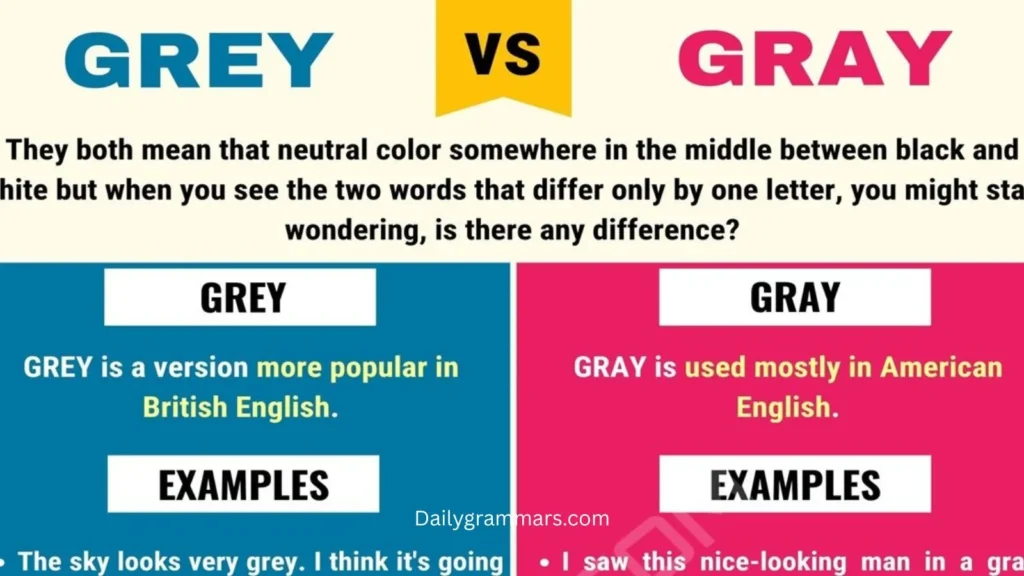
Gray vs Grey – Short Details
Both gray and grey mean the same color between black and white. The difference is spelling based on region.
- Gray → used in American English
- Grey → used in British English
Examples:
He wore a grey jacket to the meeting. (UK)
The sky looks gray before a storm. (US)
RELATED: xenodochial vs xenodochium
Meaning of Gray vs Grey Hair
The phrase gray vs grey hair refers to hair strands that appear silver, white, or ash-colored due to reduced melanin. While it’s a physical trait, it also symbolizes wisdom, maturity, and life experience.
For example, someone might say, “His gray hair reflects years of leadership,” or “Her grey hair adds elegance.” Both spellings convey the same idea—aging with dignity and natural change.
Why People Misspell Gray vs Grey Hair
Many writers get confused with gray vs grey hair because English often includes tricky spelling variations. Just like words such as “address” or “success”, small differences create uncertainty.
Typing quickly also leads to errors. People might switch between gray and grey unintentionally. Unlike double-letter confusion (like missing the second “s”), this mistake stems from regional habits rather than incorrect spelling.
Origin of Gray vs Grey Hair
The word behind gray vs grey hair comes from Old English grǣg, which described a neutral color between black and white. Its roots trace back to Germanic languages, not Latin directly, but it evolved through centuries of linguistic adaptation.
Over time, spelling variations emerged. American English simplified it to gray, while British English preserved grey, reflecting historical spelling traditions.
British vs American English
The difference in gray vs grey hair follows a clear regional pattern:
| Region | Preferred Spelling | Example Sentence |
|---|---|---|
| American English | Gray | She noticed her first gray hair at 30. |
| British English | Grey | He embraced his grey hair proudly. |
Both forms are correct. Consistency matters more than the choice itself.
When to Use Gray vs Grey Hair
Use gray vs grey hair depending on your audience and context.
- Essays & Assignments: Follow your institution’s style guide.
- Emails & Reports: Match your company’s preferred English style.
- Legal Documents: Stay consistent throughout.
- Casual Writing: Either spelling works naturally.
For example, a U.S. blog should use gray hair, while a UK publication prefers grey hair.
Common Mistakes
Writers often confuse gray vs grey hair due to inconsistency rather than incorrect spelling.
- ❌ Mixing both in one document
- ❌ Assuming one is wrong
- ❌ Typing quickly without checking
Correct vs Incorrect Examples:
- ✔ She loves her gray hair.
- ❌ She loves her grey hair (in American-only writing context)
Consistency is key—pick one and stick with it.
Possess in Everyday Examples
Using gray vs grey hair correctly in daily writing improves clarity and professionalism.
- Emails: “I’ve started noticing gray hair recently.”
- Social Media: “Embracing my grey hair journey!”
- Professional Writing: “The executive’s gray hair reflects experience.”
- School Assignments: “Aging often leads to grey hair.”
Choose the version that matches your audience.
Usage Comparison Table
| Context | Correct Usage | Incorrect Usage |
|---|---|---|
| Objects | Her gray hair shines. | Her grey hair shines (US doc) |
| Skills (metaphor) | His grey hair shows wisdom. | His gray hair shows wisdom (UK doc inconsistency) |
| Legal Terms | The subject has gray hair. | Mixing gray/grey randomly |
| Daily Speech | I found a grey hair today! | Spelling inconsistency |
FAQs
1. Gray vs Grey Hair – Which is correct?
Seealso:Authorised or Authorized: Which Spelling Is Correct?
Both are correct. Gray versus grey hair differs only by region.
2. How do I remember the spelling?
Think: “A” for America → gray, “E” for England → grey.
3. Is gray hair different from grey hair?
No. Gray versus grey hair refers to the same thing.
4. Which spelling should I use in SEO?
Use both variations of gray versus grey hair to capture wider search traffic.
5. Can I use both in one article?
Yes, but keep usage consistent or clarify the difference.
6. Why are there two spellings?
Historical language evolution caused gray vs grey hair variations.
7. Does it matter in professional writing?
Yes. Choose one style and stay consistent.
Conclusion
Understanding gray vs grey hair is simple once you know the rule: both spellings are correct, but usage depends on region. American English prefers gray, while British English uses grey.
Stay consistent, match your audience, and avoid mixing spellings. With practice, you’ll naturally remember the difference—just like mastering tricky words such as “success” or “address.”