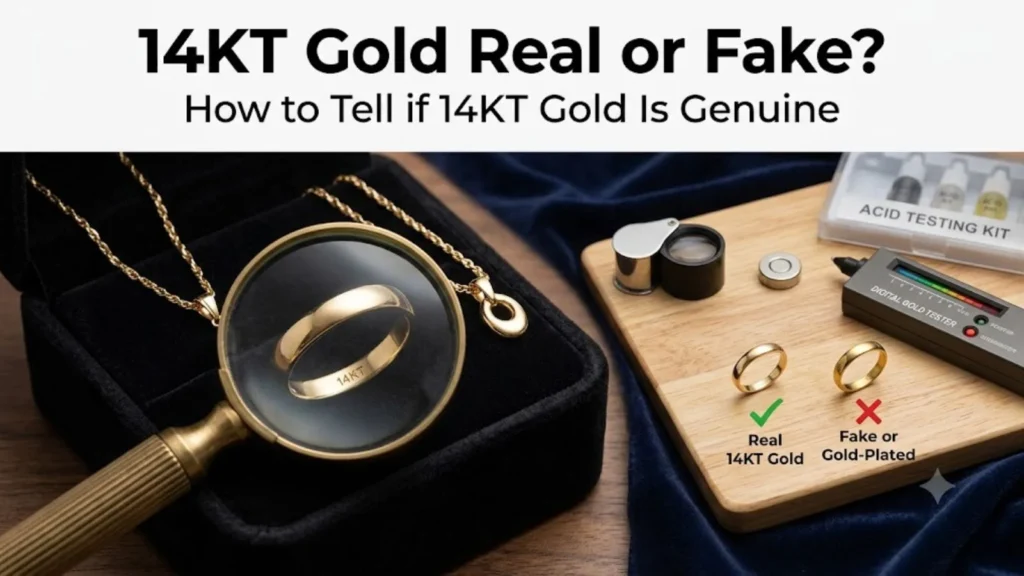
Have you found a ring, necklace, bracelet, or other piece of jewelry stamped 14KT and wondered, “Is 14KT gold real or fake?” You’re not alone. Many people search this question before buying, selling, or inheriting gold jewelry. The small stamp can be confusing, especially when you also see markings like 14K, 585, or 14KP.
The good news is that a 14KT stamp usually means the jewelry is made from real gold, not fake gold. However, a stamp alone does not guarantee authenticity. Counterfeit jewelry can also carry fake markings. That’s why it’s important to understand what the stamp means and how to verify whether your jewelry is genuine.
In this guide, you’ll learn what 14KT gold means, how to identify real and fake gold, common myths, and practical testing methods. We’ll also explain regional spelling differences, compare common gold markings, answer frequently asked questions, and help you make informed decisions when buying or selling gold jewelry.
14KT Gold Real or Fake – Quick Answer
Quick Answer: 14KT gold is real gold. The 14KT stamp means the jewelry contains 14 parts pure gold out of 24 parts, or about 58.5% pure gold.
Example
- 14KT Ring → Real gold (58.5% gold)
- 14K Necklace → Real gold (same purity)
- 585 Bracelet → Real gold (same purity)
However, a stamp alone does not prove authenticity. Fake jewelry may also have a false 14KT mark.
How to Check
- Look for a clear 14KT, 14K, or 585 stamp.
- Test with a magnet (gold is not magnetic).
- Perform an acid or electronic gold test.
- Ask a professional jeweler for verification.
The Origin of “14KT Gold Real or Fake”
The term karat (K or KT) measures the purity of gold. The word karat comes from the Italian word carato, which traces back to the Greek keration, meaning the carob seed once used as a standard weight.
Pure gold is 24 karats.
A piece marked 14KT contains:
- 14 parts pure gold
- 10 parts other metals
This equals 58.5% pure gold.
The abbreviation KT is simply another way of writing K. Both represent the same gold purity.
British English vs American English Spelling
Unlike many grammar topics, this subject involves jewelry terminology rather than spelling rules.
The biggest difference is the word used to describe purity.
- American English: Karat
- British English: Carat (mainly for gemstones) but jewelry often still uses 14K or 585 for gold.
Examples
American English
This ring is made from 14K gold.
British English
This ring is crafted from 14-carat gold.
Comparison Table
| Feature | American English | British English |
|---|---|---|
| Gold purity | 14K or 14KT | 14-carat or 14K |
| Gemstone weight | Carat | Carat |
| Gold markings | 14K, 14KT, 585 | 14K, 585 |
Which Spelling Should You Use?
Choose the wording based on your audience.
United States
Use 14K gold or 14KT gold.
United Kingdom
Use 14-carat gold in general writing, although jewelry may still be stamped 14K.
International Audience
Use 14K gold because it is widely recognized worldwide.
Common Mistakes with 14KT Gold Real or Fake
Mistake 1: Thinking 14KT Means Fake Gold
❌ 14KT is fake.
✔ 14KT is real gold with 58.5% purity.
Mistake 2: Trusting the Stamp Alone
❌ Every 14KT stamp is genuine.
✔ Fake jewelry can carry counterfeit stamps.
Mistake 3: Confusing Gold-Plated Jewelry with Solid Gold
❌ 14KGP equals solid gold.
✔ 14KGP means 14-karat gold plated, not solid gold.
Mistake 4: Assuming All Real Gold Is 24K
❌ Only 24K is real gold.
✔ 10K, 14K, 18K, 22K, and 24K are all real gold with different purity levels.
14KT Gold Real or Fake in Everyday Examples
I confirmed that the necklace is stamped 14KT and tested as genuine gold.
News
Gold prices increased, leading buyers to verify whether older 14KT jewelry was authentic.
Social Media
Is my grandmother’s ring marked 14KT real or fake?
Jewelry Store
This bracelet is made from genuine 14K gold and comes with certification.
Online Marketplace
Before buying used jewelry, verify that the 14KT stamp is authentic.
14KT Gold Real or Fake – Google Trends & Usage Data
Searches for “14KT gold real or fake” remain steady throughout the year.
Interest usually increases during:
- Holiday shopping
- Engagement season
- Estate sales
- Pawn shop purchases
- Jewelry resale periods
Countries with High Search Interest
- United States
- Canada
- United Kingdom
- Australia
- India
People often search this keyword before purchasing second-hand jewelry or evaluating inherited items.
Comparison Table
| Marking | Meaning | Real Gold? |
|---|---|---|
| 14KT | 58.5% gold | Yes |
| 14K | 58.5% gold | Yes |
| 585 | 58.5% gold | Yes |
| 18K | 75% gold | Yes |
| 24K | 99.9% gold | Yes |
| 14KGP | Gold plated | No (not solid gold) |
| HGE | Heavy Gold Electroplate | No |
| GP | Gold Plated | No |
Frequently Asked Questions
1. Is 14KT gold real?
Yes. A genuine 14KT stamp means the jewelry contains 58.5% pure gold.
2. Can fake jewelry have a 14KT stamp?
Yes. Counterfeit jewelry can include fake stamps, so additional testing is recommended.
3. Is 14KT the same as 14K?
Yes. Both markings represent the same gold purity.
4. What does 585 mean?
The 585 stamp indicates 58.5% pure gold, which equals 14K gold.
5. Does 14KT gold tarnish?
Because 14KT contains alloy metals, it may dull slightly over time but does not rust like ordinary metals.
6. Is 14KT better than 18K?
It depends. 14KT is more durable, while 18K contains more pure gold and has a richer color.
7. How can I test if my 14KT gold is real?
Use a magnet test, acid test, electronic gold tester, XRF analysis, or ask a certified jeweler for professional verification.
Conclusion
If you’re asking whether 14KT gold is real or fake, the answer is straightforward: 14KT gold is real gold. The stamp indicates that the jewelry contains 58.5% pure gold, with the remaining percentage made up of stronger metals that improve durability. This makes 14KT gold one of the most popular choices for rings, necklaces, bracelets, and everyday jewelry because it offers an excellent balance of beauty, strength, and value.
Still, remember that a stamp alone does not guarantee authenticity. Counterfeit items can also display fake markings. If you’re buying expensive jewelry, selling inherited pieces, or simply want peace of mind, have the item tested by a trusted jeweler or use reliable gold-testing methods. Understanding common markings such as 14K, 14KT, and 585 helps you avoid scams and make confident purchasing decisions. With the right knowledge, you’ll know exactly what you’re buying and whether your jewelry is truly worth its value.