People often get confused when comparing obituary vs eulogy because both relate to honoring someone who has passed away.
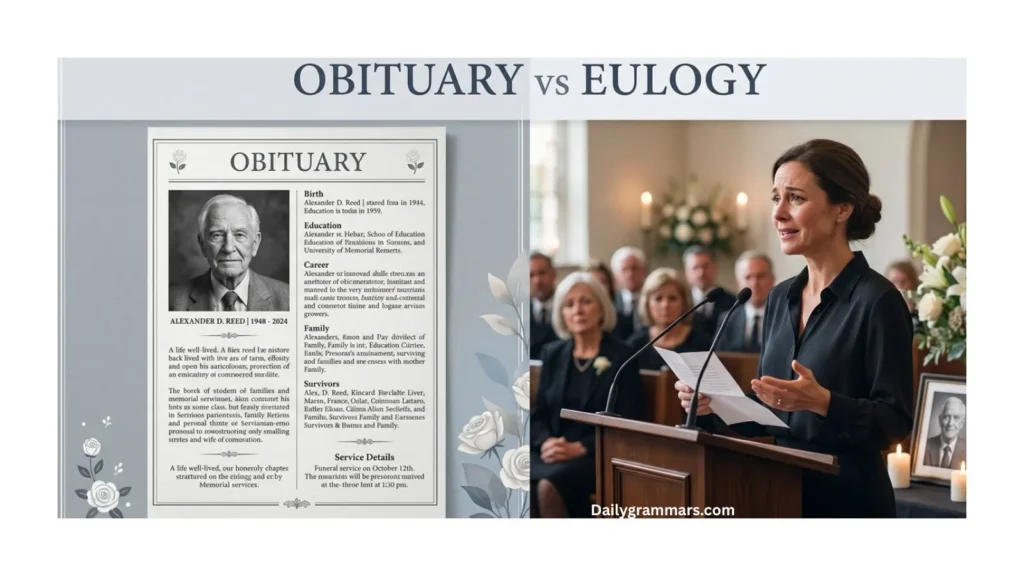
However, they serve very different purposes in real life. An obituary vs eulogy discussion helps clarify that an obituary is a written public notice, while a eulogy is a spoken tribute at a funeral.
|See also solicited vs unsolicited
Many readers search for obituary vs eulogy to understand how each is used in newspapers, memorial services, and formal writing.
This topic is important because it helps avoid mistakes in sensitive situations. Learning about obituary vs eulogy also improves communication during emotional events.
In simple terms, obituary vs eulogy explains the difference between written announcements and heartfelt speeches that honor a person’s life respectfully.
Obituary vs Eulogy – Quick Answer
An obituary is a written notice about a person’s death, usually published in a newspaper or online. It includes basic life details like name, age, family, and funeral information. Example: A newspaper posts a death announcement with a short life summary.
A family member or friend gives a eulogy at a funeral or memorial service to honor the person’s life and memories. Example: A son speaks about his father’s kindness during the funeral.
The Origin of Obituary vs Eulogy
The word “obituary” comes from the Latin word obitus, meaning “death” or “departure.” It became common in English to describe written death notices in newspapers.
The word “eulogy” comes from the Greek word eulogia, meaning “good words” or “praise.” It refers to spoken praise for someone who has died.
Both terms developed in different cultures and traditions but are now widely used in modern **English language writing and communication.
British English vs American English Spelling
There is no major spelling difference between “obituary” and “eulogy” in United Kingdom and United States. Both countries use the same spelling.
However, usage frequency and style can differ slightly in newspapers and formal writing.
Comparison Table
| Term | US Usage | UK Usage | Meaning Type |
|---|---|---|---|
| Obituary | Common | Common | Written notice of death |
| Eulogy | Common | Common | Spoken tribute at funeral |
Which Spelling Should You Use?
Since global English spelling uses both words the same way, context—not region—determines your choice.
- Use obituary in newspapers, websites, and formal death announcements
- Use eulogy in speeches, memorial services, and emotional tributes
- Global readers, including those in the UK and US, understand both terms equally
Common Mistakes with Obituary vs Eulogy
- Using “eulogy” for written death notices (incorrect)
- Using “obituary” for funeral speeches (incorrect)
- Thinking both mean the same thing (incorrect)
- Mixing formal writing contexts with spoken contexts
- Assuming one replaces the other
Correct understanding avoids confusion in sensitive situations.
Obituary vs Eulogy in Everyday Examples
- Email (formal): “We have published the obituary online for public reference.”
- News article: “The obituary highlighted his career and achievements.”
- Social media: “She gave a touching eulogy at her grandmother’s funeral.”
- Speech context: “His eulogy moved everyone in the room.”
- Memorial page: Obituaries are often shared on tribute websites
Obituary vs Eulogy – Google Trends & Usage Data
Search trends show that people search “obituary” more in news-related contexts, while they search “eulogy” more during personal or event-related moments.
- In United States, obituary searches spike in local news sections
- In United Kingdom, both terms are steady but used more formally
- Globally, “eulogy” often trends during public memorial events or celebrity deaths
Comparison Table: Obituary vs Eulogy
| Feature | Obituary | Eulogy |
|---|---|---|
| Format | Written | Spoken |
| Purpose | Announce death | Honor life |
| Location | Newspaper/online | Funeral/memorial |
| Tone | Informative | Emotional |
| Author | Family/newspaper | Family/friend |
FAQs
What should you not say in a eulogy?
Avoid criticism, blame, family conflicts, or embarrassing stories. Keep it respectful and kind.
What should you not put in an obituary?
Don’t include sensitive personal data, negative details, or anything that may cause distress or privacy issues.
Is the obituary usually read at a funeral?
No, an obituary is usually published or shared in writing, not read aloud at the funeral.
Who writes the eulogy for a funeral?
A close family member, friend, or sometimes a religious leader writes and delivers it.
What 3 colors not to wear to a funeral?
Bright red, neon colors, and flashy prints are generally avoided; black or dark tones are preferred.
What is the best closing line for an eulogy?
“May we always remember and honor their life with love and gratitude.”
Conclusion
Understanding the difference between obituary and eulogy helps you communicate clearly during emotional and formal situations.
An obituary is a written announcement that shares key life details and informs the public about a death. A eulogy is a spoken tribute that expresses feelings, memories, and respect during a funeral or memorial service.
People use both to honor a person’s life, but they use them in very different ways.
This difference is especially important in English language, where word choice affects clarity and tone. Whether you are reading news in United States or attending a service in United Kingdom, the meanings remain the same.
By remembering this simple distinction—written notice vs spoken tribute—you can avoid common mistakes and use both terms correctly with confidence.