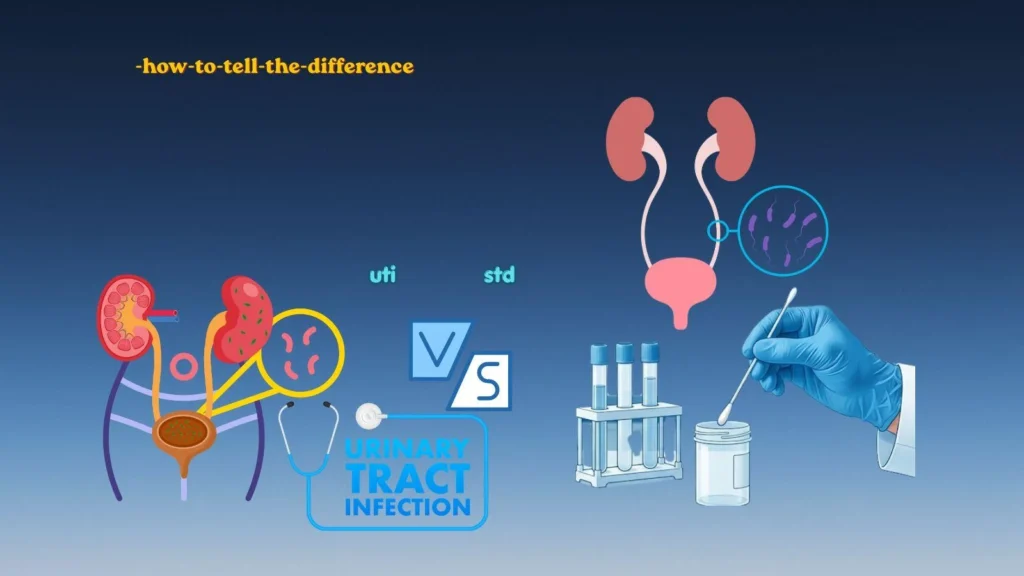
Burning when you pee can be uncomfortable—and confusing. Is it a UTI or STD? Both can cause pain during urination, so symptoms alone do not always provide a clear answer.
A urinary tract infection (UTI) is an infection in the urinary system, often caused by bacteria. A sexually transmitted infection (STI), sometimes called an STD, is an infection that can spread through sexual contact. Some STIs can cause symptoms that look very similar to a UTI, especially burning or pain when urinating.
People often search “UTI or STD” because they want to know what their symptoms mean and whether they need a urine test, STI test, or medical treatment. The key point is that burning urination does not prove that you have a UTI or an STI. Some people with STIs have no symptoms at all.
This guide explains the main differences, common symptoms, testing options, treatment, and when to seek medical care.
UTI or STD – Quick Answer
A UTI affects the urinary tract. An STI is transmitted through sexual contact. They are different conditions, but their symptoms can overlap.
| Feature | UTI | STI |
|---|---|---|
| Main cause | Usually bacteria entering the urinary tract | Bacteria, viruses, fungi, or parasites transmitted through sexual contact |
| Burning when urinating | Common | Can occur with some STIs |
| Frequent urination | Common | Less typical, but may occur |
| Urgency to urinate | Common | Less typical |
| Genital discharge | Not usually a main symptom | Can occur with some STIs |
| Genital sores or blisters | Not typical | Can occur with some STIs |
| May have no symptoms | Yes | Yes, very commonly with some STIs |
| Main testing | Urine testing may be used | Urine, blood, or swab tests may be used |
UTIs commonly cause burning, frequent urination, urgency, and lower abdominal discomfort.
STIs may cause discharge, genital sores, rash, unusual bleeding, itching, or pain when urinating. However, many STIs cause no symptoms.
If you have urinary symptoms after sexual contact, an STI should not automatically be ruled out.
The Origin of UTI or STD
The terms UTI and STD come from different medical concepts.
UTI stands for urinary tract infection. The urinary tract includes organs and structures involved in making and passing urine. UTIs can affect the bladder, urethra, or kidneys.
STD stands for sexually transmitted disease. Today, healthcare organizations often use the term STI, meaning sexually transmitted infection. The word “infection” can be more accurate because a person may carry an infection without having noticeable disease symptoms.
The CDC explains that an STI can involve a virus, bacterium, fungus, or parasite transmitted through sexual contact. An STD generally refers to an STI that has developed into disease.
So, “UTI or STD” is not really a spelling comparison. It is a health-information search asking whether symptoms may be caused by a urinary infection or a sexually transmitted infection.
British English vs American English Spelling
There is no major British-versus-American spelling difference between UTI and STD.
Both British and American English use:
- UTI = urinary tract infection
- STI = sexually transmitted infection
- STD = sexually transmitted disease
The larger difference is often terminology rather than spelling. STI is widely used in modern medical information, while STD remains common in everyday searches and conversations.
| Term | Meaning | British English | American English |
|---|---|---|---|
| UTI | Urinary tract infection | UTI | UTI |
| STI | Sexually transmitted infection | STI | STI |
| STD | Sexually transmitted disease | STD | STD |
| Urinary tract infection | Full term | Same | Same |
| Sexually transmitted infection | Full term | Same | Same |
There can be spelling differences in related words, such as centre/center or practise/practice, but those differences do not change the abbreviations UTI, STI, or STD.
Which Spelling Should You Use?
For health content, use the term that matches your audience.
For American readers
Use UTI, STI, and STD. “STI” is particularly common in current medical and public-health information.
For British readers
UTI and STI are also standard. British health information commonly uses “STI” when discussing sexually transmitted infections.
For a global audience
A good approach is to write the full term first:
“A urinary tract infection (UTI) is different from a sexually transmitted infection (STI).”
You can then use the abbreviations throughout the article.
If your target keyword is “UTI or STD,” keep that phrase naturally in the title and relevant headings because it reflects what people actually search for.
Common Mistakes with UTI or STD
Mistake 1: Assuming burning means a UTI
Burning while urinating is common with UTIs, but it can also happen with urethritis and some STIs.
Better approach: Consider other symptoms and your recent sexual exposure, then seek appropriate testing.
Mistake 2: Assuming an STI always causes symptoms
Many STIs cause no noticeable symptoms.
Better approach: Testing may be important even when you feel well if you have had a potential exposure.
Mistake 3: Treating every urinary symptom with leftover antibiotics
Different infections require different treatments. Taking an unsuitable antibiotic may not treat the cause and can contribute to antibiotic resistance.
Better approach: Speak with a healthcare professional about testing and treatment.
Mistake 4: Thinking a UTI is always sexually transmitted
A UTI is not classified as an STI. UTIs commonly occur when bacteria enter the urinary tract. Sexual activity can increase UTI risk, but that does not make a UTI an STI.
Mistake 5: Assuming a urine test checks for every STI
Different infections require different tests. STI testing can involve urine, blood, or swabs depending on the infection and exposure.
UTI or STD in Everyday Examples
In an email to a doctor
“I have burning when I urinate and would like to know whether I should be tested for a UTI or an STI.”
This gives the healthcare professional useful information without assuming the diagnosis.
In health news
A health article may explain that UTIs and STIs can have overlapping symptoms but require different approaches to testing and treatment.
On social media
Someone might write:
“Can burning when I pee be a UTI or an STI?”
This is a common health question, but a social-media answer cannot reliably diagnose the cause.
In formal writing
A professional health article could say:
“Burning during urination may occur with a UTI, urethritis, or certain sexually transmitted infections.”
This wording avoids making a diagnosis based on one symptom.
UTI or STD – Google Trends & Usage Data
People search for “UTI or STD” because urinary symptoms can overlap with symptoms of certain sexually transmitted infections. Google Trends allows users to compare search interest by location and time, but its data represents relative search interest, not the actual number of infections or confirmed diagnoses.
Search interest can also change because of:
- seasonal health concerns
- increased public awareness
- sexual-health campaigns
- news coverage
- changes in testing behavior
- changes in terminology, such as increased use of “STI” instead of “STD”
For SEO purposes, related searches may include:
- UTI or STD symptoms
- UTI or STI
- burning when peeing UTI or STD
- can an STD feel like a UTI
- UTI symptoms after sex
- STI symptoms
- UTI testing
- STD testing
Because Google Trends results change over time and by location, current trend comparisons should be checked directly for the target country and date range rather than treated as permanent search-volume statistics.
UTI vs STD: Key Differences at a Glance
| Question | UTI | STI/STD |
|---|---|---|
| What is it? | Infection of the urinary tract | Infection transmitted through sexual contact |
| Usually caused by | Often bacteria | Bacteria, viruses, fungi, or parasites |
| Burning urination | Common | Possible |
| Frequent urination | Common | Less characteristic |
| Urgency | Common | Less characteristic |
| Discharge | Usually not a main symptom | Can occur |
| Sores or blisters | Not typical | Can occur |
| Can have no symptoms? | Yes | Yes |
| Testing | Urine tests may help | Urine, blood, or swab tests may be used |
| Treatment | Depends on the cause; bacterial UTIs may require antibiotics | Depends on the specific infection |
A healthcare professional may need to consider both possibilities when symptoms overlap. CDC guidance notes that STIs can cause urethral irritation and should be considered when symptoms or examination findings suggest an STI.
FAQs About UTI or STD
1. Can an STD feel like a UTI?
Yes. Some STIs can cause burning or pain when urinating, which can resemble a UTI. Urethritis can also cause burning and discharge and may be caused by an STI.
2. How can I tell if I have a UTI or an STI?
Symptoms alone may not be enough. A healthcare professional can assess your symptoms, sexual history, and risk factors and decide whether urine or STI testing is appropriate.
3. Does a UTI mean you have an STD?
No. A UTI is not an STI. UTIs usually occur when bacteria enter the urinary tract.
4. Can an STI cause burning when you pee?
Yes. Some STIs can cause urethritis, which may produce burning or pain during urination.
5. Can you have an STI without symptoms?
Yes. Many STIs may have no noticeable symptoms. Testing is the only reliable way to determine whether you have an STI.
6. What tests are used for STIs?
Depending on the infection and exposure, testing may use urine, blood, or swabs from areas such as the vagina, throat, or rectum.
7. When should I see a doctor?
Seek medical advice for persistent or concerning urinary or genital symptoms. Urgent medical attention may be needed if symptoms include fever, chills, vomiting, significant back or side pain, or rapidly worsening illness because these can occur with a more serious urinary infection.
If you have symptoms after possible sexual exposure, tell the healthcare professional so appropriate STI testing can be considered.
Conclusion
Understanding UTI or STD starts with one important fact: the two conditions are different, but their symptoms can overlap. A UTI affects the urinary tract and commonly causes burning urination, frequent urination, urgency, and lower abdominal discomfort. An STI is transmitted through sexual contact and may cause burning, discharge, sores, itching, or other symptoms. However, many STIs produce no symptoms at all.
Burning when you pee does not automatically mean you have a UTI. It also does not prove that you have an STI. Testing and professional assessment are the safest ways to determine the cause.
If symptoms began after sexual contact, mention that when speaking with a healthcare professional. STI testing may be appropriate even when symptoms are mild or absent. Likewise, urinary symptoms may require evaluation for a UTI or another urinary condition.
For SEO and everyday health writing, “UTI or STD” is a useful search phrase, but “UTI or STI” may better reflect current medical terminology. Use the full terms on first mention, explain the difference clearly, and avoid diagnosing yourself from symptoms alone.