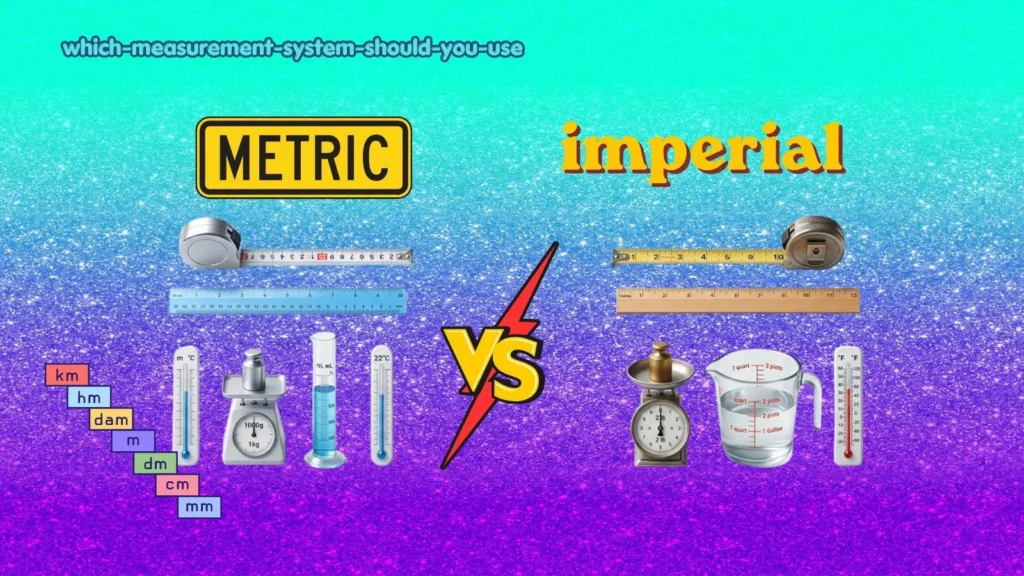
Choosing between metric or imperial can seem simple until you see measurements such as kilometers, miles, kilograms, pounds, liters, gallons, Celsius, and Fahrenheit in the same place. The confusion becomes even greater when shopping online, traveling, cooking from foreign recipes, reading technical documents, or comparing product sizes.
The good news is that the difference is easy to understand. The metric system is based on decimal units such as millimeters, meters, kilograms, and liters. The imperial system uses traditional units such as inches, feet, yards, miles, pounds, and gallons. However, there is an important detail: U.S. customary units and British Imperial units are not exactly the same.
People search for “metric or imperial” because they want to know which system their country uses, which units to enter into an app, or how to convert a measurement correctly. This guide explains the history, differences, common mistakes, and everyday uses of both systems so you can choose the right measurement for your audience.
RELATED;Compliment vs Complement: Key Difference & Usage Guide
Metric or Imperial – Quick Answer
Metric is the main measurement system used internationally and is the standard for science, engineering, and most countries. Imperial is still familiar in the United Kingdom and is widely used in everyday life in the United States, although the United States technically uses U.S. customary units, not the British Imperial system.
The metric system uses decimal relationships:
- 1 meter = 100 centimeters
- 1 kilometer = 1,000 meters
- 1 kilogram = 1,000 grams
- 1 liter = 1,000 milliliters
Traditional imperial-style measurements use different relationships:
- 12 inches = 1 foot
- 3 feet = 1 yard
- 1,760 yards = 1 mile
- 16 ounces = 1 pound
Metric vs Imperial Quick Comparison
| Measurement | Metric | Imperial / U.S. customary |
|---|---|---|
| Length | millimeter, meter, kilometer | inch, foot, yard, mile |
| Mass/weight | gram, kilogram | ounce, pound, stone |
| Volume | milliliter, liter | pint, quart, gallon |
| Temperature | Celsius | Fahrenheit |
| Distance | kilometer | mile |
| Example | 5 km | 3.1 miles |
One important point is that “imperial” should not automatically mean “American.” British Imperial and U.S. customary units have different definitions for some measurements, especially liquid volume.
The Origin of Metric or Imperial
The two systems have very different histories.
The metric system developed in France during the late 18th century. It was designed as a decimal system that could provide a more consistent approach to weights and measures. Over time, it developed into the modern International System of Units (SI).
The British system developed differently. Traditional English measurements existed long before the modern Imperial system. These included units such as the inch, foot, yard, pound, and gallon.
In 1824, Britain passed the Weights and Measures Act, establishing the British Imperial system. The system came into official use across the British Empire during the 19th century.
The United States had already become independent before the British Imperial system was established. It continued using its own U.S. customary system, which was derived from earlier English units. This is why U.S. customary and British Imperial measurements share many names but are not always identical.
Metrication expanded significantly during the 19th and 20th centuries. The modern SI system became the international framework used for scientific measurement.
British English vs American English Spelling
Unlike words such as colour/color, “metric” and “imperial” do not have a major British-versus-American spelling difference.
The spelling is normally the same:
| Term | British English | American English |
|---|---|---|
| Metric | metric | metric |
| Imperial | imperial | imperial |
| Kilometer/kilometre | kilometre | kilometer |
| Meter/metre | metre | meter |
| Liter/litre | litre | liter |
| Centimeter/centimetre | centimetre | centimeter |
| Kilogram | kilogram | kilogram |
The important difference is often unit terminology, rather than the words metric and imperial themselves.
For example:
- British English: 5 kilometres
- American English: 5 kilometers
- British English: 2 litres
- American English: 2 liters
British spelling commonly uses -re in metre, kilometre, and litre, while American spelling generally uses -er in meter, kilometer, and liter.
Which Spelling Should You Use?
The words metric and imperial can be used in both British and American English. Your choice should depend more on your audience and the measurement system being discussed.
For a U.S. audience
Use American spellings such as:
- meter
- kilometer
- liter
- centimeter
When discussing everyday measurements, U.S. customary units are often more familiar:
- miles
- feet
- inches
- pounds
- Fahrenheit
- gallons
The U.S. government has also established metric as the preferred system for trade and commerce, even though customary units remain widely used in everyday American life.
For a UK audience
Use British spellings:
- metre
- kilometre
- litre
- centimetre
The UK uses metric units for most regulated trade, while certain traditional units remain familiar and legally permitted in specific contexts, such as miles on road signs and pints for some beverages.
For a global audience
Metric is usually the clearest choice, particularly for:
- science
- engineering
- international business
- education
- technical writing
- product specifications
If your readers may use another system, provide both measurements.
Example:
The table is 180 cm (about 5 ft 11 in) long.
This prevents readers from having to perform their own conversion.
Common Mistakes with Metric or Imperial
Mistake 1: Calling U.S. customary units “Imperial”
Many people use imperial as a general term for inches, feet, pounds, and gallons. However, U.S. customary and British Imperial systems are distinct.
Better: Say U.S. customary when specifically referring to the American system.
Mistake 2: Assuming gallons are identical
A U.S. gallon is different from an Imperial gallon.
- 1 U.S. gallon ≈ 3.785 liters
- 1 Imperial gallon ≈ 4.546 liters
This difference can cause serious confusion in recipes, fuel consumption, and product descriptions.
Mistake 3: Mixing units without labeling them
Writing “The bottle holds 2 gallons” without specifying the system can create ambiguity.
Better:
The bottle holds 2 U.S. gallons (7.57 liters).
Mistake 4: Confusing mass and weight
In everyday speech, people commonly use weight when they mean kilograms or pounds. In technical contexts, mass and weight are different physical concepts.
Mistake 5: Assuming every English-speaking country uses Imperial
English-speaking countries do not all use Imperial measurements. Australia, New Zealand, and many other countries primarily use metric units.
Metric or Imperial in Everyday Examples
In Emails
For international business, metric measurements can reduce confusion.
The package measures 40 cm × 30 cm × 20 cm.
For a U.S.-focused customer, you could provide a conversion:
The package measures 40 × 30 × 20 cm (approximately 15.7 × 11.8 × 7.9 inches).
In News
News organizations may choose units according to their audience.
A U.S. publication might report:
The storm was 50 miles offshore.
An international publication may use:
The storm was 80 kilometers offshore.
On Social Media
Social media posts often use the units familiar to the creator’s audience.
Examples:
- “I ran 5 km today.”
- “I ran 3.1 miles today.”
- “The temperature reached 35°C.”
- “The temperature reached 95°F.”
In Formal Writing
Technical and academic writing should clearly identify the measurement system.
Instead of:
The pipe is 10 inches long.
You might write:
The pipe is 10 inches (25.4 cm) long.
This is particularly useful for international readers.
Metric or Imperial – Google Trends & Usage Data
Search behavior for “metric or imperial” is generally connected to practical measurement questions rather than a spelling issue.
People commonly search the topic when they need to:
- convert measurements;
- understand product specifications;
- follow recipes from another country;
- compare miles and kilometers;
- convert pounds and kilograms;
- convert gallons and liters;
- understand temperature scales;
- select measurement settings in apps or devices.
There is no reliable basis for giving a fixed worldwide Google Trends number for the exact phrase without specifying a country, time period, search category, and comparison terms. Google Trends reports relative search interest rather than an absolute number of searches, and interest changes over time.
The broader geographic pattern is clearer. Most countries use metric/SI as their primary measurement framework, while U.S. customary units remain dominant in everyday American use. The UK is a mixed case: metric units are used extensively, but some Imperial units remain common in everyday contexts.
Search interest can also rise when people encounter foreign products, recipes, travel information, fitness measurements, or technical specifications. Current web discussions and guides similarly show that conversion questions remain a major reason people look up metric-versus-Imperial information.
Metric vs Imperial Comparison Table
| Feature | Metric | Imperial / U.S. customary |
|---|---|---|
| Basic approach | Decimal | Traditional mixed-unit relationships |
| Length | mm, cm, m, km | in, ft, yd, mi |
| Mass | g, kg | oz, lb |
| Volume | mL, L | fl oz, pt, qt, gal |
| Temperature | °C | °F |
| Common worldwide use | Very widespread | Mainly U.S. customary in the United States; some Imperial use remains in the UK |
| Scientific use | Standard | Limited compared with SI |
| Easy decimal conversion | Yes | No |
| Common road distance in UK | Kilometers for most measurements, but miles on road signs | Miles |
| Common U.S. road distance | Miles | Miles |
| Common UK liquid measure | Liters, with some traditional pint use | Pints in specific contexts |
| Best for international technical work | Metric/SI | Usually provide conversion |
FAQs About Metric or Imperial
1. Is metric or imperial used in the USA?
The United States primarily uses U.S. customary units in everyday life, including inches, feet, miles, pounds, and gallons. Metric/SI is also widely used in science, medicine, manufacturing, and other professional fields.
2. Is Imperial the same as U.S. customary?
No. They have a shared historical origin, but some units differ. The most noticeable everyday difference is liquid volume, especially gallons and pints.
3. Does the UK use metric or Imperial?
The UK primarily uses metric units for most regulated trade and official measurement. However, some Imperial units remain part of everyday life, including miles for road distances and pints for certain drinks.
4. Which countries use the metric system?
Metric/SI is the primary measurement framework in most countries worldwide. Metrication has replaced Imperial or other traditional systems across much of Europe, Asia, Africa, Oceania, and the Americas.
5. Is metric easier to convert?
Metric conversions are often simpler because units are related by powers of ten. For example, 1 meter equals 100 centimeters, while 1 foot contains 12 inches.
6. Should I use metric or Imperial in a website?
Use the system your target audience expects. For an international website, consider displaying metric measurements with U.S. customary or Imperial conversions where useful.
7. Why does the U.S. still use miles and pounds?
Historical usage, established infrastructure, consumer familiarity, and the long development of U.S. customary measurement all contributed to its continued everyday use. The U.S. has nevertheless adopted policies supporting metric use, especially in trade and commerce.
Conclusion
The choice between metric or imperial depends largely on your audience, location, and purpose. Metric measurement is the international standard and is used extensively in science, engineering, education, manufacturing, and everyday life across most of the world. Its decimal structure also makes many conversions straightforward.
Imperial measurements remain important too. In the United States, people commonly use U.S. customary units such as miles, feet, inches, pounds, and gallons. The United Kingdom presents a mixed system, with metric measurements used extensively alongside selected traditional Imperial units.
The most important point is that Imperial and U.S. customary are not always interchangeable. A gallon, pint, or other volume measurement can mean different quantities depending on the system.
For international communication, metric/SI is usually the clearest starting point. When writing for a specific national audience, however, use the units readers already understand. When in doubt, give both measurements and label them clearly.