Choosing between a semicolon or colon can be confusing, especially when both punctuation marks appear to connect ideas. They look similar, but they perform different jobs in a sentence.
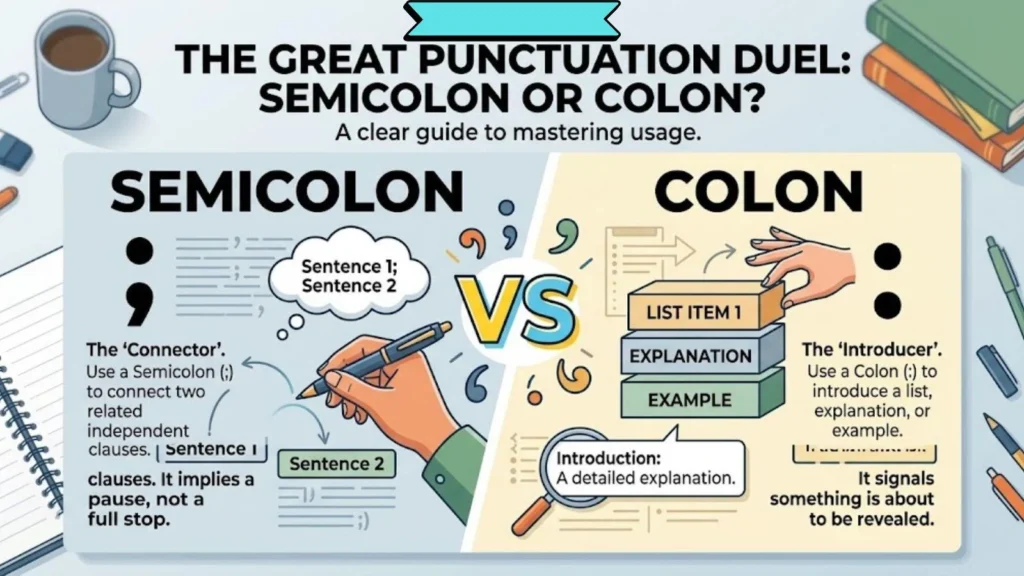
A semicolon (;) usually connects two closely related independent clauses. A colon (:) usually introduces something that explains, expands, lists, or illustrates what came before it. Knowing this simple difference can prevent many common punctuation mistakes.
People often search for “semicolon or colon” when writing essays, emails, reports, blog posts, academic work, or professional documents. The confusion usually comes from knowing that both marks create a stronger pause than a comma but not knowing exactly when each one belongs.
The good news is that there is no British-versus-American spelling choice between semicolon and colon. The words are spelled the same in both varieties of English. The real issue is punctuation and sentence structure.
This guide explains the difference with simple examples, common mistakes, everyday uses, and practical advice.
Semicolon or Colon – Quick Answer
Use a semicolon (;) to connect two closely related complete sentences:
The meeting ended early; everyone went home.
Use a colon (:) to introduce an explanation, example, list, or additional information:
She brought three things: a notebook, a pen, and a laptop.
The easiest way to remember
| Punctuation | Main job | Example |
|---|---|---|
| Semicolon (;) | Connects related complete thoughts | I was tired; I kept working. |
| Colon (:) | Introduces information | I had one goal: finish the report. |
A semicolon says, “These two complete ideas are closely connected.”
A colon says, “Here comes more information about what I just mentioned.”
The Australian Government Style Manual similarly describes semicolons as links between sentences and colons as marks that draw attention to what follows.
The Origin of Semicolon or Colon
The words semicolon and colon have different historical roots.
The word semicolon combines semi-, meaning “half” or “partly,” with colon. The name reflects the punctuation mark’s traditional position between a comma and a full stop in strength.
The word colon comes from an ancient Greek term associated with a clause or part of a sentence. Over time, the colon developed into the punctuation mark we use today.
The symbols are also different:
- Semicolon:
; - Colon:
:
Neither word has a special British or American spelling. Both semicolon and colon are standard spellings in British English and American English.
The difference people are usually asking about is therefore not spelling. It is how the punctuation marks function.
Why are they easy to confuse?
Both marks can create a noticeable pause. Both can appear in formal writing. Both can occur between related pieces of information.
However, their grammatical jobs are different:
The weather was terrible; we continued the trip.
Here, each side of the semicolon can stand as a complete sentence.
Compare:
We continued the trip for one reason: the tickets were nonrefundable.
The colon introduces the reason.
British English vs American English Spelling
There is no spelling difference between semicolon and colon in British and American English.
| Term | British English | American English | Symbol |
|---|---|---|---|
| Semicolon | semicolon | semicolon | ; |
| Colon | colon | colon | : |
| Semicolon punctuation | Same rules in general | Same rules in general | ; |
| Colon punctuation | Same basic function | Same basic function | : |
Although punctuation style can vary somewhat between individual style guides, the words themselves do not change spelling.
For example:
British English:
The report was difficult to complete; the deadline was very short.
American English:
The report was difficult to complete; the deadline was very short.
Likewise:
British English:
She had one concern: the project was behind schedule.
American English:
She had one concern: the project was behind schedule.
The fundamental distinction remains the same.
Important difference from spelling comparisons
Unlike colour/color, centre/center, or authorised/authorized, there is no British-American spelling pair here.
So, if you are writing for an American audience, you do not need to change semicolon to another spelling. The same applies to British, Australian, Canadian, and other English-language audiences.
Which Spelling Should You Use?
Use semicolon and colon regardless of whether your audience uses British or American English.
The important choice is not spelling. It is selecting the correct punctuation mark.
For American English
Follow the punctuation rules required by your chosen style guide. In general:
The plan was simple: reduce costs.
And:
The plan was simple; everyone understood it.
For British English
The same basic distinction applies:
We had one option: delay the launch.
And:
The launch was delayed; the equipment had not arrived.
For international or global writing
Use the standard spellings:
- semicolon
- colon
Focus on making the sentence structure clear.
If your workplace, university, publisher, or organization has its own style guide, follow that guide when it gives more specific punctuation rules.
Common Mistakes with Semicolon or Colon
1. Using a semicolon before a simple list
Incorrect:
I bought three items; bread, milk, and eggs.
Better:
I bought three items: bread, milk, and eggs.
The colon introduces the list.
2. Using a semicolon between a sentence and a fragment
Incorrect:
I had one goal; to finish early.
Better:
I had one goal: to finish early.
The words after the punctuation are not an independent sentence.
3. Using a colon between two closely related sentences
A colon can sometimes introduce a complete clause, but writers should not use it automatically where a semicolon or full stop would be clearer.
For example:
The weather changed suddenly; we returned home.
This clearly connects two complete thoughts.
4. Using a semicolon where a comma and conjunction would work
Incorrect:
I wanted to go; but I was too tired.
Better:
I wanted to go, but I was too tired.
Or:
I wanted to go; I was too tired to continue.
5. Putting a colon after an incomplete lead-in
Incorrect:
The things I need are: paper, pens, and folders.
Better:
The things I need are paper, pens, and folders.
Or:
I need three things: paper, pens, and folders.
A colon should not normally interrupt a sentence unnecessarily. The Australian Government Style Manual specifically warns against using a colon when the list simply flows as part of the sentence.
6. Overusing semicolons
Semicolons can make writing harder to read when used too often. Modern plain-language guidance often recommends shorter sentences when a semicolon adds unnecessary complexity.
Semicolon or Colon in Everyday Examples
In emails
Colon:
I have one request: please send the updated document today.
Semicolon:
I reviewed the document; I will send my comments this afternoon.
The colon introduces the request. The semicolon connects two related complete thoughts.
In news writing
Colon:
Breaking news: the company announced a new policy.
Semicolon:
The company announced a new policy; employees will receive more details tomorrow.
In social media
Colons are often useful for introductions:
Weekend plans: sleep, food, and movies.
Semicolons can create a deliberate connection:
I planned to relax; my inbox had other ideas.
In academic writing
A semicolon can connect related claims:
The results were unexpected; further research is necessary.
A colon can introduce an explanation:
The study produced one important finding: regular practice improved accuracy.
In formal writing
Both marks can be useful when applied correctly:
The proposal has one major weakness: it lacks supporting evidence.
The proposal has several strengths; the research is detailed and the evidence is clear.
Semicolon or Colon – Google Trends & Usage Data
People searching “semicolon or colon” are usually looking for a usage explanation rather than a spelling correction. This is important because the two words do not represent alternative British and American spellings.
Google Trends measures relative search interest, not exact numbers of searches. Google also notes that low-volume searches can appear as zero and that Trends data should not be treated as a perfect mirror of total search activity.
Google Trends allows users to compare search terms by location and time period and examine interest by region.
For this topic, search interest can reasonably be connected with contexts such as:
- English-language learning
- School and university writing
- Grammar questions
- Essay writing
- Professional communication
- Editing and proofreading
- Blogging and content creation
Exact rankings for the phrase “semicolon or colon” can change depending on the selected date range, country, search type, and whether Google treats the query as a term or topic. Google recommends using its comparison and location tools when analyzing Trends data.
What the search intent tells us
The popularity of this type of grammar query reflects a practical question:
“Which punctuation mark should I use here?”
That makes examples more useful than simply memorizing definitions.
Semicolon vs Colon: Comparison Table
| Feature | Semicolon (;) | Colon (:) |
|---|---|---|
| Main purpose | Connects closely related ideas | Introduces information |
| Can connect two complete sentences? | Yes | Sometimes, depending on construction |
| Introduces a list? | Usually no | Yes |
| Introduces an explanation? | Usually no | Yes |
| Introduces an example? | Usually no | Yes |
| Indicates a strong relationship? | Yes | Yes |
| British spelling | semicolon | colon |
| American spelling | semicolon | colon |
| Symbol | ; | : |
| Common use | Related independent clauses | Lists, explanations, examples |
Compare these examples
Semicolon:
The store was closed; we came back later.
Colon:
The store was closed for one reason: it was a holiday.
The semicolon connects two related statements.
The colon introduces the reason.
A Simple Trick to Remember the Difference
Ask yourself one question:
Is something coming next to explain or list what I just mentioned?
If yes, consider a colon.
I need three things: time, patience, and practice.
Are two complete, closely related thoughts being connected?
If yes, consider a semicolon.
I needed more practice; I kept trying.
This simple test handles many everyday punctuation decisions.
FAQs About Semicolon or Colon
1. Is a semicolon stronger than a comma?
Generally, yes. A semicolon creates a stronger break than a comma and can connect two closely related independent clauses.
I was tired; I continued working.
2. When should I use a colon?
Use a colon when introducing information such as a list, explanation, example, or clarification.
She brought everything we needed: food, water, and blankets.
3. Can a colon connect two complete sentences?
A colon can introduce a closely related complete clause in certain constructions, particularly when the second part explains or expands the first.
He knew one thing: the plan had failed.
However, do not use a colon simply because two complete sentences are next to each other.
4. Can I use a semicolon before “and”?
Sometimes, but usually you do not need one.
I wanted to leave, and she wanted to stay.
A semicolon may be useful in a more complicated sentence, especially when the clauses already contain commas.
5. Is “semicolon” spelled differently in British English?
No. Semicolon is the standard spelling in both British and American English.
6. Is “colon” spelled differently in American English?
No. Colon is spelled the same in British and American English.
7. Which is more formal: a semicolon or a colon?
Neither is automatically more formal. They perform different grammatical functions. The correct choice depends on the relationship between the information in the sentence.
Conclusion
Understanding semicolon or colon becomes much easier when you focus on function rather than appearance. A semicolon (;) normally connects two closely related complete thoughts. A colon (:) normally introduces information that explains, expands, or lists something mentioned before it.
There is also no British-versus-American spelling problem. Semicolon is spelled semicolon in both major varieties of English, while colon remains colon. The important decision is choosing the punctuation mark that matches the sentence structure.
For quick writing, remember this rule: semicolon connects; colon introduces.
For example, write:
The work was difficult; we finished it anyway.
But write:
We had one goal: finish the work.
In emails, essays, reports, articles, and professional documents, correct punctuation makes relationships between ideas easier to understand. When a sentence becomes too complicated, however, a full stop may be clearer than either punctuation mark. Good writing is not about using more punctuation. It is about using the right punctuation at the right time.