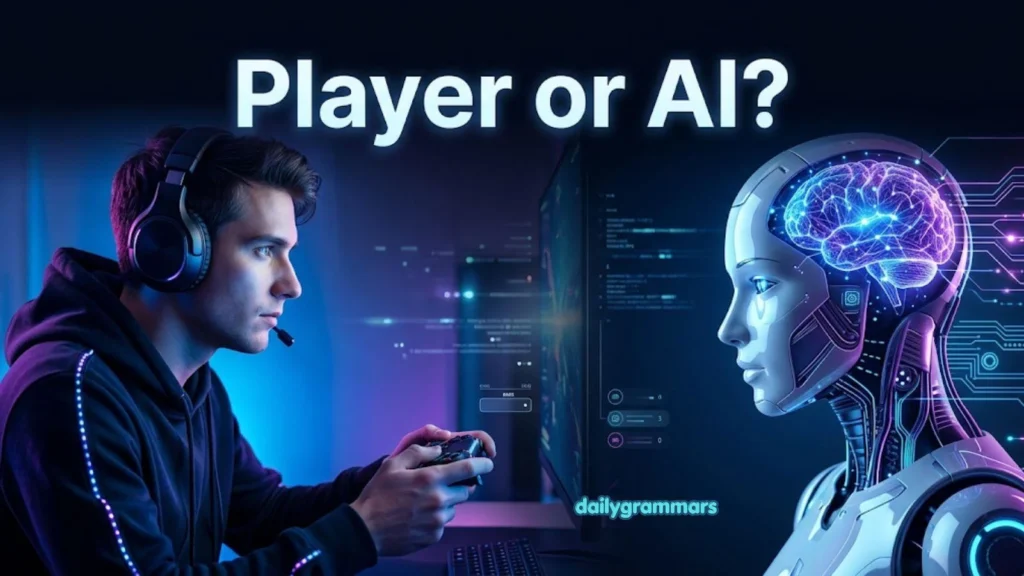
Have you ever played a game and wondered, “Is this a real players or AI?” You are not alone. As video games become more advanced, the line between human-controlled players and computer-controlled characters can feel less obvious.
The phrase “players or AI” is usually used in gaming and technology. It asks whether a character, opponent, teammate, or participant is controlled by a real person or by an artificial intelligence system. The confusion often comes from related terms such as player, AI, bot, NPC, and computer-controlled character.
A human player makes decisions and controls actions directly. AI, on the other hand, uses computer-based systems to produce behavior or make decisions. However, not every computer-controlled character uses advanced AI, so the terms are not always perfect synonyms.
This guide explains players or AI, its meaning, history, correct usage, common mistakes, examples, and how the phrase is used today.
Players or AI – Quick Answer
Player usually means a human participant in a game.
AI means artificial intelligence. In gaming, it often refers to a computer-controlled opponent, teammate, character, or system.
For example:
- The player defeated the AI.
- The AI controls the opposing team.
- Three players joined the match.
- The game lets you play against AI.
So, the simplest rule is:
Player = usually a human participant.
AI = artificial intelligence controlling or assisting behavior.
A game can contain both at the same time. A human player may compete against an AI opponent, or several human players may play alongside AI-controlled teammates. Gaming terminology can vary by game, so terms such as bot, NPC, and computer player may also be used.
Players vs AI at a Glance
| Term | Meaning | Example |
|---|---|---|
| Player | Human participant | The player scored |
| AI | Artificial intelligence | The AI defended the goal |
| AI player | Computer-controlled participant | The AI player attacked |
| Bot | Automated program | A bot joined the match |
| NPC | Non-player character | The NPC gave the player a quest |
| Human player | Real person | A human player joined |
| Computer player | Computer-controlled participant | Choose a computer player |
The Origin of Players or AI
The two terms have very different histories.
Origin of “Player”
The word player comes from the older word play. Etymological sources trace player to Middle English pleiere and Old English plegere, meaning someone who takes part in pastimes or amusement.
Over time, player developed many meanings. It could describe someone who played a game, performed on stage, played a musical instrument, or participated in a sport.
Today, gaming is one of its most common uses.
Origin of “AI”
AI is short for artificial intelligence.
The term artificial intelligence became established as the name of a research field in 1956 during the Dartmouth Summer Research Project on Artificial Intelligence. John McCarthy is credited with coining the term.
The early goal was to explore whether machines could simulate aspects of human intelligence. That idea eventually developed into the broad field of AI used today.
Why the Terms Are Different
There is no spelling difference between player and AI. Instead, they identify different concepts:
- Player identifies a participant.
- AI identifies a technology or computational system.
- AI player combines the two ideas to describe a computer-controlled participant.
That is why “player or AI” is primarily a meaning and usage question, not a British-versus-American spelling question.
British English vs American English Spelling
Unlike words such as colour/color or realise/realize, player and AI do not have different British and American spellings.
Both varieties of English normally use:
- player
- players
- AI
- artificial intelligence
| Meaning | British English | American English |
|---|---|---|
| Human participant | player | player |
| More than one | players | players |
| Artificial intelligence | AI | AI |
| Full term | artificial intelligence | artificial intelligence |
| Computer-controlled opponent | AI opponent | AI opponent |
| Computer participant | computer player | computer player |
The main difference may be style or terminology, not spelling.
For example:
- British English: Play against the computer.
- American English: Play against the AI.
Both are correct.
Is “AI Player” Correct?
Yes. AI player can be used when an AI system fills the role of a player in a game.
However, if you simply mean the technology, AI is usually clearer.
Compare:
- The AI defeated me.
- The AI player defeated me.
Both can work, but the second specifically emphasizes that the AI is occupying a player position.
Which Spelling Should You Use?
There is no British-versus-American spelling choice for player or AI.
Use player when you mean a human participant.
Use AI when you mean artificial intelligence.
Use AI player, AI opponent, or computer-controlled player when you need to explain that an artificial system is filling a player role.
For US Audiences
Use simple gaming terms such as:
- player
- AI
- AI opponent
- computer player
- bot
For UK and Commonwealth Audiences
The same terms are generally understood:
- player
- AI
- AI opponent
- computer-controlled character
- bot
For Global Audiences
For maximum clarity, write:
human player vs AI opponent
This is especially useful in websites, game instructions, tutorials, and technical writing.
Common Mistakes with Player or AI
Because player, AI, bot, and NPC can overlap, several mistakes are common.
Mistake 1: Calling Every Computer Character AI
Not every automated character necessarily uses sophisticated artificial intelligence.
Better:
“The game uses a computer-controlled character.”
Mistake 2: Calling a Human Player AI
A real person is a player, not an AI.
Incorrect:
“The AI scored the goal,” when a human actually scored it.
Correct:
“The player scored the goal.”
Mistake 3: Treating Bot and AI as Exact Synonyms
A bot is an automated program. Some bots use AI, but not every bot needs advanced AI.
Better:
“The game uses bots controlled by programmed rules.”
Mistake 4: Treating NPC and AI as Identical
NPC means non-player character. AI describes technology or automated decision-making.
An NPC may use AI, but the words describe different things.
Mistake 5: Assuming Every Online Opponent Is Human
Some games include bots alongside human players.
Better:
“Is this opponent a real player or an AI-controlled bot?”
Quick Correction Table
| Incorrect or unclear | Better |
|---|---|
| Is the player an AI? | Is the opponent AI-controlled? |
| The AI player is a human | The player is human |
| Every bot is AI | Some bots use AI |
| Every NPC is AI | NPCs may use AI |
| The computer is a player | The computer is controlling an AI player |
| Is this player real? | Is this a human player or AI? |
Player or AI in Everyday Examples
The phrase appears most naturally in gaming, technology, online discussions, and game reviews.
In a Game Menu
Choose: Player or AI
This tells the user to choose between a human-controlled participant and a computer-controlled opponent.
In an Email
“Can you confirm whether the opponent is a player or AI?”
This is clear and professional.
On Social Media
“I honestly can’t tell if that was a player or AI.”
This casual use is common when discussing realistic game behavior.
In Gaming News
“The new game allows users to compete against human players or AI opponents.”
This is more formal and precise.
In a Game Review
“The AI opponents react quickly and create a challenging experience.”
In Formal Writing
For technical or academic writing, define AI the first time:
“The game uses artificial intelligence (AI) to control computer opponents.”
After that, AI can be used throughout the article.
Player or AI – Google Trends & Usage Data
Google Trends measures relative search interest, rather than giving a simple count of total searches. Google explains that its data is sampled, normalized, and scaled from 0 to 100 based on the selected location and time period.
For this reason, there is no single permanent worldwide search-volume number for “player or AI.” Interest can change by country, time period, and search context.
The phrase is especially relevant to:
- video games
- AI opponents
- online multiplayer games
- bots
- NPCs
- esports
- gaming technology
- human vs AI comparisons
Related searches include:
- player vs AI
- players vs AI
- human vs AI
- AI opponent
- play against AI
- AI player
- player or bot
- human or AI
- is this a bot?
The growing use of AI in games has also made the distinction more important. Research and game-development literature commonly distinguishes human players from AI-controlled characters and other automated entities.
Player or AI Comparison Table
| Phrase | Meaning | Best Use |
|---|---|---|
| Player or AI | Human participant or artificial intelligence | Asking who controls something |
| Player vs AI | Human competing against AI | Game modes |
| Player vs Player | Human competing against another human | Multiplayer |
| Players vs AI | Multiple humans competing against AI | Team games |
| AI player | AI filling a player role | Games |
| AI opponent | Computer-controlled opponent | Gaming |
| Human player | Real person playing | Clear identification |
| Computer player | Computer-controlled participant | Traditional gaming |
| Player or bot | Human or automated program | Online games |
| Human or AI | Person or artificial system | General technology |
Player vs AI: Why the Difference Matters
The difference becomes important when describing a game accurately.
Imagine a football game where you control one team and the computer controls the other.
You are the player.
The opposing computer-controlled team is the AI or AI opponent.
You could say:
“The player scored against the AI.”
Now imagine a four-person team game. Two people join the match, while two computer-controlled characters fill the remaining positions.
Calling all four participants players could create confusion.
A clearer description would be:
“Two human players joined the match, while two AI teammates filled the remaining positions.”
This distinction helps readers understand exactly who is human and what is computer-controlled.
FAQs About Player or AI
1. What does “player or AI” mean?
It usually asks whether a character or opponent is controlled by a human player or by an artificial intelligence system.
2. Is an AI considered a player?
Not usually. A player normally means a human participant. However, an AI can act as an AI player or computer player in some games.
3. What is the difference between a player and AI?
A player is normally a human participant who makes decisions and provides input. AI is a computer-based system that can make decisions or generate behavior automatically.
4. Is a bot the same as AI?
Not exactly. A bot is an automated program. Some bots use AI, while others can work with simple programmed rules.
5. Is an NPC the same as AI?
No. NPC means non-player character. AI describes technology or automated behavior. An NPC may use AI, but the terms have different meanings.
6. Can AI play a video game?
Yes. AI systems can control game characters, compete against humans, make decisions, navigate environments, and provide automated teammates or opponents.
7. How can you tell if a player is AI?
It depends on the game. Some games label bots or AI opponents. Others provide clues through game settings, match information, or behavior. Human-like behavior alone does not prove that an opponent is human.
Conclusion
The difference between player or AI is simple once you focus on the role each term describes. A player normally means a human participant who controls a game character, makes choices, or takes part in a match. AI means artificial intelligence, which can control opponents, teammates, NPCs, or other systems.
The two terms are not interchangeable. A human player can compete against AI, work with AI teammates, or interact with AI characters. At the same time, a computer-controlled character may be called an AI player, bot, NPC, or computer player depending on the game and the exact technology involved.
There is also no British-versus-American spelling difference here. Player and AI are used in both forms of English.
For the clearest writing, use player for a human participant and AI for artificial intelligence. When precision matters, use terms such as AI opponent, human player, bot, or NPC.
Understanding these terms makes gaming menus, articles, reviews, and technical discussions much easier to understand.