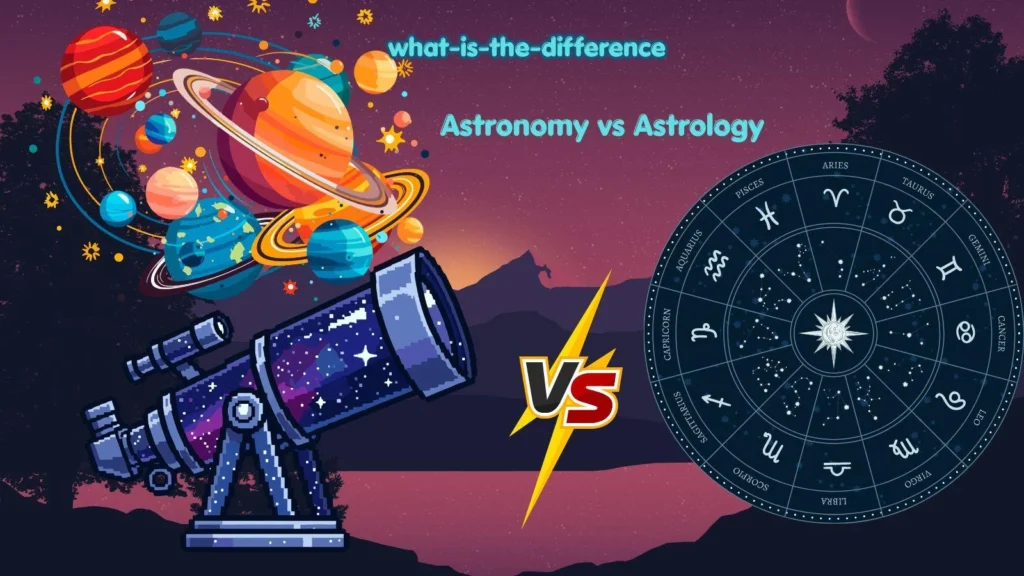
If you have ever mixed up astronomy vs astrology, you are not alone. The two words look almost identical, share ancient roots, and both deal with stars, planets, and the sky. Yet they describe very different fields. Astronomy is a scientific discipline that studies the universe and celestial objects, while astrology is a belief system that connects celestial positions with human personality or future events.
People often search for “astronomy vs astrology” because the terms are easy to confuse in conversation, schoolwork, articles, and online searches. The confusion is understandable because the words were historically much closer in meaning than they are today. Their meanings gradually separated as astronomy developed as an evidence-based science.
This guide explains the difference in simple terms. It also covers their origins, spelling, common mistakes, everyday examples, search trends, and frequently asked questions. By the end, you will know exactly when to use astronomy and when to use astrology.
RELATED;Astigmatism vs Nystagmus: Clear Differences, Meaning
Astronomy vs Astrology – Quick Answer
The simplest answer is:
- Astronomy = the scientific study of the universe.
- Astrology = a system that interprets the positions of celestial bodies as having meaning for human life.
NASA defines astronomy as the scientific study of matter in outer space, including celestial bodies and their properties, movements, and evolution.
Astrology, by contrast, involves beliefs that the positions of stars and planets can describe personality traits or predict events. NASA notes that these claims are not supported by scientific evidence.
Simple examples
Astronomy:
“She studies astronomy at university.”
This means she studies space, stars, planets, galaxies, and other celestial phenomena.
Astrology:
“He reads his horoscope every morning.”
This refers to astrology and the interpretation of celestial positions.
Astronomy vs Astrology comparison
| Feature | Astronomy | Astrology |
|---|---|---|
| Main focus | Universe and celestial objects | Meaning of celestial positions |
| Field | Natural science | Belief system/traditional practice |
| Uses scientific methods | Yes | No |
| Studies stars and planets | Yes | Yes, for interpretive purposes |
| Uses telescopes | Yes | Not as a scientific research method |
| Horoscopes | No | Yes |
| Predicts personality from planets | No | Yes |
| Scientific evidence | Evidence-based | Claims are not scientifically supported |
The Origin of Astronomy vs Astrology
The words astronomy and astrology both have roots in ancient Greek and originally had much closer meanings.
Astronomy comes through Latin astronomia from Greek astronomia. It is connected with astron, meaning “star,” and nomos, meaning “arranging,” “rule,” or “law.”
Astrology comes from Greek astrologia, from astron (“star”) and -logia, meaning something like “study” or “treating of.”
In earlier periods, the boundary between the two subjects was not as clear as it is today. Historical sources show that astrology and astronomy once overlapped considerably. Over time, astronomy became associated with systematic scientific investigation, while astrology became associated with interpreting celestial positions in relation to human affairs. This distinction became much clearer in English by the late 17th century.
So, the similarity between the words is not an accident. They share an ancient connection with the study and interpretation of the stars.
British English vs American English Spelling
Unlike pairs such as colour/color or organise/organize, there is no major British-American spelling difference between astronomy and astrology.
Both forms are normally spelled the same in British English and American English.
| Word | British English | American English | Meaning |
|---|---|---|---|
| Astronomy | Astronomy | Astronomy | Scientific study of the universe |
| Astrology | Astrology | Astrology | Interpretation of celestial positions |
| Astronomer | Astronomer | Astronomer | Person who studies astronomy |
| Astrologer | Astrologer | Astrologer | Person who practices astrology |
| Astronomical | Astronomical | Astronomical | Related to astronomy |
| Astrological | Astrological | Astrological | Related to astrology |
Examples
British English:
“Astronomy is a fascinating subject.”
American English:
“Astronomy is a fascinating subject.”
The spelling does not change.
The same is true for astrology:
“She is interested in astrology.”
There is no standard British spelling such as astrologie or an American alternative. Astronomy and astrology are standard in both varieties of English.
Which Spelling Should You Use?
For this pair, you do not need to choose a British or American spelling.
Use:
- Astronomy when discussing the scientific study of space.
- Astrology when discussing horoscopes, zodiac signs, or beliefs about celestial influences on people.
For US audiences
Use astronomy and astrology exactly as written.
For UK and Commonwealth audiences
Use the same spellings.
For global audiences
The same spellings are also appropriate. The important issue is not spelling. It is meaning.
For example:
“The astronomy department studies distant galaxies.”
This is about science.
“The astrology column discusses today’s zodiac signs.”
This is about astrology.
Common Mistakes with Astronomy vs Astrology
Because the words look similar, several mistakes are common.
Mistake 1: Calling astrology a branch of astronomy
Incorrect:
“Astrology is a branch of astronomy.”
Better:
“Astronomy and astrology are different fields with different purposes.”
Astronomy is a science. Astrology involves interpretations or beliefs about celestial positions.
Mistake 2: Using “astrologer” for a scientist
Incorrect:
“The astrologer discovered a new planet.”
Correct:
“The astronomer discovered a new planet.”
An astronomer studies the universe scientifically.
An astrologer practices or interprets astrology.
Mistake 3: Using “astronomical” for horoscopes
Incorrect:
“She writes astronomical predictions for each zodiac sign.”
Better:
“She writes astrological predictions for each zodiac sign.”
Mistake 4: Assuming the similar names mean the same thing
The shared beginning does not mean the words have the same modern meaning.
Think of the difference this way:
Astronomy → evidence, observation, universe
Astrology → zodiac, horoscopes, interpretation
Astronomy vs Astrology in Everyday Examples
Knowing the difference helps you choose the right word in everyday writing.
In emails
Astronomy:
“Our science club is planning an astronomy observation night.”
Astrology:
“The newsletter will include a short astrology section.”
In news
Astronomy:
“Astronomers observed a distant galaxy using a powerful telescope.”
Astrology:
“The magazine published its monthly astrology forecast.”
On social media
Astronomy:
“Tonight’s sky is perfect for astronomy and stargazing.”
Astrology:
“What does your astrology chart say about your personality?”
In formal writing
Astronomy:
“Astronomy examines the physical properties and behavior of celestial objects.”
Astrology:
“Astrology interprets celestial positions in relation to human affairs.”
In education
“Students learned about planets in their astronomy class.”
Not:
“Students learned about planets in their astrology class.”
The correct word depends on what the class is actually studying.
Astronomy vs Astrology – Google Trends & Usage Data
Google Trends measures relative search interest, not the total number of searches. Its results can be compared by location, time period, and search category, but the figures should not be treated as absolute search counts.
For the keyword “astronomy vs astrology,” search interest can vary by country and by the type of question people are asking.
Common search contexts
Astronomy searches often relate to:
- planets
- stars
- galaxies
- telescopes
- space missions
- eclipses
- astronomy careers
- astronomy education
Astrology searches often relate to:
- zodiac signs
- horoscopes
- birth charts
- compatibility
- personality
- monthly predictions
- planetary meanings
Search interest can also change around major astronomical events, while astrology-related searches may rise around horoscope topics and popular zodiac content.
Google Trends provides country-specific exploration, including interfaces for locations such as Pakistan and the United Kingdom.
For SEO, this means “astronomy” and “astrology” should generally be treated as separate search intents. A page targeting one topic should make its purpose clear rather than mixing the two.
Astronomy vs Astrology: Key Differences at a Glance
| Category | Astronomy | Astrology |
|---|---|---|
| Definition | Scientific study of the universe | Interpretation of celestial positions |
| Main subject | Space and celestial objects | Zodiac and celestial influences |
| Scientific discipline | Yes | No |
| Evidence-based research | Yes | Not supported by scientific evidence |
| Common professional | Astronomer | Astrologer |
| Common content | Space research | Horoscopes |
| Common tools | Telescopes, observatories, instruments | Birth charts and astrological systems |
| Example | Studying how stars form | Interpreting a birth chart |
| Related adjective | Astronomical | Astrological |
Frequently Asked Questions
1. What is the main difference between astronomy and astrology?
Astronomy is the scientific study of the universe and celestial objects. Astrology interprets celestial positions as having meaning for human personality or events.
2. Is astrology a science?
No. Modern astronomy follows scientific methods and uses evidence and data. Astrology’s claims about celestial influences on human life are not supported by scientific evidence.
3. Are astronomy and astrology related?
Seealso;Polar or Nonpolar: How to Tell the Difference Easily
They are historically related. Both words have ancient roots connected with stars, and the two subjects once overlapped more than they do today. Their meanings gradually became distinct.
4. What is an astronomer?
An astronomer is a scientist who studies the universe and celestial objects, including their properties, history, locations, and movements.
5. What is an astrologer?
An astrologer is someone who practices or interprets astrology, such as zodiac signs, birth charts, and planetary positions.
6. Is astronomy spelled differently in British English?
No. Astronomy is spelled the same in British and American English.
7. Which word should I use for horoscopes?
Use astrology. Horoscopes are associated with astrology, not astronomy.
Conclusion
The difference between astronomy vs astrology becomes simple once you focus on what each word describes. Astronomy is the scientific study of the universe, including stars, planets, galaxies, and other celestial objects. Astrology is a system of beliefs and interpretations that connects celestial positions with human personality or events. NASA clearly distinguishes the two and identifies astronomy as a science based on evidence and data.
The words have similar appearances because they share ancient roots. Historically, astronomy and astrology were much less separate than they are today. Their meanings gradually developed in different directions, giving each word its modern use.
There is also no British-versus-American spelling problem to solve. Astronomy and astrology are spelled the same in both major varieties of English.
For clear writing, remember one simple rule: astronomy studies the universe scientifically; astrology interprets the stars and planets through an astrological system.