Have you ever written “vallies” and wondered whether it should be “valleys” instead? You are not alone. This spelling question often appears because English has several words that change their endings when they become plural. Learners may expect valley to follow a pattern such as city → cities, which can make “vallies” look reasonable at first glance.
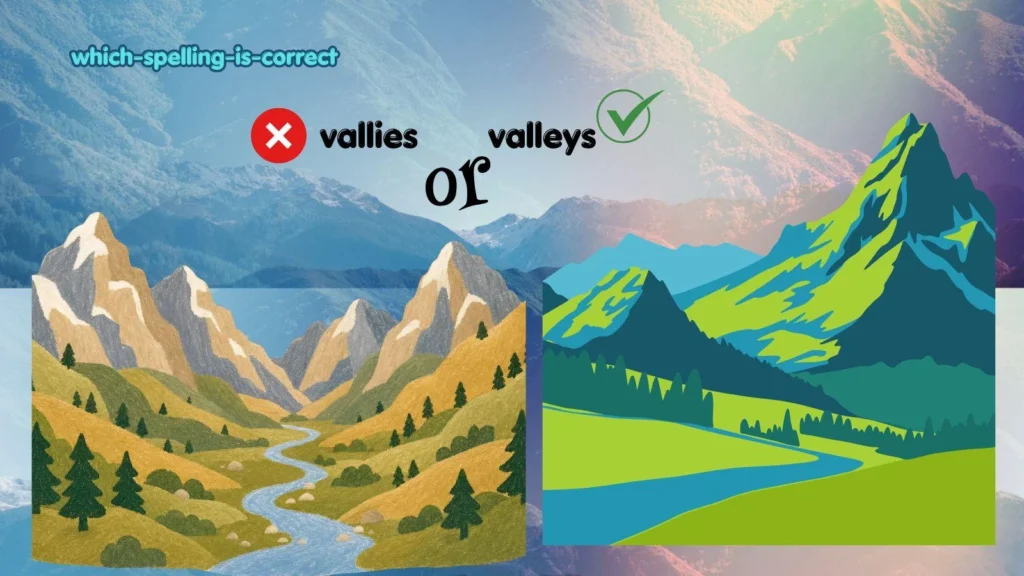
The correct spelling is “valleys.” The word valley means a low area of land between hills or mountains, often with a river or stream running through it. Its plural form is made by simply adding -s: valley → valleys.
This article explains why “valleys” is correct and why “vallies” is a common mistake. It also covers British and American English, common errors, everyday examples, usage patterns, and answers to frequently asked questions. Whether you are writing an email, school assignment, website article, or professional document, this guide will help you use the correct spelling with confidence.
Vallies or Valleys – Quick Answer
“Valleys” is the correct spelling. “Vallies” is incorrect in standard English.
- Singular: valley
- Plural: valleys
- Incorrect: vallies
Examples
- We drove through several beautiful valleys.
- The mountains surround three large valleys.
- Heavy rain caused flooding in the valleys.
- These valleys are popular with hikers.
The reason is simple: valley ends in -ey, not -y. To make it plural, add -s.
| Singular | Plural | Correct? |
|---|---|---|
| valley | valleys | ✅ Yes |
| vallie | vallies | ❌ No |
| valley | vallies | ❌ No |
A useful rule is to keep the -ey ending when forming the plural:
valley + s = valleys
The Origin of Vallies or Valleys
The word valley comes from Old French valée, meaning a valley or low land between hills. It is related to the Latin word vallis, meaning “valley.”
Over time, the word entered Middle English and developed into the modern spelling valley.
The spelling “vallies” is usually created by applying the wrong plural rule. English does have many words ending in a consonant + y that change y to ies:
- city → cities
- baby → babies
- country → countries
- party → parties
However, valley does not follow that pattern because the letter immediately before the final y is e.
Compare:
- city → cities
- country → countries
- valley → valleys
- journey → journeys
So, the spelling stays valleys, rather than changing to vallies.
British English vs American English Spelling
There is no spelling difference between British and American English for this word.
Both varieties use:
valley → valleys
| Variety | Singular | Plural |
|---|---|---|
| British English | valley | valleys |
| American English | valley | valleys |
| Canadian English | valley | valleys |
| Australian English | valley | valleys |
| New Zealand English | valley | valleys |
The difference between British and American English affects many words, such as colour/color and centre/center, but valley is not one of them.
More examples
British English:
The valleys were covered in mist.
American English:
The valleys were covered in mist.
Both sentences use exactly the same spelling.
Which Spelling Should You Use?
Use “valleys” whenever you mean more than one valley.
This spelling works in:
- American English
- British English
- Canadian English
- Australian English
- New Zealand English
- International English
If you are writing for a global audience, valleys is the standard choice.
For American readers
Use valleys in schoolwork, business writing, websites, and everyday communication.
For British and Commonwealth readers
Use valleys as well. There is no alternative British spelling.
For formal writing
Always use valleys when referring to multiple geographical valleys.
Correct:
The region contains several deep valleys.
Incorrect:
The region contains several deep vallies.
Common Mistakes with Vallies or Valleys
The most common mistake is changing the final y to ies.
Mistake 1: Vallies
❌ The sheep live in the vallies.
✅ The sheep live in the valleys.
Mistake 2: Valley’s
Valley’s is not the normal plural form. The apostrophe indicates possession.
- valleys = more than one valley
- valley’s = something belonging to one valley
Example:
The valleys are green in spring.
The valley’s river is very cold.
Mistake 3: Valleyes
Some writers may incorrectly add -es.
❌ valleyes
✅ valleys
Why does this happen?
The confusion usually comes from mixing two different spelling rules.
Words ending in consonant + y often change y to ies:
baby → babies
But words ending in a vowel + y generally add s:
boy → boys
key → keys
day → days
valley → valleys
Vallies or Valleys in Everyday Examples
The word valleys is common in many types of writing.
In emails
The hiking route passes through several valleys before reaching the lake.
In news writing
Heavy rainfall caused flooding across several valleys.
On social media
Exploring the beautiful valleys this weekend! 🏔️
In formal writing
The study examines how communities in mountain valleys adapt to changing weather conditions.
In travel writing
The region is known for its green valleys, mountain villages, and scenic roads.
In school assignments
Many rivers flow through valleys formed by erosion.
In every example, valleys is the correct plural spelling.
Vallies or Valleys – Google Trends & Usage Data
Searches for “vallies or valleys” usually come from people checking whether valley follows the same plural pattern as words such as city or country.
The correct form, valleys, is the standard spelling used in English-language dictionaries, educational materials, geography writing, news articles, and general online content.
Search interest can vary by country and context. Queries are more likely to appear among English learners, students, writers, and people checking spelling while preparing written content.
When interpreting Google Trends data, it is important to distinguish between search interest and actual word usage. A spelling may receive searches because people are unsure about it; that does not mean the spelling is commonly accepted.
For professional writing, the practical answer remains straightforward: use valleys, not vallies.
Vallies vs Valleys: Comparison Table
| Word | Meaning | Correct? | Example |
|---|---|---|---|
| valley | One low area between hills or mountains | ✅ Yes | The valley is peaceful. |
| valleys | More than one valley | ✅ Yes | The valleys are beautiful. |
| vallies | Incorrect plural of valley | ❌ No | Avoid this spelling. |
| valley’s | Possessive form of valley | ✅ Yes | The valley’s river is wide. |
| valleyes | Incorrect plural spelling | ❌ No | Do not use it. |
FAQs About Vallies or Valleys
1. Is “vallies” a correct word?
No. “Vallies” is not the standard plural spelling of “valley.” The correct plural is “valleys.”
2. Is it valley or valleys?
Both are correct, but they have different meanings. Valley means one, while valleys means more than one.
3. Why is it valleys and not vallies?
Because valley ends in -ey. You simply add -s to form the plural: valley → valleys.
4. Does British English use “vallies”?
No. British English also uses “valleys.” There is no British spelling variation here.
5. What is the plural of valley?
The plural of valley is valleys.
6. Is “valley’s” the plural of valley?
No. Valley’s is a possessive form or can be a contraction in a specific context. The regular plural is valleys.
7. What is an easy way to remember the spelling?
Remember this pattern:
boy → boys
key → keys
day → days
valley → valleys
Words ending in a vowel + y usually keep the y and add s.
Conclusion
When deciding between “vallies or valleys,” the answer is clear: valleys is the correct spelling. Vallies is a common spelling mistake caused by applying the wrong plural rule.
The word valley ends in -ey, so you form its plural by simply adding -s:
valley → valleys
This spelling is the same in British, American, Canadian, Australian, and other major forms of English. You should use valleys in everyday conversation, emails, school assignments, professional documents, news writing, and online content.
It is also important not to confuse valleys with valley’s. The first means more than one valley, while the second normally shows possession.
If you remember one simple rule, remember this: words such as city → cities change their ending because they end in consonant + y, while valley → valleys keeps the y because it ends in vowel + y. Using this rule makes the correct spelling much easier to remember.