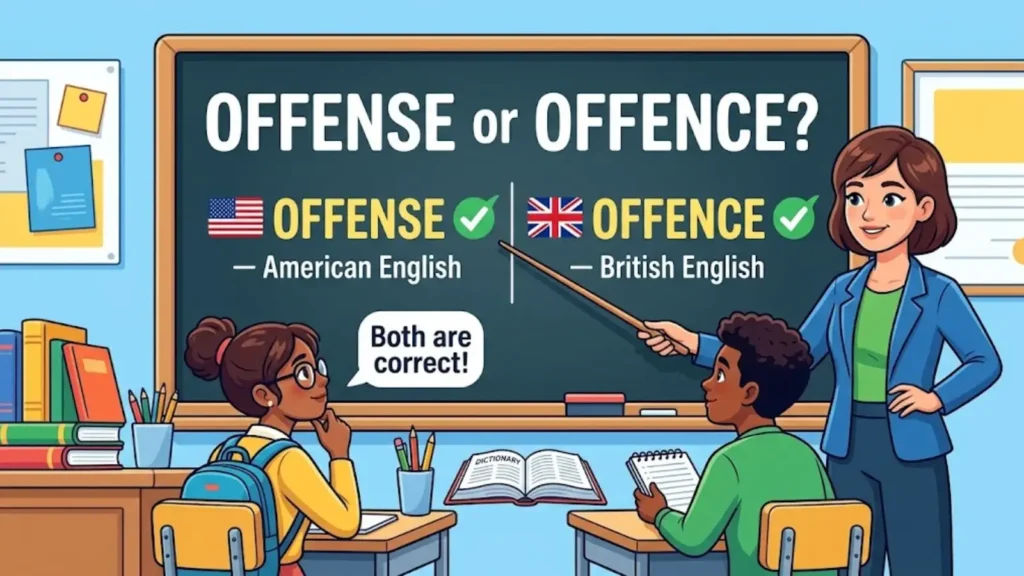
If you have ever paused before typing “offense or offence,” you are not alone. Both spellings are correct, but the right choice depends mainly on the variety of English you are using. This small spelling difference can matter in school assignments, business writing, legal documents, websites, and professional communication.
Offense is the standard spelling in American English, while offence is the standard spelling in British English. The two words have the same meanings. They can describe a crime, a violation of a rule, hurt feelings, or, especially in sports, the attacking side of a team.
People often search for “offense or offence” because they see both forms online or encounter different spellings in books and official documents. Understanding the regional difference makes the choice simple.
This guide explains the history behind both spellings, compares British and American usage, shows common mistakes, and gives practical examples. By the end, you will know exactly when to use offense and when to use offence.
RELATED: Astigmatism vs Nystagmus: Clear Differences, Meaning
Offense or Offence – Quick Answer
Offense and offence are two spellings of the same word.
- Offense = American English
- Offence = British English
- Both mean the same thing.
- Neither spelling is inherently wrong.
Examples
American English:
He was charged with a serious offense.
British English:
He was charged with a serious offence.
The same difference appears when talking about hurt feelings:
I did not mean to cause offense. — American English
I did not mean to cause offence. — British English
The difference also appears in sports:
The team’s offense is very strong. — American English
The team’s offence is very strong. — British English
Oxford and Collins both identify offense as the US form and offence as the British form.
Quick Comparison
| Spelling | Main variety | Example |
|---|---|---|
| offense | American English | He committed an offense. |
| offence | British English | He committed an offence. |
The Origin of Offense or Offence
The word has a long history. Offense/offence comes from Middle English and ultimately traces back through Old French to Latin.
The Latin verb offendere meant “to strike against.” Over time, the word developed related meanings involving harm, wrongdoing, displeasure, and insult. The noun entered English in the Middle English period.
The spelling offence appeared in English before the modern American spelling offense became established.
The difference is therefore not a difference in meaning. It is mainly a difference in spelling tradition.
American English generally prefers -se in words such as:
- offense
- defense
- pretense
British English generally prefers:
- offence
- defence
- pretence
The spelling patterns developed as American and British English followed somewhat different spelling conventions.
British English vs American English Spelling
The easiest rule is simple:
Use “offense” for American English.
Use “offence” for British English.
| Meaning | American English | British English |
|---|---|---|
| Crime or violation | offense | offence |
| Hurt feelings | offense | offence |
| Sports attack | offense | offence |
| Plural | offenses | offences |
| Adjective | offensive | offensive |
Notice something important: offensive is spelled with an s in both varieties. Canada’s official language guidance also notes that Canadians generally prefer offence, while offense is acceptable; it specifically gives offensive as the spelling for the related adjective.
Similar Spelling Differences
| American English | British English |
|---|---|
| offense | offence |
| defense | defence |
| pretense | pretence |
| organize | organise |
| color | colour |
| behavior | behaviour |
These differences are normal parts of English spelling. They do not usually indicate a difference in meaning.
Which Spelling Should You Use?
Your audience should determine your choice.
If You Write for Americans
Use offense.
Examples:
- criminal offense
- first offense
- offensive play
- serious offense
If you are writing for a US company, school, newspaper, or website, offense is the natural choice.
If You Write for British Readers
Use offence.
Examples:
- criminal offence
- first offence
- serious offence
- cause offence
This is also the usual spelling in British legal and formal writing.
If You Write for Commonwealth Audiences
Offence is often the better choice in British-based varieties of English, including many Commonwealth contexts. However, local style guides can differ.
For example, Canadian English generally prefers offence, although offense is also accepted.
If You Write for a Global Audience
Pick one spelling system and stay consistent.
Do not write:
The player committed an offense and later received an offence notice.
Instead, choose one style:
The player committed an offense and later received an offense notice.
or:
The player committed an offence and later received an offence notice.
Consistency is more important than trying to mix regional spellings.
Common Mistakes with Offense or Offence
Mistake 1: Thinking One Spelling Is Wrong
Both forms are correct.
Wrong idea:
Offence is always incorrect.
Correct:
Offence is standard British English.
Likewise, offense is standard American English.
Mistake 2: Mixing Spelling Systems
A writer may use American spelling in one paragraph and British spelling in the next.
Try to keep your spelling consistent throughout a document.
Mistake 3: Changing “Offensive”
Some writers incorrectly change offensive to offencive.
The correct spelling is:
offensive
This spelling is used in both American and British English.
Mistake 4: Confusing the Word With “Offend”
The verb is:
offend
The noun can be:
offense — American English
offence — British English
The adjective is:
offensive
Mistake 5: Using the Wrong Regional Style
If you are writing an American academic paper, offense is usually the better choice.
If you are writing for a British publication, offence is usually better.
Offense or Offence in Everyday Examples
The word appears in many types of writing.
In Emails
American:
I hope you did not take offense at my comment.
British:
I hope you did not take offence at my comment.
In News Writing
American:
The suspect was charged with a criminal offense.
British:
The suspect was charged with a criminal offence.
In Social Media
American:
No offense, but I disagree.
British:
No offence, but I disagree.
In Formal Writing
American:
The law establishes penalties for this offense.
British:
The law establishes penalties for this offence.
In Sports
American:
The team’s offense scored three touchdowns.
British:
The team’s offence created several scoring chances.
Oxford lists crime, hurt feelings, and sports usage among the major meanings of offense/offence.
Offense or Offence – Google Trends & Usage Data
Search interest for offense and offence reflects the wider regional split between American and British English.
In general:
- Offense is strongly associated with American English.
- Offence is strongly associated with British English.
- British-style spelling is also common in many Commonwealth English contexts.
- Sports content can affect usage because offense is especially common in American sports terminology.
- Legal writing frequently uses the regional spelling preferred by the relevant country’s legal system.
Dictionary sources consistently identify offense as the American spelling and offence as the British spelling.
Google Trends can change over time, so exact search popularity should not be treated as a permanent measure of correctness. More searches for one spelling do not make it more grammatically correct. Regional language standards are the better guide.
Offense vs Offence: Comparison Table
| Feature | Offense | Offence |
|---|---|---|
| English variety | American | British |
| Meaning | Same | Same |
| Crime | Yes | Yes |
| Hurt feelings | Yes | Yes |
| Sports | Yes | Yes |
| Plural | offenses | offences |
| Adjective | offensive | offensive |
| Best for US writing | Yes | No |
| Best for UK writing | No | Yes |
| Canadian use | Acceptable | Preferred |
| Main difference | Spelling | Spelling |
The core distinction is regional spelling, not meaning.
FAQs About Offense or Offence
1. Is offense or offence correct?
Both are correct. Offense is the standard American spelling, while offence is the standard British spelling.
2. Is offence British or American?
Offence is primarily the British spelling. It is also used in several Commonwealth varieties of English.
3. Is offense American English?
Yes. Offense is the standard American English spelling.
4. Does offense mean something different from offence?
No. They have the same basic meanings. The main difference is spelling.
5. Should I write “criminal offense” or “criminal offence”?
Use criminal offense in American English and criminal offence in British English.
6. Is “offensive” spelled differently in British English?
No. Offensive is spelled with an s in both major spelling systems.
7. Which spelling should I use in academic writing?
Follow the English variety required by your school, university, publisher, or style guide. Use offense for American English and offence for British English.
Conclusion
The choice between offense or offence is simple once you know the regional rule. Offense is the standard American English spelling, while offence is the standard British English spelling. Both words have the same meanings and can describe a crime, violation, insult, hurt feelings, or an attacking side in sports.
The difference comes from the separate spelling traditions that developed in American and British English. Similar differences appear in pairs such as defense/defence and pretense/pretence.
For US readers, choose offense. For UK readers, choose offence. In Commonwealth English, offence is often preferred, although individual style guides may vary. Canada, for example, generally prefers offence but accepts offense.
Most importantly, stay consistent. Once you choose a spelling system for your document, use it throughout. That simple habit will make your writing look clear, polished, and professional.