Have you ever received a random email or message you didn’t ask for? Or maybe you sent a request and received the reply you actually needed? That’s where the terms solicited vs unsolicited come in.
Many people search for this keyword because they feel confused about what counts as “asked for” and what doesn’t—especially in emails, marketing, and everyday communication.
|See also Flirting Vs Sexual Harassment
This confusion matters. Using the wrong term can lead to misunderstandings in professional settings. It can also affect things like email rules, spam filters, and even legal policies. So, knowing the difference is not just helpful—it’s important.
In this guide, you’ll get a simple explanation, real examples, and clear advice on how to use both terms correctly.
Whether you are writing emails, studying English, or working in business, this article will help you understand solicited vs unsolicited in the easiest way possible.
Solicited vs Unsolicited – Quick Answer
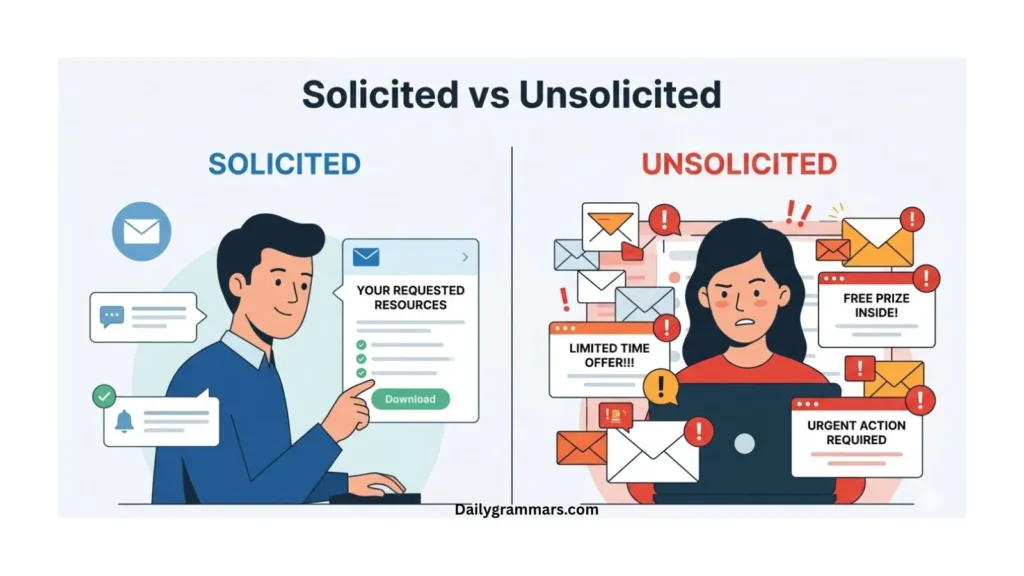
Solicited means something was asked for or requested.
Unsolicited means something was not asked for or unexpected.
Examples:
- Solicited: You ask for feedback, and someone gives it.
- Unsolicited: You receive a random marketing email you didn’t request.
👉 Simple rule:
- If you asked, it’s solicited
- If you didn’t ask, it’s unsolicited
The Origin of Solicited vs Unsolicited
The word “solicit” comes from Latin sollicitare, which means “to urge” or “to request.”
- Solicited = requested or invited
- Unsolicited = not requested
The prefix “un-” simply means “not.” So, it flips the meaning.
People have used these words for centuries in business, law, and communication. Over time, they became very common in email, marketing, and media.
British English vs American English Spelling
Good news! There is no spelling difference between British and American English for these words.
| Term | British English | American English | Meaning |
|---|---|---|---|
| Solicited | Solicited | Solicited | Requested |
| Unsolicited | Unsolicited | Unsolicited | Not requested |
Unlike words like “color/colour,” both forms stay the same.
Which Spelling Should You Use?
Since there is no variation, your choice is simple:
- US audience:
- Use solicited / unsolicited
- UK audience:
- Use solicited / unsolicited
- Global audience:
- Use the same terms confidently
👉 Focus on correct meaning, not spelling differences.
Common Mistakes with Solicited vs Unsolicited
Here are mistakes people often make:
Wrong: “Unsolicited advice I asked for”
✔️ Correct: “Solicited advice I asked for”
❌ “Solicited spam email”
Correct: “Unsolicited spam email”
❌ Mixing both in one sentence incorrectly
✔️ Keep them clearly opposite
👉 Tip: Ask yourself, “Did I request it?” That gives you the right word instantly.
Solicited vs Unsolicited in Everyday Examples
1. Emails
- Solicited: You sign up for a newsletter
- Unsolicited: You receive spam emails
2. News
- Solicited: A company asks for public feedback
- Unsolicited: A surprise statement is released
3. Social Media
- Solicited: You ask for opinions in a post
- Unsolicited: Someone gives random advice in comments
4. Formal Writing
- Solicited proposal: Requested by a client
- Unsolicited proposal: Sent without request
Solicited vs Unsolicited – Google Trends & Usage Data
The term “unsolicited” is searched more often than “solicited.” Why? Because people deal with spam, unwanted messages, and privacy issues daily.
Usage trends:
- Unsolicited → Popular in marketing, email, and legal topics
- Solicited → Used more in business and professional writing
Popular regions:
- USA, UK, Canada → High usage in email/marketing
- India & Pakistan → Growing use in business and education
👉 “Unsolicited email” is one of the most searched phrases globally.
Comparison Table: Solicited vs Unsolicited
| Feature | Solicited | Unsolicited |
|---|---|---|
| Meaning | Asked for | Not asked for |
| Tone | Positive | Often negative |
| Example | Requested feedback | Spam email |
| Usage | Business, formal | Marketing, complaints |
| Control | User-initiated | Sender-initiated |
FAQs
What is the difference between solicited and unsolicited?
In simple terms, solicited means something is requested, whereas unsolicited means it is not requested.
Why do 90% option traders lose money?
Generally, most option traders lose money because they lack strategy, risk control, and proper market understanding.
What is the difference between solicited and unsolicited advice?
Basically, solicited advice is asked for, while unsolicited advice is given without being requested.
What is a red flag for a financial advisor?
For instance, a major red flag is when a financial advisor guarantees high returns or avoids clear explanations.
What is solicited vs unsolicited?
In short, solicited means invited or requested, whereas unsolicited means uninvited or not requested.
Is unsolicited advice disrespectful?
Often, yes—unfortunately, unsolicited advice can feel disrespectful because it is given without permission or need.
Conclusion
You can easily understand solicited vs unsolicited once you know the core idea: you request one, and you do not request the other. This small difference plays a big role in communication, especially in emails, business, and online interactions.
Using the correct term helps you sound more professional and clear. It also helps you understand what kind of communication you are dealing with—whether it is welcome or unwanted.
In today’s digital world, this knowledge is even more important because we receive so many messages every day.