
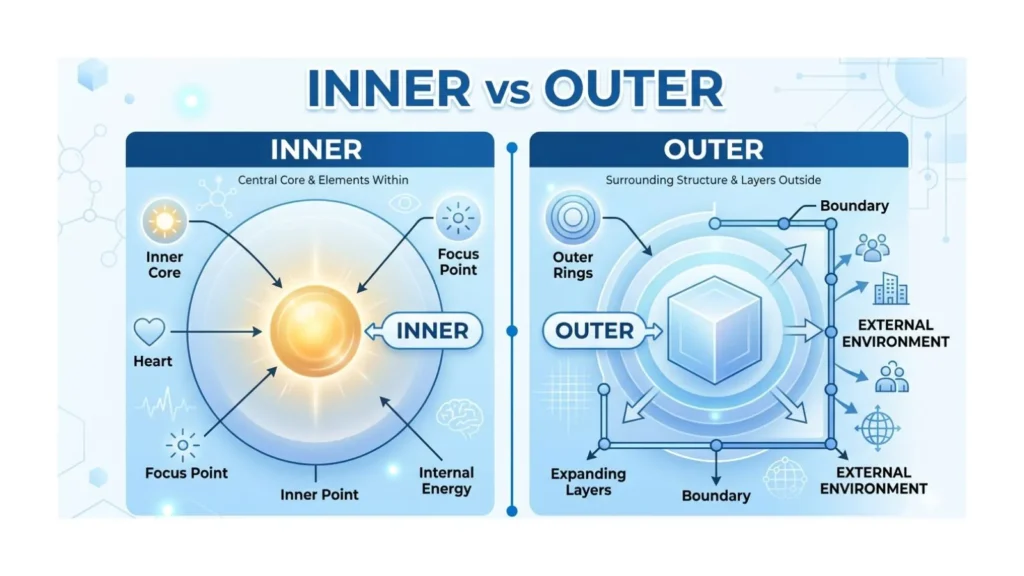
Understanding the debate of Inner vs Outer growth helps people balance emotions, appearance, and personal identity.
While inner strength shapes confidence, values, and emotional intelligence, outer presentation influences first impressions, communication, and social perception.
A healthy lifestyle combines both dimensions to create harmony in everyday life. Developing self-awareness, improving personal growth, maintaining mental balance, building emotional resilience, and enhancing physical appearance are all essential for long-term success.
RELATED :Obituary vs Eulogy
Many individuals focus only on external beauty, yet inner peace often determines happiness and stability.
By nurturing the mind and body together, people can achieve stronger relationships, better decision-making, and a more fulfilling life in both personal and professional environments for lasting fulfillment.
Inner vs Outer – Quick Answer
“Inner” means something located inside or toward the center. “Outer” means something located outside or away from the center.
For example, the inner circle of a group means close friends, while the outer circle means less close members. In clothing, the inner layer is worn under, and the outer layer is worn on top. So, the key idea is simple: inner = inside, outer = outside.
The Origin of Inner vs Outer
The word “inner” comes from Old English “innor,” meaning inside or more within. The word “outer” comes from “utera,” meaning outside or farther away.
Both words developed in English to describe position and space. Over time, they became common in science, geography, design, and daily speech. Today, they are widely used to show contrast between inside and outside.
British English vs American English Usage
There is no major spelling difference between British and American English for “inner” and “outer.” However, usage can slightly differ in tone and frequency.
- British English often uses “outer” in formal descriptions (outer London area).
- American English uses both words in simple everyday speech (outer space, inner peace).
Comparison Table
| Concept | Inner Example | Outer Example |
|---|---|---|
| Space | inner room | outer space |
| Clothing | inner layer | outer jacket |
| Groups | inner circle | outer circle |
| Position | inner side | outer edge |
Which Usage Should You Use?
If your audience is global, both “inner” and “outer” are safe and correct. Use “inner” when talking about inside, deeper, or closer meaning. Use “outer” when talking about outside, surface, or distant meaning.
For SEO writing, always choose the word based on clarity, not region. Both US and UK readers understand these terms equally well.
Common Mistakes with Inner vs Outer
Many learners make simple mistakes like:
- Saying “outer inside” (wrong) instead of just “inside”
- Using “inner outside” together (confusing)
- Mixing both words in the same direction
Correct usage:
- Inner layer of skin (correct)
- Outer surface of the wall (correct)
Inner vs Outer in Everyday Examples
“Please check the inner file before sharing the outer report” in emails
In news: “The outer region of the city faced strong winds.”
In social media: “Focus on your inner peace.”
In formal writing: “The outer boundary of the system is clearly defined.”
These examples show how both words help describe position clearly in real life.
Inner vs Outer – Google Trends & Usage Data
Search data shows that “inner vs outer” is commonly searched in education, grammar learning, and science topics. It is most popular in countries like India, Pakistan, the US, and the UK.
- High usage in education-related searches
- Common in geography and science queries
- Frequently used in ESL learning content
This shows that people mainly search it to understand English meaning and correct usage.
Comparison Table: Inner vs Outer Variations
| Word Type | Inner Meaning | Outer Meaning |
|---|---|---|
| Position | Inside/center | Outside/edge |
| Emotion | Inner peace | Outer appearance |
| Structure | Inner layer | Outer layer |
| Space | Inner zone | Outer zone |
FAQs:
- What’s the difference between inner and outer JOINs?
An INNER JOIN returns only matching records from both tables, while an OUTER JOIN also includes unmatched records from one or both tables. - What is the difference between inner and outer joints?
Inner joins show common data between tables, whereas outer joins keep unmatched rows along with matched results. - What are the 4 types of JOINs?
The four main JOINs are INNER JOIN, LEFT JOIN, RIGHT JOIN, and FULL OUTER JOIN. - Is inner join left or right?
No, INNER JOIN is separate from LEFT and RIGHT JOINs because it only returns matching rows from both tables. - Which join is faster, inner or outer?
INNER JOIN is usually faster because it processes only matching records, while OUTER JOIN handles additional unmatched rows. - What are the three types of outer joins?
The three outer joins are LEFT OUTER JOIN, RIGHT OUTER JOIN, and FULL OUTER JOIN.
Conclusion (150–200 words)
Firstly, understanding “inner vs outer” is very important for clear English communication. In addition, these two simple words help you describe position, structure, and meaning in a very easy way.
Moreover, “inner” always refers to something inside, closer, or deeper.On the other hand, “outer” always refers to something outside, surface-level, or farther away.
Similar sentences often use both words, which confuses many learners because their meanings are opposite.Once you understand the basic rule—inner = inside and outer = outside—you can use them correctly in writing, speaking, and reading.
These words are widely used in education, science, daily life, and professional writing. Whether you are describing an inner layer of clothing or the outer surface of a building, the meaning becomes clear when you apply the correct word.


Pingback: Cudos or Kudos: Which Spelling Is Correct? - Dailygrammars.com