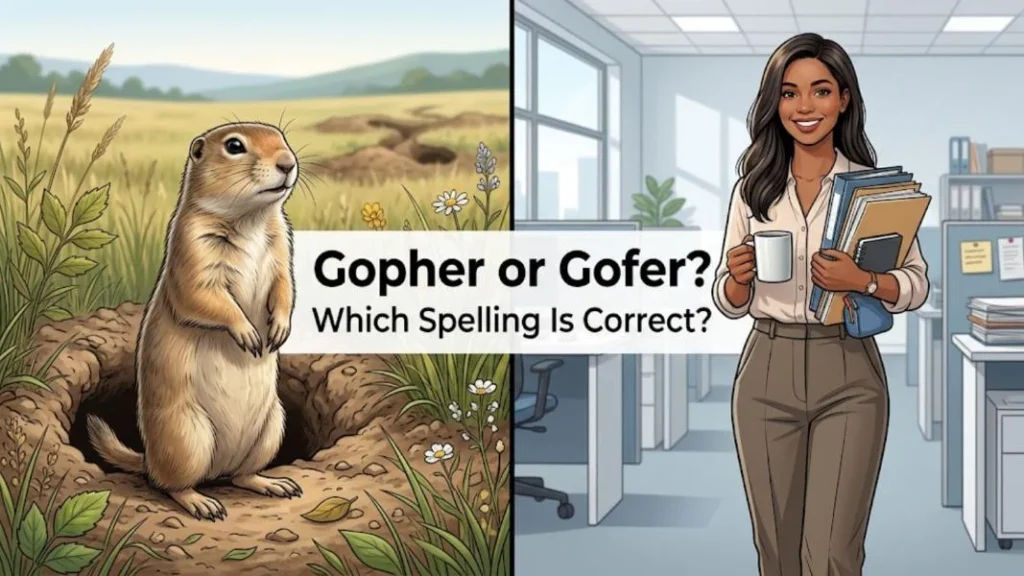
Have you ever written “gopher” or “gofer” and stopped to wonder which spelling is right? You are not alone. These two words sound the same, but they have different meanings. That makes them easy to confuse in emails, articles, schoolwork, and everyday conversations.
The simple rule is this: gopher usually refers to a burrowing animal, while gofer refers to a person who runs errands or performs small tasks. Dictionaries also recognize gopher as a less common spelling of gofer, but gofer is the clearer choice when you mean an errand-running worker.
People often search for “gopher or gofer” because the words are homophones. They sound alike but are spelled differently and can mean different things. Understanding the difference helps you choose the right word quickly.
In this guide, you will learn the meanings, origins, regional usage, common mistakes, examples, and practical rules for choosing between gopher and gofer.
Gopher or Gofer – Quick Answer
Both gopher and gofer are real English words, but their main meanings are different.
- Gopher = a burrowing animal found mainly in North America.
- Gofer = a person who runs errands or performs small tasks for others.
- Gopher can also be used as an alternative spelling of gofer, although gofer is usually clearer for the workplace meaning.
Examples
Animal:
The gopher dug several holes in the garden.
Errand worker:
The production gofer brought the documents to the director.
A useful memory trick is:
Gopher = animal
Gofer = goes for things
The words are pronounced alike, so the meaning and context tell you which spelling is intended.
The Origin of Gopher or Gofer
The two words have different histories, even though they eventually became closely associated.
The origin of “gopher”
The animal word gopher dates back to the late 18th century. Its exact origin is uncertain. Some dictionaries suggest a connection with French gaufre, meaning “honeycomb,” possibly referring to the way the animal creates networks of underground burrows. Other historical explanations have proposed Native American origins.
Merriam-Webster records the first known use of gopher in this animal sense in 1791.
The origin of “gofer”
Gofer developed much later. It comes from the phrase “go for,” describing someone who is sent to get something.
For example:
- “Go for some coffee.”
- “Go for the documents.”
- “Go for the supplies.”
Over time, go for became gofer, creating a noun for someone whose job was to fetch things or run errands. Merriam-Webster dates its first known use to 1938, while Oxford describes the word as a 1960s formation from “go for.” Historical sources show the term was already in informal American use earlier, so dictionary dating varies by source and sense.
The spelling was also influenced by the existing word gopher, which sounds exactly the same.
British English vs American English Spelling
There is an important regional point here.
Gopher is widely used for the animal in English, especially in North American contexts. Oxford lists the animal meaning and also recognizes gopher as an alternative to gofer for the person who performs small tasks.
Gofer is strongly associated with informal American English. Collins labels it mainly US and Canadian in British English usage notes.
| Word | Main meaning | American English | British English |
|---|---|---|---|
| gopher | Burrowing animal | Common | Recognized |
| gofer | Errand runner | Common informal term | Recognized, but less common |
| gopher | Errand runner | Possible alternative | Possible, but uncommon |
| assistant | Person who helps with tasks | Common | Very common |
| dogsbody | Person doing routine tasks | Less common | More traditional British term |
Examples by variety
American English:
She worked as a gofer on the film set.
British English:
She worked as an assistant on the production.
However, British English dictionaries do recognize gofer, so it is not incorrect simply because the audience is British. Cambridge also lists gofer as a US informal workplace term.
Which Spelling Should You Use?
Choose the spelling according to the meaning first.
If you mean the animal
Use gopher.
A gopher damaged the plants.
If you mean an errand runner
Use gofer.
The gofer picked up lunch for the crew.
If you are writing for a professional audience
Consider using assistant, helper, or runner instead of gofer when appropriate. “Gofer” is informal and can sometimes sound dismissive.
For US readers
Gofer is the clearest spelling for the workplace meaning.
For UK or Commonwealth readers
Gofer is understood, but assistant or another more specific job title may sound more natural in formal writing.
For global readers
Use gopher for the animal and gofer for the informal workplace role. If the context is professional, choose a more precise job title.
Common Mistakes with Gopher or Gofer
Because these words sound identical, spelling mistakes are common.
Mistake 1: Using “gopher” for an employee
Incorrect:
Our office gopher will bring the files.
This can be confusing because gopher normally suggests the animal.
Better:
Our office gofer will bring the files.
Mistake 2: Using “gofer” for the animal
Incorrect:
A gofer dug a hole under the fence.
Better:
A gopher dug a hole under the fence.
Mistake 3: Assuming only one spelling is correct
Both spellings exist. The important issue is meaning.
Mistake 4: Using “gofer” in very formal writing
“Gofer” is informal. In a formal report, assistant, coordinator, runner, or another accurate title may be better.
Mistake 5: Forgetting that context matters
Because gopher and gofer are homophones, pronunciation cannot tell you which word is intended. You must use the context.
Gopher or Gofer in Everyday Examples
Here are practical examples showing how each word works.
In emails
Workplace:
Please ask the gofer to pick up the printed materials.
For formal business communication, however, a specific role is usually better:
Please ask the office assistant to pick up the printed materials.
In news writing
Animal:
Local residents are reporting increased gopher activity in their gardens.
In social media
Workplace:
I spent the morning as the office gofer—coffee, copies, and deliveries!
In formal writing
Biology or environmental writing:
Gophers create extensive underground burrow systems.
Business writing:
The employee was responsible for administrative support and deliveries.
Here, assistant or a specific job title may be more professional than gofer.
In film and television
“Gofer” is often used informally for someone who handles small jobs on a production.
The young gofer delivered the revised script pages.
Oxford specifically notes this workplace and film-set use.
Gopher or Gofer – Google Trends & Usage Data
Search interest in gopher and gofer should be interpreted carefully because gopher has several meanings.
The word gopher can refer to an animal, a person as an alternative spelling of gofer, and the older Gopher internet information system. Collins lists the computing meaning as well as the animal meaning.
This means a simple Google search comparison does not measure the workplace spelling alone.
In general:
- Gopher has broader usage because of its animal meaning.
- Gopher also receives search interest from computing-related searches.
- Gofer is narrower and is mainly connected with the informal workplace meaning.
- North American English has particularly strong associations with gopher because the animals are native to the region.
- Gofer is recognized internationally but is especially associated with informal US English.
Search results available online consistently show gopher as the broader term, but exact Google Trends numbers change over time and depend heavily on the search category, location, and date range. Therefore, it is safer to discuss the trend qualitatively rather than claim a fixed worldwide percentage.
Gopher vs Gofer Comparison Table
| Feature | Gopher | Gofer |
|---|---|---|
| Main meaning | Burrowing animal | Person who runs errands |
| Pronunciation | Same | Same |
| Word type | Noun | Noun |
| Formality | Neutral for animal | Informal |
| Main association | Nature, animals | Workplace, errands |
| Common in US English | Yes | Yes |
| Common in British English | Yes | Less common |
| Can mean an errand worker? | Yes, as an alternative spelling | Yes |
| Best choice for animal | Yes | No |
| Best choice for workplace helper | Less clear | Yes |
Frequently Asked Questions
1. Is it gopher or gofer?
Both are correct, but they usually have different meanings. Gopher normally means a burrowing animal, while gofer means someone who runs errands or performs small tasks.
2. Is a gofer the same as an assistant?
Not exactly. A gofer is an informal type of assistant who mainly handles errands and small tasks. Assistant is broader and more professional.
3. Are gopher and gofer pronounced the same?
Yes. They are generally pronounced the same, which makes them homophones.
4. Can “gopher” mean an errand runner?
Yes. Dictionaries recognize gopher as a less common spelling of gofer in this sense. However, gofer makes the intended meaning clearer.
5. Is “gofer” a formal word?
No. Gofer is generally considered informal. It is common in casual workplace, entertainment, and conversational contexts.
6. Which spelling should I use for the animal?
Use gopher.
The gopher disappeared into its burrow.
7. Which spelling is better for professional writing?
If you mean an employee who runs errands, gofer is clearer than gopher, but a more specific title such as assistant, production assistant, or office assistant is often better in formal writing.
Conclusion
The difference between gopher and gofer is simple once you focus on meaning. Gopher is primarily the word for a burrowing North American animal. Gofer is an informal word for a person who runs errands or handles small tasks for others. Both words sound the same, which explains why writers often confuse them.
For the animal, choose gopher. For an informal workplace errand runner, choose gofer. Although dictionaries recognize gopher as an alternative spelling for the workplace meaning, gofer is usually the clearer choice.
Regional usage also matters. Gofer is especially associated with American English, while British writers may prefer terms such as assistant or dogsbody, depending on the context. In formal professional writing, a specific job title is usually better than either informal term.
The easiest memory trick is “gopher = animal” and “gofer = goes for things.” Keep that rule in mind, and you can choose the correct spelling quickly.