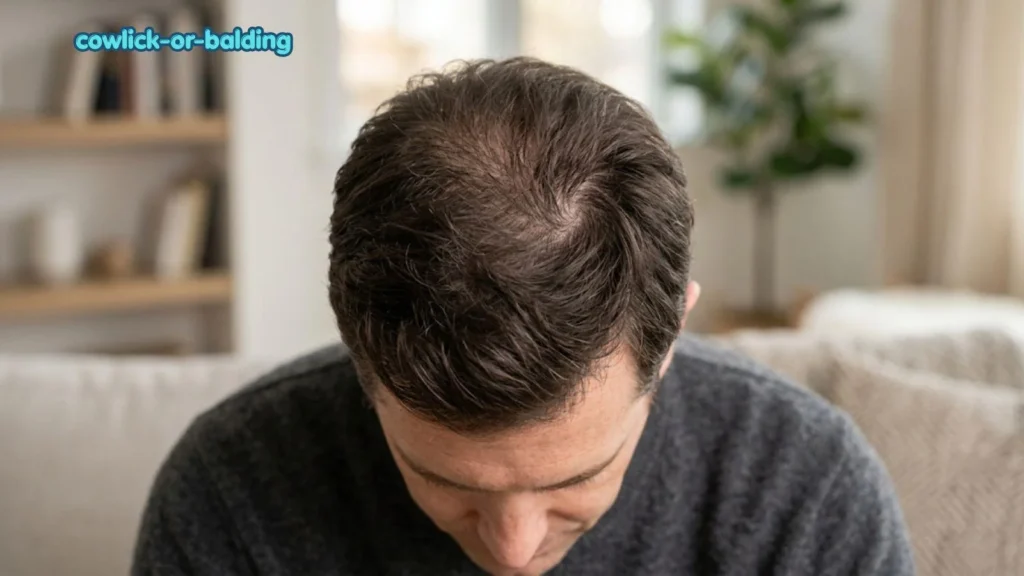
Seeing more scalp at the crown can be worrying. Is it simply a cowlick, or is it an early sign of balding? These two can look surprisingly similar, especially after a short haircut, when hair is wet, or under bright light.
People search for “cowlick or balding” because a cowlick can create a visible patch of scalp. The hair grows in a swirl, so the strands separate and expose the skin underneath. Early hair loss can also make the scalp more visible, but for a different reason: there is less hair density.
The most important clue is change over time. A cowlick is a natural hair-growth pattern and usually stays stable. Balding involves progressive hair loss and may cause the crown or hairline to become thinner over months or years.
This guide explains the difference in simple terms, shows common signs, and explains when it may be worth getting professional advice.
Cowlick or Balding – Quick Answer
A cowlick is a natural section of hair that grows in a different direction, often forming a swirl at the crown or hairline. It can expose some scalp without meaning that you are losing hair.
Balding means hair loss or progressive thinning. The hair may become finer, the scalp may become more visible, and the affected area can gradually expand.
| Feature | Cowlick | Balding |
|---|---|---|
| What it is | Natural hair-growth pattern | Hair loss or thinning |
| Hair direction | Swirls or points in another direction | Usually not defined by a swirl |
| Hair density | Usually normal | Often reduced |
| Scalp visibility | Can be visible at the center of the swirl | Often increases over time |
| Changes over time | Usually stable | Often progresses |
| Common location | Crown, hairline, forehead | Crown, temples, hairline |
| Usually needs treatment? | No | Sometimes |
Simple rule: A cowlick changes how your hair grows. Balding changes how much hair you have.
The Origin of Cowlick or Balding
Unlike spelling comparisons such as colour vs color, “cowlick or balding” is not a British-versus-American spelling question. These are two different terms describing different hair conditions.
The word cowlick dates back to the late 1500s. The name comes from the idea that a section of hair resembles the pattern left after a cow licks its calf. Collins lists the word’s origin as “cow + lick” and dates it to around 1590–1600.
A cowlick is essentially an unruly lock or section of hair that grows differently from surrounding hair.
The word balding comes from bald and refers to the process of losing hair. Baldness commonly refers to excessive scalp hair loss, with hereditary hair loss being a major cause.
So, the terms have different meanings:
- Cowlick: a natural hair-growth direction or pattern.
- Balding: a reduction or loss of hair.
- Cowlick or balding: a question people ask when the two appearances are difficult to distinguish.
British English vs American English Spelling
There is no major British-American spelling difference between cowlick and balding. Both forms are used in British and American English.
| Term | British English | American English | Meaning |
|---|---|---|---|
| Cowlick | Cowlick | Cowlick | Hair that grows in a different direction |
| Balding | Balding | Balding | Gradual hair loss or thinning |
| Hair loss | Hair loss | Hair loss | Loss or reduction of hair |
| Hair whorl | Hair whorl | Hair whorl | Spiral pattern of hair growth |
Cambridge and Oxford both list cowlick as an English word, while Collins provides both British and American definitions.
Therefore, you do not need to change the spelling depending on whether your readers are in the United States or the United Kingdom.
Which Spelling Should You Use?
Use cowlick when you mean a natural section of hair that grows in a different direction.
Use balding when you mean progressive hair loss or thinning.
For a US audience:
“Is this a cowlick or balding?”
For a UK audience:
“Is this a cowlick or balding?”
Both are correct.
For a global website, these same terms work well. You may also use related phrases such as hair whorl, crown thinning, bald spot, and hair loss to make the explanation clearer.
If you are unsure about your own hair, avoid diagnosing yourself from one photograph. Compare photographs taken under similar lighting over time. A dermatologist can assess whether genuine hair thinning is occurring.
Common Mistakes with Cowlick or Balding
Several common assumptions can make a normal cowlick look like hair loss.
Mistake 1: Assuming visible scalp always means balding
A cowlick can separate the hair and reveal the scalp underneath. Wet hair, short hair, and bright lighting can make this even more noticeable.
Mistake 2: Looking at only one photograph
One photograph cannot reliably show whether hair is getting thinner. Changes over time are more useful.
Mistake 3: Thinking a cowlick causes baldness
A cowlick is a growth pattern. It does not automatically mean that you are developing hair loss. However, someone can naturally have a cowlick and later experience hair loss.
Mistake 4: Confusing direction with density
This is one of the easiest ways to remember the difference:
Cowlick = direction.
Balding = density.
Mistake 5: Ignoring progressive changes
If the crown becomes increasingly thin, the hairline keeps receding, or individual hairs become noticeably finer, professional evaluation may be appropriate. Hair loss can have several causes, so identifying the cause matters before choosing treatment.
Cowlick or Balding in Everyday Examples
In an Email
“I have noticed a swirl at the crown. Could it be a cowlick rather than balding?”
In News Writing
“Experts explain how consumers can distinguish a natural cowlick from signs of hair thinning.”
On Social Media
“I thought I was balding, but I think it is just my cowlick.”
In Formal Writing
“A cowlick is a natural hair-growth pattern, whereas balding involves hair loss or progressive thinning.”
In Everyday Conversation
“My crown looks thin, but it has always had that cowlick.”
These examples show that cowlick and balding should not be used as synonyms. One describes the direction of hair growth; the other describes hair loss.
Cowlick or Balding – Google Trends & Usage Data
People commonly search phrases such as:
- “cowlick or balding”
- “cowlick vs balding”
- “am I balding”
- “cowlick bald spot”
- “crown cowlick”
- “balding crown”
- “hair swirl or balding”
The search intent is usually practical rather than linguistic. People want to know whether visible scalp at the crown is normal or a possible sign of hair loss.
Recent online discussions also show repeated questions about whether a visible crown is a normal cowlick or developing thinning.
It is important not to invent exact Google Trends percentages from search results. Google Trends uses relative search interest, rather than publishing a simple worldwide count of searches. Interest can also vary by country, season, language, and related search terms.
For SEO, the broader topic is useful because it connects several related searches:
cowlick → hair whorl → crown → bald spot → hair thinning → balding
This means content targeting “cowlick or balding” can naturally answer several closely related user questions.
Cowlick vs Balding Comparison Table
| Question | Cowlick | Balding |
|---|---|---|
| Is it a natural hair pattern? | Yes | No |
| Is hair actually being lost? | Usually no | Yes |
| Can it show scalp? | Yes | Yes |
| Is there usually a swirl? | Often | Not necessarily |
| Does it stay stable? | Usually | Often changes |
| Can it become more noticeable after a haircut? | Yes | Yes |
| Can wet hair make it look worse? | Yes | Yes |
| Does it automatically mean hair loss? | No | Yes |
| Should you monitor changes? | Helpful | Important |
| May medical advice be useful? | Usually unnecessary | Yes, if progressive |
The key distinction is stability versus progression. A stable hair pattern is more consistent with a cowlick. Progressive thinning deserves closer attention.
FAQs
1. How can I tell if I have a cowlick or balding?
Look for changes over time. A cowlick usually creates a stable swirl with normal-looking hair density. Balding tends to involve progressive thinning or loss of hair.
2. Does a cowlick mean I am balding?
No. A cowlick is a natural hair-growth pattern and does not by itself mean you are balding.
3. Can a cowlick look like a bald spot?
Yes. Because the hair separates around a swirl, the scalp can become visible in the center. This is one reason cowlicks are often confused with balding.
4. Can a cowlick turn into balding?
A cowlick itself does not turn into balding. However, someone can have a cowlick and separately develop hair loss later.
5. Is a visible crown always a sign of hair loss?
No. A visible crown can result from a natural cowlick, hair direction, short hair, wet hair, or lighting. Increasing visibility combined with progressive thinning is more concerning.
6. Does balding happen only at the crown?
No. Hair loss can affect different areas. Pattern hair loss commonly involves the hairline, temples, or crown, depending on the person.
7. When should I see a dermatologist?
Consider professional advice if you notice rapidly increasing hair loss, significant thinning, a widening bald area, sudden patchy loss, or other scalp changes. A healthcare professional can help identify the cause instead of relying on appearance alone.
Conclusion
The difference between cowlick or balding is easier to understand once you focus on what is actually changing. A cowlick is a natural pattern in which hair grows in a swirl or different direction. It can expose a small amount of scalp and become more noticeable after a haircut, when hair is wet, or under bright light.
Balding is different. It involves actual hair loss or thinning, and the affected area may gradually become larger or more noticeable. Hereditary hair loss is one common cause of baldness, but hair loss can have many possible causes.
The simplest rule is direction versus density: a cowlick changes the direction of your hair, while balding reduces hair density. If the same area has looked similar for years, a cowlick is more likely. If you notice progressive thinning or increasing scalp visibility, consider speaking with a dermatologist.
There is also no British-versus-American spelling issue here. Cowlick and balding are spelled the same in both varieties of English, so either form is suitable for a global audience.