Many people search for “whos or whose” because the two words look almost the same. They sound alike too. This makes them easy to mix up in writing. Students, bloggers, office workers, and even native English speakers often pause before typing one of these words.
The confusion usually happens because English has many words with apostrophes and possessive forms. Some people think “who’s” and “whose” follow the same rule, but they do not. One form is a contraction, while the other shows ownership.
|See also Address vs Adress
If you have ever asked yourself, “Should I write whos, whose, or who’s?” this guide will help. You will learn the quick answer, the history behind the words, common mistakes, and real-life examples.
You will also see the difference between British and American English usage. By the end, you will know exactly which spelling to use in emails, social posts, school work, and professional writing.
Whos or Whose – Quick Answer
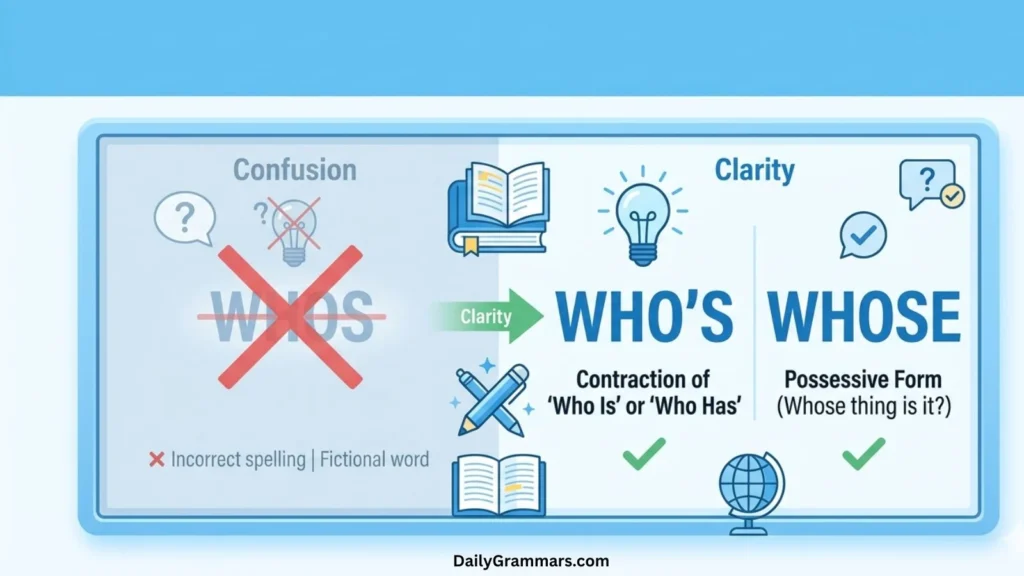
The correct word is usually whose or who’s.
“Whos” without an apostrophe is not standard English.
Quick Rule
| Word | Meaning | Example |
|---|---|---|
| Whose | Shows ownership | Whose phone is this? |
| Who’s | Short for “who is” or “who has” | Who’s coming tonight? |
| Whos | Incorrect spelling | ❌ Whos car is outside? |
Easy Test
Replace who’s with who is.
- Who’s ready? → Who is ready? ✅
- Whose jacket is this? → Who is jacket is this? ❌
So the second sentence must use whose.
The Origin of Whos or Whose
The word whose comes from Old English. It was used to show ownership connected to a person. Over time, English spelling changed, but “whose” stayed almost the same.
The form who’s appeared later. It is a contraction made from:
- who + is
- who + has
English often uses apostrophes in contractions:
- it’s = it is
- she’s = she is
- who’s = who is
This is why many people get confused. In English, apostrophes can show possession or contraction. But in this case, whose is the possessive form, not “who’s.”
Why the Difference Exists
English grammar kept the older possessive form “whose.”
The apostrophe version became a shortcut for speech and informal writing.
British English vs American English Spelling
There is no major spelling difference between British and American English for whose and who’s. Both forms are used the same way in both regions.
However, writing style can differ slightly. British English may use more formal sentence structures, while American English often prefers shorter and simpler phrasing.
Comparison Table
| Usage | British English | American English |
|---|---|---|
| Possession | Whose bag is this? | Whose bag is this? |
| Contraction | Who’s calling? | Who’s calling? |
| Incorrect Form | Whos ❌ | Whos ❌ |
Example Sentences
- UK style: Whose flat are we visiting today?
- US style: Whose apartment are we visiting today?
The grammar stays the same.
Which Spelling Should You Use?
Your choice depends on meaning, not country.
Use “whose” when showing ownership
Examples:
- Whose keys are on the table?
- Do you know whose book this is?
Use “who’s” when you mean “who is” or “who has”
Examples:
- Who’s at the door?
- Who’s finished the report?
Best Advice by Audience
| Audience | Recommended Usage |
|---|---|
| US readers | Follow standard grammar rules |
| UK readers | Follow standard grammar rules |
| Commonwealth countries | Use the same rules |
| Global audience | Keep sentences simple and clear |
No matter where your audience lives, “whos” is usually incorrect.
Common Mistakes with Whos or Whose
Many writers make the same errors again and again.
Mistake 1: Using “whos” without an apostrophe
❌ Whos laptop is this?
✅ Whose laptop is this?
Mistake 2: Using “who’s” for possession
❌ Who’s shoes are these?
✅ Whose shoes are these?
Mistake 3: Forgetting the contraction rule
❌ Whose going to the party?
✅ Who’s going to the party?
Simple Memory Trick
- Whose = ownership
- Who’s = who is
Whos or Whose in Everyday Examples
In Emails
- Whose turn is it to present?
- Who’s joining the meeting today?
In News Writing
- Police are searching for the driver whose car hit the fence.
- The actor who’s starring in the film arrived today.
On Social Media
- Whose playlist is this? It’s amazing.
- Who’s online right now?
In Formal Writing
- The student whose project won received an award.
- The manager who’s leading the team spoke first.
Whos or Whose – Google Trends & Usage Data
Search data shows that many people type “whos or whose” into search engines every month. The confusion is common in countries where English is widely used.
Countries with High Search Interest
| Country | Common Search |
|---|---|
| United States | whos or whose |
| United Kingdom | whose meaning |
| Canada | who’s vs whose |
| Australia | whose grammar |
| India | whose examples |
Why People Search It
People usually want to:
- Fix grammar mistakes
- Improve school writing
- Write better emails
- Understand apostrophe rules
- Avoid embarrassing errors online
Usage Contexts
| Context | Most Common Form |
|---|---|
| Questions about ownership | Whose |
| Conversations | Who’s |
| Academic writing | Both correctly used |
| Casual typing | Often confused |
Comparison Table: Whos vs Whose vs Who’s
| Word | Correct? | Meaning | Example |
|---|---|---|---|
| Whos | ❌ No | Incorrect spelling | Whos car? |
| Whose | ✅ Yes | Shows ownership | Whose car is this? |
| Who’s | ✅ Yes | Who is / who has | Who’s driving? |
FAQs:
Is “whos” ever correct?
No. Standard English does not use “whos” as a correct spelling.
What is the difference between “whose” and “who’s”?
“Whose” shows ownership. “Who’s” means “who is” or “who has.”
How do I remember the difference?
Replace “who’s” with “who is.” If the sentence still works, use “who’s.”
Can “whose” refer to objects?
Yes.
Example: The company whose office closed moved online.
Do British and American English use different rules?
No. Both use the same grammar rules for “whose” and “who’s.”
Why do people confuse these words?
They sound the same when spoken, and apostrophe rules in English can be tricky.
Is “whose” formal or informal?
It works in both formal and informal writing.
Conclusion
The difference between “whos or whose” becomes simple once you know the rule. “Whose” is used for ownership, while “who’s” is a contraction for “who is” or “who has.” The spelling “whos” is not correct in standard English.
This small grammar point matters more than many people think. Correct usage helps your emails look professional, improves school assignments, and makes online writing clearer.
Since the words sound the same, many writers make mistakes without noticing. That is why learning the quick test can help so much. Just replace “who’s” with “who is.” If the sentence still makes sense, you have the correct word.
Whether you write for American, British, or global readers, the grammar rules stay the same. Keep your writing simple, check for ownership versus contraction, and avoid the incorrect “whos” spelling. With practice, choosing between “whose” and “who’s” will become natural and easy every time you write.