Have you ever typed “monkeys or monkies” and stopped to wonder which spelling is correct? You are not alone. This is a common spelling mistake because the word monkey ends in -ey, and English has several plural spelling patterns that can be confusing.
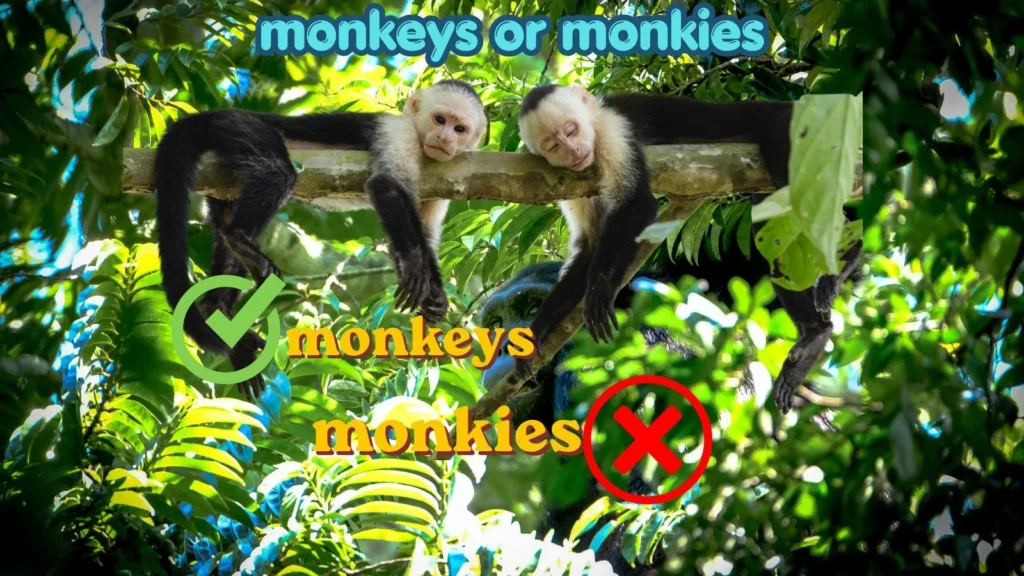
The good news is simple: monkeys is the correct plural spelling. Monkies is incorrect in standard English.
The confusion usually comes from words such as baby, city, and puppy. When these words end in a consonant followed by y, the y changes to ies in the plural: baby → babies and city → cities. Because monkey ends in y, some writers assume the same rule applies.
But monkey is different. The letter before y is a vowel, e, so the normal plural form simply adds s: monkey → monkeys.
This guide explains the difference between monkeys or monkies, shows the spelling rule, gives everyday examples, and answers common questions.
Monkeys or Monkies – Quick Answer
Monkeys is the correct spelling.
Monkies is a misspelling and should not be used in standard English.
| Singular | Correct plural | Incorrect plural |
|---|---|---|
| monkey | monkeys | monkies |
| donkey | donkeys | donkies |
| turkey | turkeys | turkies |
| valley | valleys | vallies |
| key | keys | kies |
Examples
- There are several monkeys in the zoo.
- The monkeys climbed the trees.
- We watched the monkeys playing.
- The documentary showed wild monkeys in the forest.
So, if you are choosing between monkeys or monkies, always use monkeys.
The Origin of Monkeys or Monkies
The word monkey has an interesting history. It appeared in English in the late Middle Ages, although its exact origin is uncertain. It may have developed from forms connected with older European words for monkeys or apes.
The plural is formed according to a common English spelling rule.
The singular word is:
monkey
It ends with -ey. When making the plural, English normally adds s:
monkey + s = monkeys
There is no need to change y to i.
This is different from words ending in a consonant + y.
For example:
- baby → babies
- city → cities
- country → countries
- puppy → puppies
The key difference is the letter immediately before y.
In monkey, the letter before y is e, a vowel. Therefore, the plural is monkeys.
British English vs American English Spelling
There is no British-American spelling difference between monkeys and monkies.
Both British English and American English use:
monkeys
The same spelling is also standard in other major varieties of English.
| English variety | Correct spelling | Incorrect spelling |
|---|---|---|
| American English | monkeys | monkies |
| British English | monkeys | monkies |
| Canadian English | monkeys | monkies |
| Australian English | monkeys | monkies |
| General international English | monkeys | monkies |
The spelling rule stays the same because monkey ends in a vowel + y.
Compare These Words
| Singular | Plural | Rule |
|---|---|---|
| monkey | monkeys | vowel + y → add s |
| boy | boys | vowel + y → add s |
| toy | toys | vowel + y → add s |
| baby | babies | consonant + y → change y to ies |
| city | cities | consonant + y → change y to ies |
| story | stories | consonant + y → change y to ies |
This pattern makes the spelling easier to remember.
Which Spelling Should You Use?
Use monkeys regardless of whether you are writing for an American, British, or international audience.
For American English
Write:
The monkeys are eating bananas.
For British English
Write:
The monkeys are climbing the trees.
For International Writing
Use:
The researchers observed several monkeys.
There is no reason to write monkies in formal or professional English.
If you are writing an essay, article, report, email, school assignment, website, or social media post, monkeys is the correct choice.
Common Mistakes with Monkeys or Monkies
1. Writing “monkies”
Incorrect:
The monkies were playing.
Correct:
The monkeys were playing.
The mistake happens when writers apply the baby → babies rule incorrectly.
2. Assuming every word ending in Y changes to IES
This is not true.
Words ending in a vowel + y usually form their plurals by adding s.
Examples:
- monkey → monkeys
- key → keys
- boy → boys
- day → days
- toy → toys
3. Confusing “monkeys” with a possessive
Monkeys means more than one monkey.
Monkey’s means something belongs to one monkey.
Example:
The monkeys are eating.
But:
The monkey’s food is on the ground.
For possession involving multiple monkeys, use monkeys’:
The monkeys’ habitat was recently renovated.
Monkeys or Monkies in Everyday Examples
Knowing the correct spelling is useful in many types of writing.
In Emails
The children enjoyed watching the monkeys at the zoo.
In News Writing
Several monkeys were rescued after being found near the road.
On Social Media
These monkeys are having way too much fun! 🐒
In Formal Writing
Researchers studied the behavior of monkeys in their natural habitat.
In School Assignments
Monkeys are intelligent animals that belong to the primate group.
A Website Content
Learn more about different species of monkeys and their natural habitats.
In every example, monkeys is the correct plural.
Monkeys or Monkies – Comparison Table
Here is a quick side-by-side comparison:
| Feature | Monkeys | Monkies |
|---|---|---|
| Correct spelling | ✅ Yes | ❌ No |
| Standard English | ✅ Yes | ❌ No |
| American English | ✅ Yes | ❌ No |
| British English | ✅ Yes | ❌ No |
| Plural of monkey | ✅ Yes | ❌ No |
| Suitable for formal writing | ✅ Yes | ❌ No |
| Common spelling mistake | No | Yes |
The answer is clear: monkeys is the standard plural form.
Monkeys or Monkies – Google Trends & Usage Data
Searches for “monkeys or monkies” usually come from people checking whether the plural of monkey follows the same spelling pattern as words such as baby and city.
Search interest can vary by country, language-learning context, and educational needs. English learners may search for the spelling because the -y → -ies rule appears frequently in basic English grammar.
The important point is that search popularity does not change the spelling rule. Across English-language usage, monkeys is the established standard spelling, while monkies is generally treated as an error.
Google Trends can be useful for seeing where people search for a spelling question, but it should not be used as a dictionary. A frequently searched spelling is not automatically a correct spelling.
FAQs About Monkeys or Monkies
1. Is it monkeys or monkies?
Monkeys is correct. Monkies is an incorrect spelling.
2. Why is monkey pluralized as monkeys?
Because monkey ends in a vowel followed by y. The plural is formed by adding s.
monkey → monkeys
3. Does the Y change to I in monkeys?
No. The y stays unchanged.
Correct:
monkeys
Incorrect:
monkies
4. Is “monkies” ever correct?
In standard English, monkies is not the correct plural of monkey. It may appear as an intentional name, username, brand, or other proper label, but that does not make it the standard plural spelling.
5. What is the singular of monkeys?
The singular is monkey.
- One monkey
- Two monkeys
6. What is the possessive form of monkeys?
For one monkey, use monkey’s:
The monkey’s food.
For several monkeys, use monkeys’:
The monkeys’ food.
7. Why is baby → babies but monkey → monkeys?
Because baby ends in consonant + y, while monkey ends in vowel + y.
- baby → babies
- monkey → monkeys
This is the main spelling rule to remember.
Conclusion
When choosing between monkeys or monkies, the correct answer is simple: monkeys. The spelling monkies is a common mistake, but it is not the standard plural form of monkey.
The reason is based on a basic English spelling rule. When a word ends in a vowel followed by y, the plural is normally made by adding s. Since monkey ends in -ey, we write monkeys. The y does not change to i.
This is different from words such as baby, city, and puppy. These words end in a consonant followed by y, so their plurals change y to ies: babies, cities, and puppies.
Whether you use American English, British English, or another standard variety of English, monkeys is the spelling to use. Remember the simple pattern: monkey → monkeys.