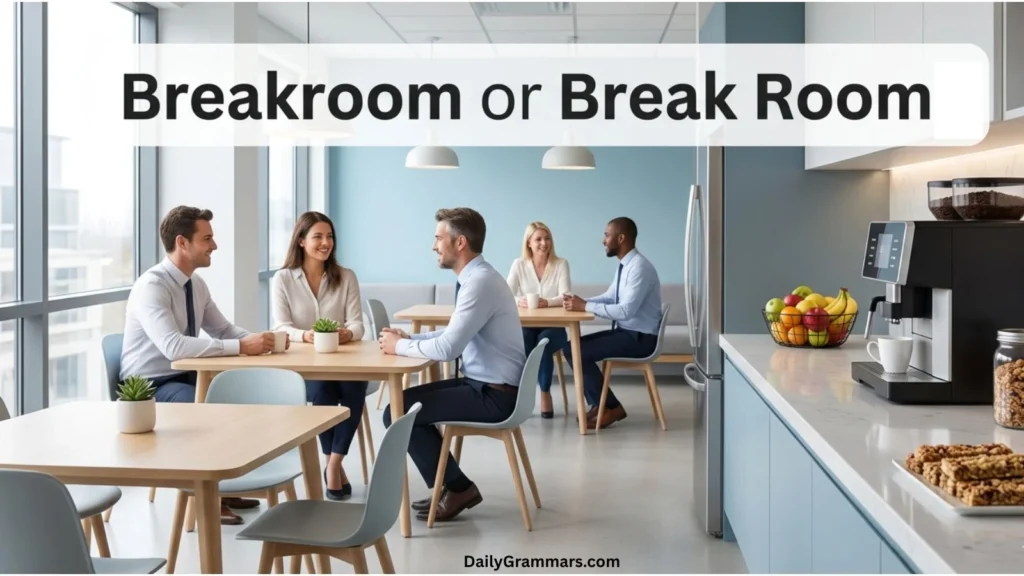
Have you seen the words “breakroom” and “break room” and wondered which one is right? You are not alone. Many people search for this keyword because both spellings appear online, in office signs, and even in company documents.
Some websites use “breakroom” as one word, while others prefer “break room” as two words.This confusion happens because English changes over time.
|See more Success vs Succes
Compound words often begin as two separate words and later become one word. Think about “web site” becoming “website.” The same thing is happening with “break room” and “breakroom.”
People search this keyword to learn the correct spelling for emails, workplace policies, blogs, job posts, and professional writing. They also want to know which version looks more natural in American English and British English.
In this guide, you will get a quick answer, spelling rules, real examples, common mistakes, and advice on which spelling you should use for your audience.
Breakroom or Break Room – Quick Answer
The most common and widely accepted spelling is “break room” as two words.
Example:
- Employees can relax in the break room during lunch.
However, “breakroom” as one word is also used, especially in:
- Brand names
- Informal writing
- Modern workplace apps and websites
Example:
- The company redesigned its breakroom area.
Quick Comparison Table
| Variation | Correct? | Common Usage |
|---|---|---|
| Break room | Yes | Standard and professional writing |
| Breakroom | Yes, less common | Informal or branding use |
The Origin of Breakroom or Break Room
The term “break room” comes from workplaces where employees take short breaks during work hours. The phrase combines:
- “Break” = rest period
- “Room” = physical space
At first, English speakers used the phrase as two separate words:
- break room
Over time, many compound nouns in English become one word. This is why some people now write:
- breakroom
The same language pattern happened with:
- Living room → still two words
- Classroom → one word
- Lunch room → lunchroom
The spelling difference exists because English spelling evolves slowly. Some dictionaries still prefer “break room,” while modern companies sometimes use “breakroom.”
British English vs American English Spelling
Both American and British English usually prefer “break room” as two words. Still, American workplaces use the term more often because office break rooms are common in US company culture.
British English may also use:
- staff room
- common room
Spelling Comparison Table
| English Style | Preferred Form | Notes |
|---|---|---|
| American English | Break room | Most common |
| British English | Break room | Less common term overall |
| Canadian English | Break room | Standard form |
| Australian English | Break room | Often replaced with “staff room” |
| Informal/Branding | Breakroom | Growing online use |
Examples
| Region | Example Sentence |
|---|---|
| US | The snacks are in the break room. |
| UK | Staff members met in the break room. |
| Australia | Employees relaxed in the staff room. |
Which Spelling Should You Use?
The best spelling depends on your audience.
Use “Break Room” If:
- You write formal documents
- You create workplace policies
- You publish professional blogs
- Your audience is in the US, UK, Canada, or Australia
Use “Breakroom” If:
- You use it as a brand name
- Your company already uses it
- You want a modern or casual style
Best Advice for Global Audiences
For SEO, professional writing, and clarity, “break room” is the safer choice because more people recognize it.
Common Mistakes with Breakroom or Break Room
Many writers make small errors with this term.
Incorrect Capitalization
❌ break Room
✅ break room
Wrong Hyphen Usage
❌ break-room
✅ break room
Mixing Spellings
❌ The break room was updated and the breakroom got new chairs.
✅ The break room was updated and got new chairs.
Using It as One Word in Formal Writing
❌ Please clean the breakroom daily.
✅ Please clean the break room daily.
Breakroom or Break Room in Everyday Examples
In Emails
- Please leave your dishes in the break room sink.
- The new coffee machine is in the break room.
In News Articles
- The company opened a larger break room for employees.
On Social Media
- Our office breakroom now has free snacks!
In Formal Writing
- Employees must keep the break room clean at all times.
In Job Listings
- Modern office with a large break room and lounge area.
Breakroom or Break Room – Google Trends & Usage Data
Search data shows that “break room” is much more popular than “breakroom.”
Most Common Countries Using “Break Room”
- United States
- Canada
- United Kingdom
- Australia
Where “Breakroom” Appears More Often
- Company brands
- Interior design websites
- Workplace apps
- Social media posts
Why “Break Room” Wins in Search
People usually type words separately in search engines because dictionaries and professional writing guides still prefer the two-word form.
Usage Comparison Table
| Keyword Version | Search Popularity | Common Context |
|---|---|---|
| Break room | High | Professional and general use |
| Breakroom | Medium | Branding and casual use |
FAQs:
How do you spell breakroom?
Both are used: “break room” (two words) is standard, while “breakroom” is also common in modern informal or branding use.
What is a breakroom?
A breakroom is a workplace room where employees rest, eat, or take short breaks.
What is another name for a breakroom?
It is also called a staff room, lunch room, or rest area.
Is breakout room one word or two?
“Breakout room” is two words.
Is lunchroom two words?
No, it is usually one word: “lunchroom.”
Is there a hyphen in break in?
No hyphen. It is written as “break in” (two words).
Conclusion
The spelling debate between “breakroom” and “break room” is a good example of how English changes over time. Today, the two-word version, “break room,” remains the most common and professional choice. It appears more often in dictionaries, workplace documents, blogs, and search results.
The one-word form, “breakroom,” is still valid in some cases. Many modern brands, office design companies, and online platforms use it because it feels shorter and more modern. Still, it is less formal and less widely accepted.
If you write for business, education, or global audiences, use “break room.” It is clearer and safer for professional communication. If you create branding or casual content, “breakroom” may fit your style better.
For the best SEO results, include both spellings naturally in your content. This helps readers find your page no matter which version they search online.