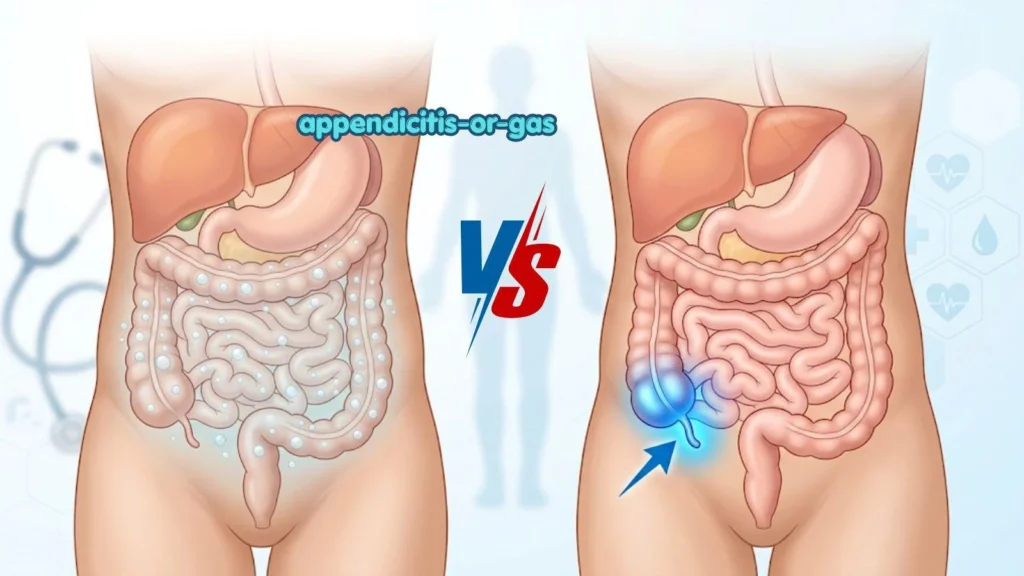
Stomach pain can be confusing. Appendicitis or gas may cause pain, bloating, nausea, or discomfort, but they are not the same problem. Gas often causes temporary pain that moves around or improves after passing gas or having a bowel movement. Appendicitis can cause pain that becomes stronger and often moves to the lower right side of the abdomen.
People search for “appendicitis or gas” because early symptoms can look similar. It is easy to wonder whether stomach pain is something minor or a sign of a medical emergency. Knowing the common differences can help you understand what may be happening.
However, symptoms alone cannot confirm appendicitis. Appendicitis can become serious if the appendix ruptures. Severe or worsening abdominal pain, especially with fever, vomiting, or marked tenderness, needs prompt medical attention.
This guide explains the differences between appendicitis and gas, common symptoms, warning signs, and when professional medical care is needed.
Appendicitis or Gas – Quick Answer
Gas commonly causes bloating, pressure, cramps, and abdominal discomfort. The pain may move around and may improve after passing gas or having a bowel movement.
Appendicitis is inflammation of the appendix. Pain often starts around the belly button and may later move to the lower-right abdomen. The pain usually becomes more constant and severe.
| Feature | Gas | Appendicitis |
|---|---|---|
| Pain | Often crampy or pressure-like | Often becomes constant and stronger |
| Location | Can occur in different areas | Often moves toward the lower-right abdomen |
| Bloating | Common | May occur |
| Passing gas | May provide relief | Usually does not resolve the pain |
| Fever | Usually absent | May occur |
| Nausea/vomiting | Possible | Common |
| Appetite | Usually normal or mildly affected | Loss of appetite is common |
| Medical urgency | Usually not an emergency | Can require urgent treatment |
These patterns are not a diagnosis. Appendicitis can present differently from person to person.
The Origin of Appendicitis or Gas
The two terms describe very different things.
Appendicitis comes from appendix, referring to the appendix, plus the medical suffix -itis, which means inflammation. Therefore, appendicitis literally refers to inflammation of the appendix.
The word gas has a much broader history. In everyday health language, gas refers to air or other gases in the digestive tract. Gas can build up when people swallow air or when bacteria in the digestive system break down certain foods.
There is no spelling difference between British and American English for appendicitis or gas. The terms are spelled the same in both varieties of English.
The confusion behind the keyword is therefore not mainly a spelling issue. It is a symptom-identification question: people want to know whether abdominal pain could be caused by ordinary digestive gas or something more serious, such as appendicitis.
British English vs American English Spelling
Unlike words such as colour/color or centre/center, appendicitis and gas have the same spelling in British and American English.
| Term | British English | American English |
|---|---|---|
| Appendicitis | appendicitis | appendicitis |
| Gas | gas | gas |
| Appendix | appendix | appendix |
| Abdominal pain | abdominal pain | abdominal pain |
So if you are writing about the medical condition, appendicitis is correct in both major forms of English.
The important distinction is not spelling. It is understanding what the words mean.
Which Spelling Should You Use?
Use appendicitis and gas regardless of whether your audience uses British or American English.
For a US audience:
- “Could this pain be appendicitis or gas?”
- “The patient was evaluated for possible appendicitis.”
For a UK or Commonwealth audience:
- “Could this pain be appendicitis or gas?”
- “The doctor checked for signs of appendicitis.”
For a global audience, these spellings are also appropriate.
If you are writing health content, clarity matters more than regional spelling. Avoid changing the medical term to an informal alternative that could confuse readers.
Common Mistakes with Appendicitis or Gas
Mistake 1: Assuming all abdominal pain is gas
Not all stomach pain is caused by gas. Persistent or worsening pain should not automatically be dismissed as digestive discomfort.
Better: Consider the pattern of symptoms and seek medical advice when warning signs appear.
Mistake 2: Assuming lower-right pain always means appendicitis
Lower-right abdominal pain can have many causes. Appendicitis is one possibility, but it cannot be diagnosed from location alone.
Better: Have unexplained or severe pain assessed by a healthcare professional.
Mistake 3: Waiting for every classic symptom
Not everyone with appendicitis has exactly the same symptoms.
Better: Pay attention to worsening pain and combinations of symptoms rather than waiting for a textbook pattern.
Mistake 4: Trying to diagnose yourself from a search result
Online information can help you understand symptoms, but it cannot replace an examination and appropriate testing.
Better: Contact a healthcare professional when symptoms are concerning.
Appendicitis or Gas in Everyday Examples
The phrase “appendicitis or gas” is often used when someone is trying to understand abdominal symptoms.
In an Email
“I have had persistent abdominal pain since yesterday and would like to know whether I should be evaluated.”
This is better than simply telling a doctor, “I think it is gas,” because it describes the problem without assuming the diagnosis.
In News Writing
A health article might discuss how abdominal pain can have several causes, including digestive problems and appendicitis.
On Social Media
People may post:
“How can you tell if abdominal pain is gas or something more serious?”
Such posts can start useful conversations, but social-media responses should not be treated as medical diagnoses.
In Formal Writing
A more precise sentence is:
“Gas may cause abdominal discomfort, while appendicitis can produce progressively worsening abdominal pain.”
Appendicitis or Gas – Google Trends & Usage Data
Search interest in “appendicitis or gas” reflects a common type of health-information query: people experiencing abdominal symptoms often search for possible explanations before deciding whether to seek medical care.
However, Google Trends measures search interest, not the number of people who actually have appendicitis or gas. A high search volume does not mean a condition is more common.
Interest can also vary by:
- Country
- Season
- News coverage
- Public health campaigns
- Search wording
- General interest in digestive health
- Awareness of appendicitis symptoms
Search terms may also differ between countries. For example, people may search for combinations such as “appendicitis symptoms,” “gas pain,” “appendix pain,” or “lower right abdominal pain.”
Because search interest changes over time, current Google Trends data should be checked directly for the country and date range being studied rather than treating a general trend as a permanent statistic.
Appendicitis vs Gas: Key Differences
Here is another quick comparison:
| Question | Gas | Appendicitis |
|---|---|---|
| Is it caused by digestive gas? | Yes | No |
| Can it cause cramps? | Yes | Yes, especially early on |
| Can it cause bloating? | Yes | Sometimes |
| Does pain often move? | It can | It may move from around the belly button toward the lower right abdomen |
| Does pain usually keep worsening? | Not typically | It can |
| Can fever occur? | Usually not | Yes |
| Can vomiting occur? | Sometimes | Yes |
| Can appetite decrease? | Sometimes | Commonly |
| Can it become dangerous? | Usually not | Yes, if untreated |
These are general patterns, not diagnostic rules.
When Abdominal Pain May Need Urgent Medical Attention
Seek urgent medical care if abdominal pain is severe, worsening, persistent, or accompanied by concerning symptoms.
Possible warning signs include:
- Increasing pain, particularly in the lower-right abdomen
- Fever
- Repeated vomiting
- Significant tenderness
- A swollen or rigid abdomen
- Loss of appetite together with worsening pain
- Difficulty walking or moving because of abdominal pain
- Feeling very unwell
Appendicitis can progress to a ruptured appendix, which is a serious complication. If you are concerned that your symptoms could represent appendicitis, it is safer to seek professional medical assessment rather than trying to distinguish it from gas at home.
FAQs About Appendicitis or Gas
1. How can I tell if my pain is gas or appendicitis?
Gas often causes bloating, pressure, or cramps that may improve after passing gas or having a bowel movement. Appendicitis often causes pain that becomes more persistent and severe. Symptoms can overlap, so only a healthcare professional can diagnose appendicitis.
2. Does appendicitis feel like gas?
It can initially feel similar to other types of abdominal discomfort. This is one reason people search for “appendicitis or gas.” Appendicitis may become more localized and painful as it progresses.
3. Can gas cause pain on the lower right side?
Yes. Gas can cause pain in different parts of the abdomen, including the right side. Location alone cannot establish whether the cause is gas or appendicitis.
4. Does passing gas rule out appendicitis?
No. Passing gas does not reliably rule out appendicitis. If pain continues, worsens, or occurs with other concerning symptoms, seek medical advice.
5. Does appendicitis always cause a fever?
No. Fever can occur with appendicitis, but its absence does not automatically rule it out.
6. Can appendicitis pain come and go?
Symptoms can vary, especially early in the illness. Persistent or worsening abdominal pain should be assessed rather than relying on whether the pain temporarily improves.
7. When should I see a doctor for abdominal pain?
Seek prompt medical care for severe or worsening abdominal pain, especially when it is accompanied by fever, vomiting, marked tenderness, or other signs of serious illness.
Conclusion
Understanding appendicitis or gas starts with recognizing that they are very different conditions. Gas is a common digestive problem that can cause bloating, pressure, and cramping. Appendicitis involves inflammation of the appendix and can cause abdominal pain that becomes increasingly severe, often moving toward the lower-right side.
The symptoms can overlap, especially early on. That makes self-diagnosis difficult. Passing gas or having a bowel movement may relieve gas-related discomfort, but these observations cannot reliably rule out appendicitis. Likewise, lower-right abdominal pain does not automatically mean that someone has appendicitis.
The words appendicitis and gas are spelled the same in British and American English, so the main issue is meaning rather than spelling. If abdominal pain is severe, persistent, or getting worse—or occurs with fever, vomiting, or significant tenderness—professional medical assessment is important. When appendicitis is possible, prompt evaluation can help prevent serious complications.