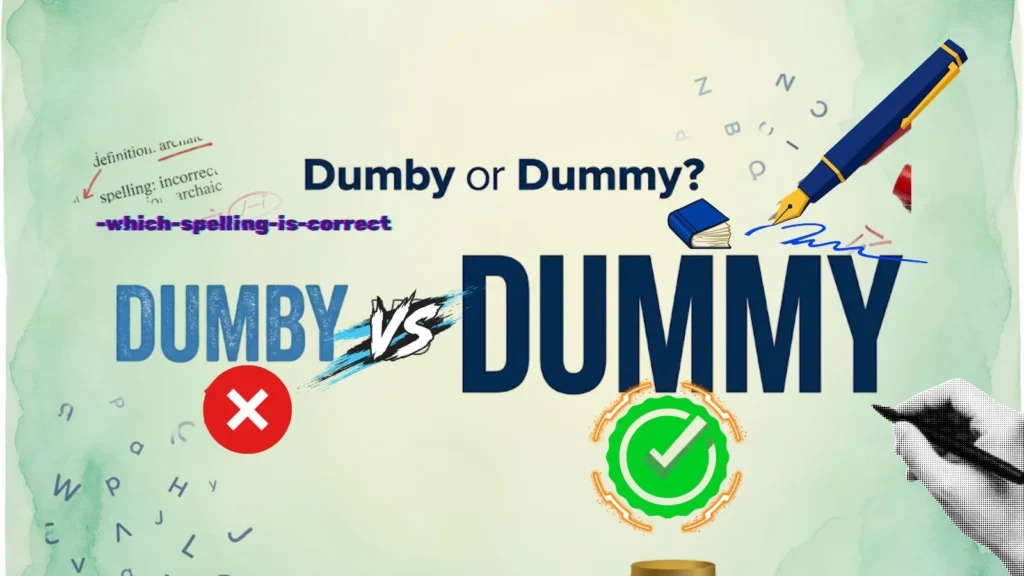
When you are unsure whether to write “dumby or dummy,” the answer is simple: dummy is the standard spelling in modern English. Dumby exists as a rare historical or alternative form, but it is not the normal spelling you should use in everyday, academic, business, or professional writing.
This confusion is understandable because dummy is historically connected with dumb, which contains a silent b. A writer may therefore think that adding -y should produce dumby. However, the established modern form developed as dummy, with two m’s and no b.
People search for “dumby or dummy” when writing emails, essays, websites, technical documents, or social media posts. They may also encounter both forms online and wonder whether the difference is related to British and American English.
In this guide, you will learn the correct spelling, word origin, British and American usage, common mistakes, everyday examples, and what search data can—and cannot—tell us about the two forms.
Dumby or Dummy – Quick Answer
Dummy is the standard spelling.
- ✅ dummy — standard modern English
- ⚠️ dumby — rare historical/alternative form; generally avoid
- ❌ dumy — incorrect
- ❌ dummie — incorrect as the standard singular spelling
- ✅ dummies — correct plural
Examples
- ✅ The engineers used a crash-test dummy.
- ❌ The engineers used a crash-test dumby.
- ✅ We created dummy data for testing.
- ❌ We created dumby data for testing.
- ✅ Please use the dummy account.
- ❌ Please use the dumby account.
Easy rule: If you mean the ordinary modern English word, write dummy.
| Spelling | Standard? | Use |
|---|---|---|
| dummy | Yes | Normal English |
| dumby | Rare/archaic | Usually avoid |
| dumy | No | Misspelling |
| dummie | No | Usually a misspelling |
| dummies | Yes | Plural |
The Origin of Dumby or Dummy
A word dummy comes historically from dumb + -y. Etymonline dates the noun dummy to the 1590s, when it referred to a person who could not speak. Later, the word developed additional meanings, including a figure representing a person and an imitation or substitute object.
The historical connection with dumb explains why people sometimes expect the spelling dumby. However, the modern standard spelling became dummy.
The word has developed several meanings over the centuries:
- An older term for a person who could not speak.
- An informal term for a foolish person.
- A model representing a person or object.
- A crash-test figure.
- A practice or training object.
- A substitute or nonfunctional object.
- Artificial or placeholder information, such as dummy data.
- In British English, a baby’s pacifier.
The rare spelling dumby has also appeared historically. Modern references list it as a rare alternative form rather than the normal spelling.
Why Isn’t It Spelled “Dumby”?
The spelling of dummy became established independently rather than simply being formed by writing dumb + y.
The b in dumb is silent in modern pronunciation. Over time, the established spelling of the related word became dummy, not dumby. Historical evidence shows that dumby has existed, but it is now uncommon and generally unsuitable for normal modern writing.
British English vs American English Spelling
There is no major British-versus-American spelling difference between dummy and dumby.
Both British and American English use dummy as the standard spelling.
The more noticeable difference is sometimes meaning, rather than spelling.
For example, British English commonly uses dummy for a baby’s pacifier, while American English usually uses pacifier.
| Feature | British English | American English |
|---|---|---|
| Standard spelling | dummy | dummy |
| Dumby as normal spelling | No | No |
| Crash-test figure | dummy | dummy |
| Model/mannequin | dummy | dummy |
| Foolish person | dummy | dummy |
| Baby’s pacifier | dummy | pacifier |
| Plural | dummies | dummies |
So, whether you are writing for readers in the UK, US, Canada, Australia, or elsewhere, dummy is the normal spelling.
Which Spelling Should You Use?
For almost every situation, use dummy.
For American English
Use:
The developer created a dummy account for testing.
The car was tested with a crash-test dummy.
For British English
Use:
The shop displayed the clothes on a dummy.
The baby dropped its dummy.
For International English
Dummy is the safest standard form.
Avoid dumby unless you are intentionally reproducing a historical spelling, quotation, username, fictional name, or another proper name that is officially spelled that way.
For professional writing, the simple rule is:
dummy = standard
dumby = generally avoid
Common Mistakes with Dumby or Dummy
Mistake 1: Writing “dumby”
❌ We created a dumby account.
✅ We created a dummy account.
The standard spelling has no b.
Mistake 2: Writing “dumy”
❌ The software uses dumy data.
✅ The software uses dummy data.
Remember the two m’s.
Mistake 3: Writing “dummie”
❌ The child dropped his dummie.
✅ The child dropped his dummy.
The standard singular form ends in -y.
Mistake 4: Getting the plural wrong
The plural of dummy is:
✅ dummies
Not:
❌ dummys
Mistake 5: Confusing “dumb” and “dummy”
These words are related, but they do not work in exactly the same way.
- dumb is commonly an adjective.
- dummy is commonly a noun and can also function as a modifier.
Examples:
That was a dumb mistake.
The engineer used a dummy model.
Mistake 6: Assuming “dumby” is the British spelling
It is not. British English also uses dummy as the standard spelling.
Dumby or Dummy in Everyday Examples
The word dummy appears in many different contexts.
In Emails
Please use the dummy account to test the new software.
In Business
The team prepared a dummy report before producing the final version.
In Technology
We used dummy data during application testing.
In Education
The teacher gave students a dummy example before the real exercise.
In News Writing
Investigators discovered that the device was only a dummy.
On Social Media
I created a dummy account to test the new feature.
In Formal Writing
The researchers included a dummy variable in their statistical model.
In Safety Testing
The vehicle was tested using a crash-test dummy.
These examples show why dummy is more than just an informal word. It is also established technical and professional vocabulary.
Dumby or Dummy – Google Trends & Usage Data
Google Trends can help show relative search interest, but it is important to understand what the data mean. Google Trends does not provide a simple count of all searches. Instead, it normalizes search interest on a relative scale, with the highest point in a selected comparison represented as 100.
For “dumby or dummy,” the available search evidence should be interpreted carefully because dummy has many meanings. Searches for dummy can relate to:
- crash-test dummies
- mannequins
- dummy accounts
- dummy data
- dummy text
- statistics
- baby pacifiers
- card games
- informal descriptions of people
That means search interest for dummy does not represent only people asking about spelling.
The spelling itself is much clearer from dictionary and historical evidence: dummy is the established modern form, while dumby is rare and historical or nonstandard in ordinary modern usage.
What This Means for SEO
If your target keyword is “dumby or dummy,” use the exact phrase naturally in the title, introduction, headings, and relevant sections.
However, throughout the article, use dummy when referring to the standard word.
Do not repeatedly write dumby simply to increase keyword usage. Search-friendly content should still use correct English.
Comparison Table: Dumby vs Dummy
| Word | Standard Modern Spelling? | Meaning/Use | Recommendation |
|---|---|---|---|
| dummy | ✅ Yes | Model, substitute, placeholder, etc. | Use |
| dumby | ⚠️ Rare/archaic | Historical or alternative form | Usually avoid |
| dumy | ❌ No | Misspelling | Avoid |
| dummie | ❌ No | Common spelling error | Avoid |
| dummies | ✅ Yes | Plural of dummy | Use |
The most important comparison is simple:
dummy = standard
dumby = rare/nonstandard in ordinary modern writing
FAQs About Dumby or Dummy
1. Is “dumby” or “dummy” correct?
Dummy is the standard spelling in modern English. Dumby is a rare historical or alternative form and is not normally used in professional writing.
2. Is “dumby” a real word?
Yes, dumby has appeared as a rare alternative form of dummy, including in historical sources. However, it is not the normal modern spelling.
3. Why is “dummy” spelled without the b?
Dummy is historically related to dumb, but its established modern spelling is dummy. English spelling does not always preserve every letter of a word’s historical source.
4. Is “dummy” correct in British English?
Yes. Dummy is the standard spelling in British English. British English also commonly uses dummy for a baby’s pacifier.
5. Is “dummy” correct in American English?
Yes. Dummy is also the standard American English spelling.
6. What is the plural of “dummy”?
The correct plural is dummies.
Example:
The store displayed several dummies.
7. Should I use “dumby” in formal writing?
Generally, no. Use dummy in essays, reports, emails, websites, business documents, and technical writing unless Dumby is intentionally being used as a proper name or quoted historical form.
Conclusion
When choosing between dumby or dummy, the standard modern answer is clear: dummy is the spelling you should normally use. It appears in everyday English as well as professional and technical language, including phrases such as dummy data, dummy account, dummy text, dummy variable, and crash-test dummy.
The confusion comes partly from the word’s relationship with dumb. Because dumb contains a silent b, it can seem logical to write dumby. However, the established modern spelling is dummy, with two m’s and no b. Historical sources do show dumby as a rare variant, but that does not make it the normal spelling today.
British and American English also agree on the spelling. Their main difference can be seen in particular meanings, such as the British use of dummy for a baby’s pacifier.
So, when in doubt, remember the simple rule: dummy is standard; dumby is usually not.