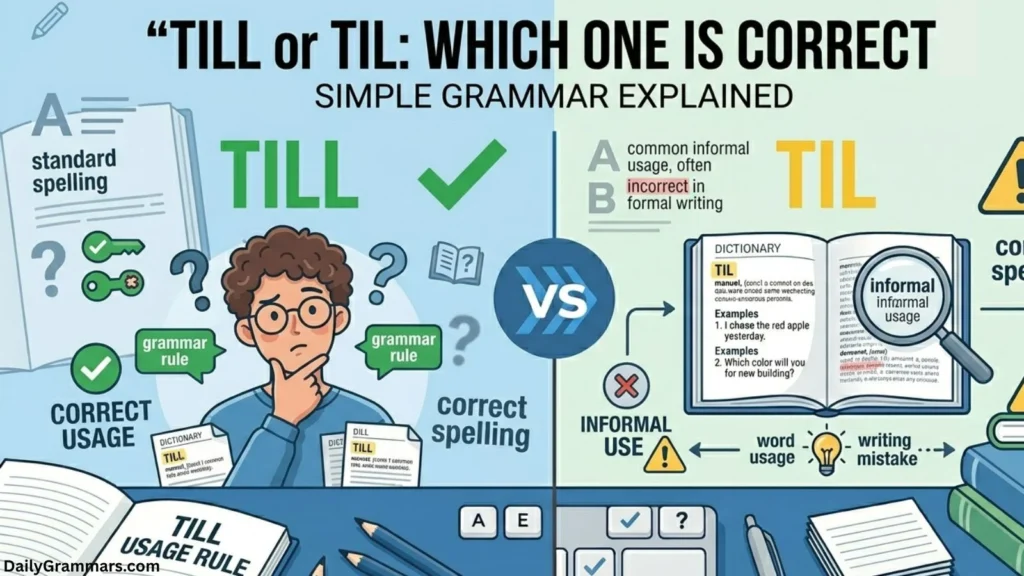
Many people search for “till or til” because both spellings appear online, in text messages, books, and even advertisements. One version looks formal, while the other seems shorter and modern. This creates confusion for students, writers, business professionals, and English learners.
|See also Curtesy or Courtesy
The good news is simple: “till” is the correct standard spelling, while “til” is usually considered informal or a shortened form. Some people also use “’til” with an apostrophe because it shows letters were removed from “until.”
This spelling question matters because using the wrong form can make your writing look less professional. In formal emails, school assignments, and business documents, choosing the right spelling helps your message look clear and polished.
In this guide, you will learn:
- The quick answer
- The history of “till” and “til”
- British vs American English rules
- Common mistakes
- Real-life examples
- Google Trends and usage data
- Expert advice on which spelling to use
By the end, you will know exactly when to use each version with confidence.
Till or Til – Quick Answer
“Till” is the standard and correct spelling in English.
“Til” is informal and less accepted in formal writing.
Correct Examples
- We stayed there till midnight.
- Wait till I call you.
Informal Examples
- I’ll be busy til Friday.
- Stay here til noon.
Best Rule
Use “till” in:
- Academic writing
- Business emails
- News articles
- Professional communication
Use “til” only in:
- Casual texting
- Social media
- Informal chat
The Origin of Till or Til
The word “till” is actually older than “until.” It comes from Old English and has been used for hundreds of years.
Many people think “till” is a shortened form of “until,” but that is not true. “Till” existed first.
Later, the word “until” became popular, and people began creating shorter forms like:
- until
- ’til
The spelling “’until” uses an apostrophe because letters are removed from “until.” However, many style guides still prefer “till.”
Why the Confusion Exists
People often assume:
- “Till” is incorrect
- “until” looks cleaner
- “’until” appears more modern
But dictionaries and grammar experts usually list “till” as the safest standard choice.
British English vs American English Spelling
Both British and American English accept “till.”
However, informal writing styles sometimes use “until” more often in the United States.
Main Difference
- British English strongly prefers “till”
- American English also prefers “till,” but informal “until” appears more online
Comparison Table
| Version | British English | American English | Formal Writing | Informal Writing |
|---|---|---|---|---|
| till | Common | Common | Yes | Yes |
| til | Rare | Sometimes used | No | Yes |
| ’til | Sometimes seen | Sometimes seen | Rarely | Yes |
Example Sentences
| Style | Example |
|---|---|
| British | We waited till evening. |
| American | Stay here till tomorrow. |
| Informal US | I’ll work til 5 PM. |
Which Spelling Should You Use?
The best spelling depends on your audience.
Use “Till” If:
- You write for work
- You create blog posts
- You write essays
- You send professional emails
- You want safe grammar
Use “Til” If:
- You text friends
- You post casually on social media
- You want a relaxed tone
Audience-Based Advice
| Audience | Best Choice |
|---|---|
| US business readers | till |
| UK readers | till |
| Commonwealth countries | till |
| Global audience | till |
| Casual social media followers | til |
Professional Recommendation
If you are unsure, always choose “till.”
Common Mistakes with Till or Til
Many writers make the same spelling mistakes.
Mistake 1: Thinking “Till” Is Wrong
❌ Incorrect idea: “Till is not a real word.”
✅ Truth: “Till” is fully correct and standard.
Mistake 2: Using “Til” in Formal Writing
❌ The report is due until Monday.
✅ The report is due till Monday.
Mistake 3: Confusing “Till” with the Cash Register Meaning
The word “till” can also mean a cash register.
Example
- The cashier opened the till.
- Wait till tomorrow.
Context changes the meaning.
Mistake 4: Overusing Apostrophes
❌ until
❌ ‘till
✅ till
✅ ’until (informal only)
Till or Til in Everyday Examples
Emails
- Please wait till the meeting starts.
- I’ll be away till next week.
News Writing
- The road will remain closed till Friday.
Social Media
- Can’t wait until summer!
- Working until midnight again.
Formal Writing
- The contract remains valid till December 31.
Casual Conversation
- Stay here till I return.
Till or Til – Google Trends & Usage Data
Search data shows that “till” is far more popular worldwide.
Usage by Region
| Country | More Common Form |
|---|---|
| United Kingdom | till |
| United States | till |
| Canada | till |
| Australia | till |
| India | till |
Online Trends
- “until” appears more in texting and social media.
- “Till” dominates books, news sites, and professional writing.
- Search engines usually recognize both forms, but grammar tools often suggest “till.”
Why “Til” Became Popular
People like shorter spellings online because they save time while typing.
Till vs Til Comparison Table
| Feature | till | til |
|---|---|---|
| Standard spelling | Yes | No |
| Formal writing | Recommended | Not recommended |
| Academic writing | Yes | No |
| Social media | Yes | Yes |
| Old English origin | Yes | No |
| Widely accepted | Yes | Limited |
FAQs:
Is “till” correct English?
Yes. “Till” is a correct and standard English word.
Is “til” a real word?
Yes, but it is informal and less accepted in professional writing.
Which is more formal: till or til?
“Till” is much more formal.
Should I use ’til with an apostrophe?
You can use it informally, but many editors still prefer “till.”
Do Americans use “til”?
Some Americans use it casually online and in text messages.
Is “till” older than “until”?
Yes. “Till” existed before “until.”
Which spelling should students use?
Students should use “till” in assignments and essays.
Conclusion
The debate over “till or until” is common because both spellings appear often in modern English. Still, the safest and most professional choice is clear: use “till.”
“Till” is the traditional spelling, and it has existed for centuries. It works in both British and American English, and it is accepted in formal, academic, and professional writing. In contrast, “until” is mostly informal and appears more in social media posts, text messages, and casual online conversations.
If your goal is clear and polished communication, “till” is the better option. It avoids grammar criticism and looks more professional to readers worldwide. While “until” may save one letter, it can weaken the tone of formal writing.
A simple rule can help:
- Use “till” for professional and public writing.
- Use “until” only for casual communication.
When in doubt, choose “till.” It is correct, trusted, and understood everywhere English is used.