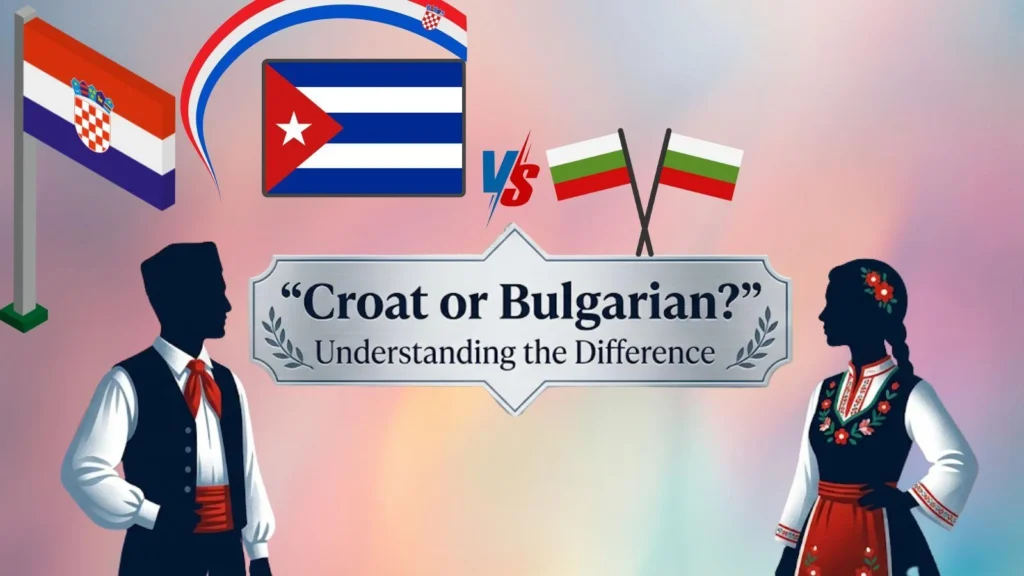
If you see the words Croat or Bulgarian, you may wonder whether they describe different spellings, languages, or nationalities. The answer is simple: Croat and Bulgarian refer to people connected with two different countries—Croatia and Bulgaria. They are not alternative spellings of the same word.
A Croat is a person from Croatia or a person belonging to the Croatian ethnic group. Bulgarian refers to a person from Bulgaria or, depending on context, something connected with Bulgarian culture, history, or language. These countries are both in southeastern Europe, but they have different national histories, languages, and cultural traditions.
People often search for “Croat or Bulgarian” when discussing nationality, ethnicity, history, sports, genealogy, travel, or language. The confusion can also come from the fact that both Croats and Bulgarians are South Slavic peoples, although that does not make the terms interchangeable.
This guide explains the difference, the origins of both words, correct usage, common mistakes, and how to use Croat and Bulgarian naturally in everyday English.
Seealso;211+ Crown vs Filling: Ultimate Guide You Need Today
Croat or Bulgarian – Quick Answer
Croat means a person from Croatia or a member of the Croatian ethnic group.
Bulgarian means a person from Bulgaria or something related to Bulgaria.
| Term | Refers to | Country | Example |
|---|---|---|---|
| Croat | A person/ethnic group | Croatia | “He is a Croat.” |
| Croatian | Country, people, culture, or language | Croatia | “She speaks Croatian.” |
| Bulgarian | A person, nationality, culture, or language | Bulgaria | “He is Bulgarian.” |
| Bulgaria | Country | Bulgaria | “Bulgaria is in southeastern Europe.” |
So:
- Croat → Croatia
- Bulgarian → Bulgaria
They are not interchangeable terms.
The Origin of Croat or Bulgarian
The two words have different historical origins.
Croat
The English word Croat comes from forms of the Slavic name Hrvat. Etymological sources trace the English noun to Serbo-Croatian Hrvat and earlier Slavic forms. The English word referring to a native or inhabitant of Croatia is recorded from the early 18th century.
The related adjective Croatian is used for things associated with Croatia, including the Croatian language and culture.
Interestingly, the English word cravat also has a historical connection to Croat. The term entered European languages in connection with Croatian soldiers and neckwear associated with them.
Bulgarian
Bulgarian comes from Bulgaria + -ian and has been used in English since the 16th century to refer to a native or resident of Bulgaria.
The deeper origin of the name Bulgaria is more complicated. One traditional explanation connects it with the Bulgars and the Volga region, while other proposed explanations connect the name with Turkic linguistic roots. The exact origin remains debated.
Therefore, the two words developed independently:
Croat → Hrvat → Croatia
Bulgarian → Bulgaria → Bulgarian
British English vs American English Spelling
Unlike pairs such as colour/color or organise/organize, Croat and Bulgarian are not British-versus-American spelling variants.
English speakers in both the United States and the United Kingdom normally use:
- Croat
- Croatian
- Bulgarian
- Croatia
- Bulgaria
There is no standard American spelling Bulgarien or British spelling Bulgarien, for example.
Comparison Table
| Meaning | British English | American English |
|---|---|---|
| Person from Croatia | Croat | Croat |
| Croatian adjective | Croatian | Croatian |
| Person from Bulgaria | Bulgarian | Bulgarian |
| Bulgarian adjective | Bulgarian | Bulgarian |
| Country | Croatia | Croatia |
| Country | Bulgaria | Bulgaria |
The main issue is therefore meaning and usage, not British versus American spelling.
Which Spelling Should You Use?
Choose the word based on the person or thing you are describing.
Use “Croat” for a person
Examples:
- “He is a Croat.”
- “Many Croats live in Croatia.”
- “The player is a Croat.”
Use “Croatian” for an adjective
Examples:
- “She enjoys Croatian food.”
- “They visited Croatian cities.”
- “He is learning Croatian.”
Use “Bulgarian” for a person or adjective
Examples:
- “She is Bulgarian.”
- “He is a Bulgarian citizen.”
- “They enjoy Bulgarian food.”
- “She speaks Bulgarian.”
A useful distinction is:
Croat = person/ethnic identity
Croatian = related to Croatia
For Bulgaria, Bulgarian commonly serves both the noun and adjective roles.
Common Mistakes with Croat or Bulgarian
Mistake 1: Treating Croat and Bulgarian as synonyms
Incorrect:
“A Croat and a Bulgarian are the same nationality.”
Better:
“A Croat is associated with Croatia, while a Bulgarian is associated with Bulgaria.”
Mistake 2: Saying “Croatian” when you mean the person
“Croatian” can describe a person in some contexts, but Croat is the specific noun for a member of the Croatian people.
Example:
“He is a Croat.”
For nationality, you can also say:
“He is Croatian.”
Mistake 3: Calling the Bulgarian language Croatian
Croatian and Bulgarian are different South Slavic languages.
Correct:
“She speaks Bulgarian.”
Correct:
“He speaks Croatian.”
Mistake 4: Confusing Croatia with Bulgaria
The countries are separate:
- Croatia → Croat/Croatian
- Bulgaria → Bulgarian
Mistake 5: Assuming similar regional identity means the same nationality
Croats and Bulgarians both have South Slavic linguistic and historical connections, but that does not make them the same nationality or ethnic group.
Croat or Bulgarian in Everyday Examples
Knowing how the terms work in real sentences makes the distinction easier.
In an email
“Our Croatian client will arrive on Monday.”
“Our Bulgarian client will arrive on Tuesday.”
In the news
“The Croatian team announced its new plans.”
“Bulgarian officials discussed the issue.”
On social media
“My friend is a Croat from Zagreb.”
“My colleague is Bulgarian.”
In formal writing
“The study examines Croatian cultural history.”
“The research focuses on Bulgarian historical sources.”
In travel writing
“Croatia is known for its Adriatic coastline.”
“Bulgaria is known for its Black Sea coast and historic cities.”
When discussing languages
“Croatian and Bulgarian are both South Slavic languages.”
This is more accurate than saying that Croatian and Bulgarian are simply different forms of the same language.
Croat or Bulgarian – Google Trends & Usage Data
Google Trends measures search interest, not the total number of speakers, people, or citizens associated with a term. It also reports relative interest rather than a simple worldwide search-count ranking. Google describes Trends as a tool for exploring what people are searching for and provides regional and time-based search-interest information.
For Croat or Bulgarian, search interest can vary greatly depending on context.
For example:
- Croat may appear in searches about Croatian people, football, history, genealogy, or the Balkans.
- Croatian is often more useful in searches about language, travel, food, culture, and Croatia itself.
- Bulgarian can refer to nationality, the Bulgarian language, culture, food, history, and travel.
- Sports events can create temporary increases in searches involving Croatian or Bulgarian teams and athletes.
Google Trends also shows that regional search behavior can differ substantially. Its current interface provides country-specific trend information rather than treating worldwide searches as one uniform audience.
For SEO, this means that “Croat or Bulgarian” is a comparison query, while terms such as “Croatian,” “Croat,” and “Bulgarian” can serve different search intents.
Croat vs Bulgarian: Side-by-Side Comparison
| Feature | Croat | Bulgarian |
|---|---|---|
| Associated country | Croatia | Bulgaria |
| Country location | Southeastern Europe | Southeastern Europe |
| Person noun | Croat | Bulgarian |
| Common adjective | Croatian | Bulgarian |
| Language | Croatian | Bulgarian |
| Country name | Croatia | Bulgaria |
| Language family | South Slavic | South Slavic |
| Capital | Zagreb | Sofia |
| Correct example | “He is a Croat.” | “He is Bulgarian.” |
| Incorrect substitution | Croat ≠ Bulgarian | Bulgarian ≠ Croat |
FAQs About Croat or Bulgarian
1. Is a Croat Bulgarian?
No. A Croat is associated with Croatia, while a Bulgarian is associated with Bulgaria.
2. Are Croat and Croatian the same?
They are closely related but serve different grammatical roles. Croat is primarily a noun for a person, while Croatian is commonly used as an adjective and for the Croatian language.
3. Is Bulgarian Croatian?
No. Bulgarian and Croatian are different South Slavic languages.
4. Are Croats and Bulgarians Slavic?
Yes. Both Croats and Bulgarians belong to South Slavic linguistic and historical traditions, although they have distinct national histories and cultures.
5. Should I say “Croat” or “Croatian”?
When referring specifically to a person as a noun, Croat is a precise choice: “He is a Croat.” Croatian is commonly used as an adjective: “He is Croatian.”
6. Is “Bulgarian” a nationality?
Yes. Bulgarian can refer to nationality and is also used as an adjective for things connected with Bulgaria.
7. Are Croat and Bulgarian different spellings?
No. They are not spelling alternatives. They refer to people and things connected with different countries.
Conclusion
The difference between Croat or Bulgarian is mainly about nationality, identity, and geographical association, not spelling. A Croat is a person associated with Croatia, while a Bulgarian is a person associated with Bulgaria. Croatia and Bulgaria are separate countries with their own histories, cultures, and languages.
The related adjective Croatian is used for things connected with Croatia, while Bulgarian commonly works as both a noun and an adjective. Croatian and Bulgarian are also separate South Slavic languages.
There is no important British-versus-American spelling difference in this comparison. English speakers generally use the same forms: Croat, Croatian, Bulgaria, and Bulgarian.
For professional writing, the safest approach is to choose the term based on what you mean. Use Croat when referring specifically to a Croatian person, Croatian for things connected with Croatia, and Bulgarian for people or things connected with Bulgaria. This keeps your writing clear, accurate, and easy to understand.