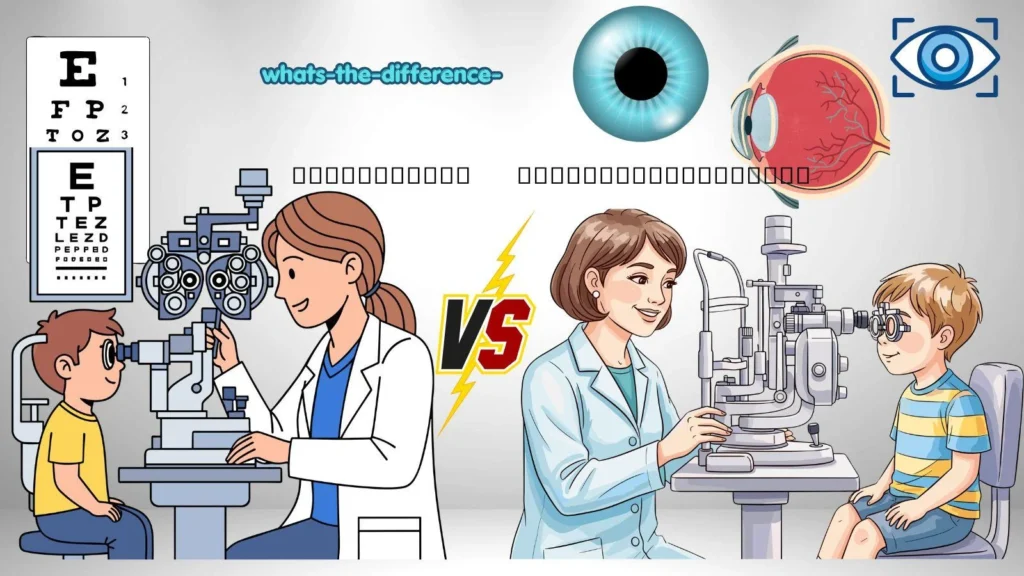
Choosing the right eye-care professional can be confusing. Should you visit an optometrist or ophthalmologist for an eye exam, blurry vision, glasses, or an eye disease?
These two professionals both care for the eyes, but their training and roles are different. An optometrist provides primary eye and vision care. An ophthalmologist is a medical doctor who specializes in medical and surgical eye care. In the United States, optometrists earn a Doctor of Optometry (O.D.) degree, while ophthalmologists complete medical school followed by residency training in ophthalmology.
People often search for “optometrist or ophthalmologist” because the terms sound similar and both professionals can perform eye examinations, diagnose problems, and prescribe vision correction. The key difference is the level and type of medical and surgical training.
This guide explains the difference in simple language. You will learn what each professional does, when to see one, how the terms are used in British and American English, common mistakes, and what search data tells us about these words.
Optometrist or Ophthalmologist – Quick Answer
An optometrist is an eye-care professional who examines vision, detects eye problems, prescribes glasses and contact lenses, and manages many eye conditions. Their exact scope of practice varies by location.
An ophthalmologist is a medical doctor who specializes in eye health. Ophthalmologists diagnose and treat eye diseases and can perform eye surgery.
| Optometrist | Ophthalmologist |
|---|---|
| Focuses heavily on vision and primary eye care | Provides medical and surgical eye care |
| Performs eye exams | Performs eye exams |
| Prescribes glasses and contacts | Can prescribe glasses and contacts |
| Detects many eye diseases | Diagnoses and treats eye diseases |
| May prescribe eye medicines, depending on local law | Can prescribe eye medicines |
| Surgical scope depends on jurisdiction | Performs eye surgery |
| May refer complex cases | Treats complex medical and surgical cases |
For example:
- Need a routine eye exam? An optometrist may be appropriate.
- Need a glasses prescription? An optometrist can usually help.
- Have a serious eye disease or need surgery? An ophthalmologist may be involved.
- Have a condition that requires specialist care? An optometrist may refer you to an ophthalmologist.
The exact division of care depends on the country and local licensing rules.
The Origin of Optometrist or Ophthalmologist
The two words come from different Greek roots.
Optometrist is built from Greek elements related to sight and measurement. The word reflects the traditional role of examining vision and measuring visual function.
Ophthalmologist comes from Greek ophthalmos, meaning eye, combined with a term associated with the study or medical specialty of the eye.
So, the words do not represent two spellings of the same profession. They are different professional titles.
This is important because “optometrist or ophthalmologist” is not like “color or colour,” where the difference is mainly regional spelling. Instead, the two terms identify different types of eye-care professionals.
In the United States, the Bureau of Labor Statistics classifies optometrists separately from ophthalmologists. Optometrists are doctors of optometry, while ophthalmologists are physicians specializing in eye care.
In the UK, the NHS also distinguishes between optometrists and ophthalmologists. It describes ophthalmologists as doctors specializing in the medical and surgical care of the eyes.
British English vs American English Spelling
There is no major British-versus-American spelling difference between these two professional titles.
The standard forms are:
- American English: optometrist, ophthalmologist
- British English: optometrist, ophthalmologist
- Canadian English: optometrist, ophthalmologist
- Australian English: optometrist, ophthalmologist
The spelling stays essentially the same across major English varieties.
| Term | American English | British English | Meaning |
|---|---|---|---|
| Optometrist | optometrist | optometrist | Eye-care professional focused on vision and eye health |
| Ophthalmologist | ophthalmologist | ophthalmologist | Medical doctor specializing in eye care |
| Optometry | optometry | optometry | Profession and field involving vision and eye care |
| Ophthalmology | ophthalmology | ophthalmology | Medical specialty dealing with the eyes |
Some related professional terminology can vary between healthcare systems. For example, the NHS commonly uses optometrist, ophthalmologist, and dispensing optician as distinct roles.
Therefore, if you are writing for a British audience, you generally do not need to change the spelling of either optometrist or ophthalmologist.
Which Spelling Should You Use?
Since the words are not regional spelling variants, choose the correct professional title based on the person or service you mean.
For a US audience
Use optometrist when referring to an optometrist and ophthalmologist when referring to a medical eye specialist.
For example:
I have an appointment with an optometrist.
Or:
The ophthalmologist recommended cataract surgery.
For a UK or Commonwealth audience
The same spellings are generally used.
The important difference is understanding the local healthcare system and scope of practice.
The NHS explains that optometrists examine eyes, test sight, detect abnormalities, and can prescribe and fit glasses and contact lenses. Ophthalmologists provide medical and surgical eye care.
For global writing
Use the exact professional title whenever possible.
If you are speaking casually, eye doctor may be understood by a broad audience. But it is less precise because it can refer to different types of eye-care professionals.
Common Mistakes with Optometrist or Ophthalmologist
Mistake 1: Treating them as two spellings
Incorrect idea:
“Optometrist” is the American version of “ophthalmologist.”
Correction: They are different professions.
Mistake 2: Assuming an optometrist only tests eyesight
Optometrists can do more than check whether you need glasses. Depending on jurisdiction, they can diagnose, manage, and treat various eye conditions.
Mistake 3: Assuming every optometrist has the same scope
Scope of practice varies by location. What an optometrist can prescribe or treat in one jurisdiction may differ elsewhere.
Mistake 4: Using “ophthalmologist” for every eye professional
An ophthalmologist is specifically a medical doctor specializing in eye care.
Mistake 5: Confusing an optometrist with an optician
An optician is different. Opticians typically fit and dispense glasses and contact lenses based on prescriptions from appropriate eye-care professionals.
Optometrist or Ophthalmologist in Everyday Examples
In an email
I have scheduled an appointment with an optometrist for a routine eye examination.
In a news article
The ophthalmologist performed surgery to treat the patient’s eye condition.
On social media
I finally visited an optometrist and got a new prescription for my glasses.
In formal writing
Patients with complex eye disease may require assessment by an ophthalmologist.
In a medical context
The optometrist identified an abnormality and referred the patient for specialist assessment.
In everyday conversation
I need to see an eye doctor.
“Eye doctor” is useful in casual speech, but optometrist and ophthalmologist are more precise when the professional role matters.
Optometrist or Ophthalmologist – Google Trends & Usage Data
Search behavior can help explain why people ask “optometrist or ophthalmologist.” However, Google Trends data should be treated as relative search interest, not an exact count of searches. Google Trends can also vary by country, time period, category, and search term selection.
Available search research shows that optometrist is strongly associated with routine vision care and contact lenses. A 12-month U.S. Google Trends analysis from April 2024 to April 2025 found that searches combining “contact lenses” with “optometrist” had substantially more relative interest than combinations with “optician” or “ophthalmologist.”
Other research has used Google Trends to study public demand for ophthalmology-related services, showing that search data can provide useful information about geographic patterns in patient interest.
Search intent also matters:
- “optometrist near me” → often indicates routine eye-care or vision services.
- “ophthalmologist near me” → may indicate specialist or medical eye care.
- “optometrist or ophthalmologist” → usually indicates confusion about which professional to choose.
- “ophthalmologist surgery” → suggests medical or surgical intent.
- “optometrist glasses” → suggests vision correction or an eye examination.
A historical Optometry Australia article also reported significant search interest for “optometrist” in Australia and noted that searches can reflect both local-provider intent and questions about the difference between optometrists and ophthalmologists.
Optometrist vs Ophthalmologist: Comparison Table
| Feature | Optometrist | Ophthalmologist |
|---|---|---|
| Routine eye examination | Yes | Yes |
| Vision testing | Yes | Yes |
| Glasses prescription | Yes | Yes |
| Contact lens prescription | Yes | Yes |
| Detects eye disease | Yes | Yes |
| Treats eye conditions | Yes, depending on jurisdiction | Yes |
| Medical doctor | No, in the physician sense in the US | Yes |
| Doctor of Optometry degree | Yes, in the US | No |
| Medical school | No, in the US pathway | Yes |
| Eye surgery | Depends on jurisdiction | Yes |
| Complex surgical eye care | Usually referred when outside scope | Yes |
| Can refer patients | Yes | Yes |
In the United States, an O.D. is a doctor of optometry but is not an M.D. or D.O. physician.
FAQs About Optometrist or Ophthalmologist
1. Is an optometrist the same as an ophthalmologist?
No. They are different eye-care professions. Optometrists focus on vision and primary eye care, while ophthalmologists are medical doctors who provide medical and surgical eye care.
2. Should I see an optometrist for glasses?
Yes. Optometrists commonly perform vision examinations and prescribe glasses and contact lenses.
3. Should I see an ophthalmologist for eye surgery?
Generally, an ophthalmologist is the relevant specialist for eye surgery because ophthalmologists have medical and surgical training.
4. Can an optometrist diagnose eye disease?
Yes. Optometrists are trained to detect and manage eye conditions, although their exact scope of diagnosis and treatment varies by jurisdiction.
5. Is “ophthalmologist” spelled differently in British English?
No major spelling change is required. Ophthalmologist is the standard spelling in both British and American English.
6. Is an optician the same as an optometrist?
No. An optician generally focuses on fitting and dispensing glasses and other optical products, while an optometrist provides eye examinations and vision and eye-health care.
7. Which one should I see?
It depends on your needs and local healthcare system. For routine vision care, an optometrist may be appropriate. For complex medical or surgical eye problems, an ophthalmologist may be involved. If you are unsure, an eye-care provider can help determine whether specialist referral is needed.
Conclusion
The difference between optometrist or ophthalmologist is about professional roles, not British versus American spelling. Both words are spelled essentially the same in major English varieties.
An optometrist provides eye and vision care, including eye examinations, vision testing, prescriptions, and management of many eye conditions. An ophthalmologist is a medical doctor specializing in eye diseases and surgical care. The exact services an optometrist can provide depend on local laws and professional regulations.
If you need glasses, contact lenses, or a routine eye examination, an optometrist may be the appropriate starting point. If you have a complex eye disease, serious eye problem, or need surgery, an ophthalmologist may provide the specialist medical care required.
For writing, use optometrist when you mean an optometrist and ophthalmologist when you mean an ophthalmologist. Do not treat them as alternative spellings. They describe different professional roles.
Understanding this distinction makes your writing more accurate and helps readers better understand which eye-care professional they may need.