Many writers search for “active voice vs passive voice” because they want clear and correct writing. Students, bloggers, business owners, and professionals often feel confused about which style sounds better.
Some people hear that passive voice is wrong. Others think active voice always sounds too direct. This confusion can make writing hard.
|See more Affect vs Effect
The good news is simple: both active and passive voice are useful. The key is knowing when to use each one. Active voice makes sentences clear and strong.
Passive voice shifts focus to the action or result. Understanding the difference helps improve emails, essays, reports, social posts, and even SEO writing.
For example:
- Active voice: “The team finished the project.”
- Passive voice: “The project was finished by the team.”
Both sentences are correct, but they create different effects.
This guide explains active voice vs passive voice in simple words. You will learn the meaning, history, spelling rules, examples, common mistakes, and best usage tips. By the end, you will know exactly which style to use and when.
Active Voice vs Passive Voice – Quick Answer
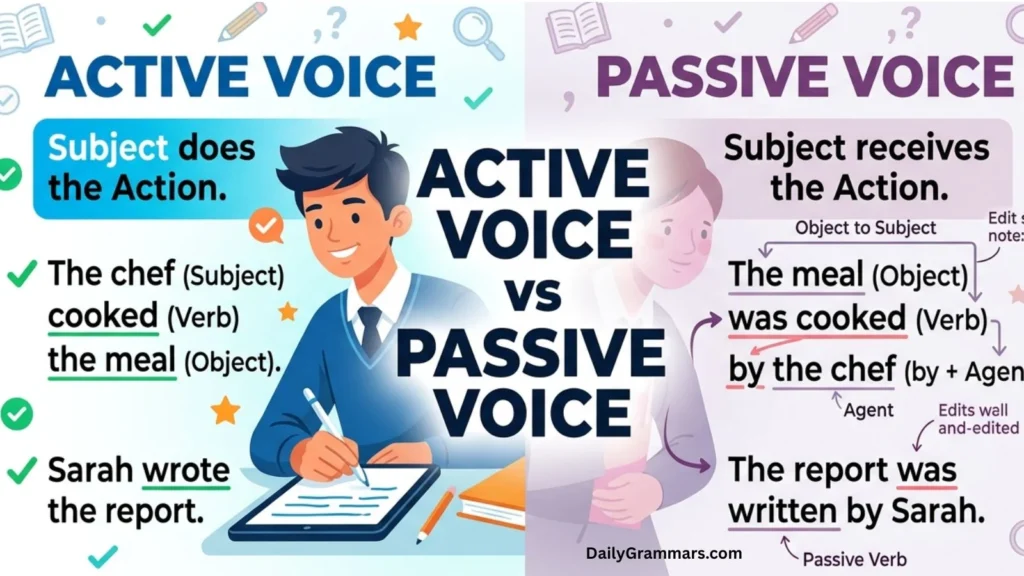
Active voice means the subject does the action.
Example:
- “Sarah wrote the email.”
Passive voice means the action happens to the subject.
Example:
- “The email was written by Sarah.”
Quick Comparison
| Active Voice | Passive Voice |
|---|---|
| Subject does the action | Subject receives the action |
| Clear and direct | Indirect and formal |
| Easier to read | Sometimes longer |
| Common in blogs and marketing | Common in science and reports |
Simple Rule
Use active voice when you want strong, clear writing.
Use passive voice when the action matters more than the person doing it.
The Origin of Active Voice vs Passive Voice
The terms “active voice” and “passive voice” come from Latin grammar. Ancient Roman scholars used these terms to explain sentence structure.
The word “active” comes from the Latin word activus, meaning “doing.” The word “passive” comes from passivus, meaning “receiving.”
English grammar adopted these ideas many centuries ago. Writers and teachers still use them today because they help explain how actions work in sentences.
Unlike words with spelling differences, “active voice” and “passive voice” are spelled the same in British English and American English. The main difference is not spelling. The difference is style and usage.
Over time, active voice became popular in modern business, journalism, and digital writing because it sounds direct and easy to understand. Passive voice stayed common in academic and scientific writing because it sounds formal and neutral.
British English vs American English Spelling
The phrase “active voice vs passive voice” has no spelling difference between British English and American English. Both use the same grammar terms.
However, examples inside sentences may change depending on spelling style.
Examples
| British English | American English |
|---|---|
| “The organisation analysed the data.” | “The organization analyzed the data.” |
| “The report was finalised yesterday.” | “The report was finalized yesterday.” |
| “The colour was changed.” | “The color was changed.” |
Grammar Style Comparison
| Feature | British English | American English |
|---|---|---|
| Preferred tone | Slightly formal | More direct |
| Active voice usage | Common | Very common |
| Passive voice usage | More accepted in formal writing | Less preferred in marketing |
Both styles use active and passive voice correctly. The choice depends more on audience and writing purpose.
Which Spelling Should You Use?
Choosing between British English and American English depends on your readers.
Choose American English If:
- Your audience is in the United States
- You write for US companies
- You create SEO content for American readers
Use British English if:
- Your audience is in the UK
- You write for schools in Britain
- You target Commonwealth countries like Pakistan, India, Australia, or South Africa
Use Simple Global English if:
- Your audience is worldwide
- You run an international website
- You want easy-to-read content
For global readers, active voice usually works best because it is simple and clear.
Example:
- Active: “We launched the product today.”
- Passive: “The product was launched today.”
The active version feels more natural and easier to understand.
Common Mistakes with Active Voice vs Passive Voice
Writers often confuse sentence structure. Here are common mistakes and fixes.
1. Using Passive Voice Too Much
❌ “The meeting was completed by the manager.”
✅ “The manager completed the meeting.”
Too much passive voice can sound weak and boring.
2. Forgetting the Real Subject
❌ “Mistakes were made.”
✅ “The team made mistakes.”
Passive voice can hide responsibility.
3. Making Sentences Too Long
❌ “The document was reviewed and approved by the supervisor.”
✅ “The supervisor reviewed and approved the document.”
Active voice is usually shorter.
4. Thinking Passive Voice Is Always Wrong
Passive voice is useful when the action matters more.
Example:
- “The building was damaged during the storm.”
The damage is more important than who caused it.
5. Mixing Voices in One Paragraph
Switching styles too often can confuse readers.
Keep your tone consistent unless there is a clear reason to change.
Active Voice vs Passive Voice in Everyday Examples
Emails
Active Voice
- “I attached the file.”
Passive Voice
- “The file was attached.”
Active voice sounds friendlier and clearer.
News Writing
Active Voice
- “Police arrested the suspect.”
Passive Voice
- “The suspect was arrested.”
News writers use both styles depending on focus.
Social Media
Active Voice
- “We launched our new app today!”
Passive Voice
- “Our new app was launched today.”
Active voice creates more energy online.
Formal Writing
Active Voice
- “Researchers conducted the experiment.”
Passive Voice
- “The experiment was conducted.”
Passive voice sounds more formal and objective.
Active Voice vs Passive Voice – Google Trends & Usage Data
Search interest for “active voice vs passive voice” stays high because grammar is important in school, business, and SEO writing.
Popular Countries
The keyword is searched often in:
- United States
- United Kingdom
- India
- Pakistan
- Canada
- Australia
Common Search Intent
People usually search this keyword to:
- Improve writing
- Prepare for exams
- Learn grammar
- Write better SEO articles
- Avoid grammar mistakes
Usage Trends
| Context | Active Voice Popularity | Passive Voice Popularity |
|---|---|---|
| Blogging | Very high | Low |
| SEO writing | Very high | Low |
| Academic writing | Medium | High |
| Scientific papers | Medium | Very high |
| Social media | Very high | Very low |
Modern digital writing strongly prefers active voice because readers scan content quickly.
Comparison Table: Active Voice vs Passive Voice
| Feature | Active Voice | Passive Voice |
|---|---|---|
| Sentence focus | Person doing action | Action itself |
| Tone | Direct | Formal |
| Readability | Easy | Moderate |
| Length | Shorter | Longer |
| SEO value | Better | Lower |
| Business writing | Preferred | Sometimes used |
| Academic writing | Less common | Common |
| Example | “John wrote the report.” | “The report was written by John.” |
FAQs About Active Voice vs Passive Voice
What is the main difference between active voice and passive voice?
Active voice shows the subject doing the action. Passive voice shows the subject receiving the action.
Is passive voice bad for SEO?
Too much passive voice can reduce clarity. Active voice is usually better for SEO because it improves readability.
Why do teachers dislike passive voice?
Teachers often prefer active voice because it sounds stronger and clearer. However, passive voice is still correct grammar.
When should I use passive voice?
Use passive voice when:
- The action matters more than the subject
- The subject is unknown
- You want a formal tone
Is active voice always shorter?
Usually yes. Active sentences are often simpler and more direct.
Can passive voice sound professional?
Yes. Passive voice is common in scientific, legal, and formal writing.
How do I identify passive voice?
Look for forms of “be” plus a past participle.
Example:
- “The cake was baked.”
Conclusion
Understanding active voice vs passive voice can improve every type of writing. Active voice makes sentences direct, simple, and engaging. It helps readers understand ideas quickly, which is why it is popular in SEO, blogs, emails, and marketing content. Passive voice, however, still has an important role. It works well when the action matters more than the subject or when a formal tone is needed.
The best writers know how to use both styles correctly. Instead of avoiding passive voice completely, focus on using it with purpose. In most everyday writing, active voice should be your first choice because it sounds natural and clear. Passive voice is useful for academic, scientific, or formal situations where neutrality matters.
Before you finish any piece of writing, read your sentences carefully. Ask yourself:
- Who is doing the action?
- Is the sentence clear?
- Does the tone fit the audience?
By making smart choices between active and passive voice, you can create stronger, cleaner, and more professional writing every time.