Many people search for “their vs there vs they’re” because these three words sound the same but mean different things. They are called homophones. Even native English speakers mix them up. These mistakes often appear in emails, school work, social media posts, and business writing.
A small spelling mistake can change the meaning of a sentence. For example, writing “Their going to the store” instead of “They’re going to the store” makes the sentence incorrect. This can confuse readers and make writing look less professional.
|SEE ALSO Affect vs Effect
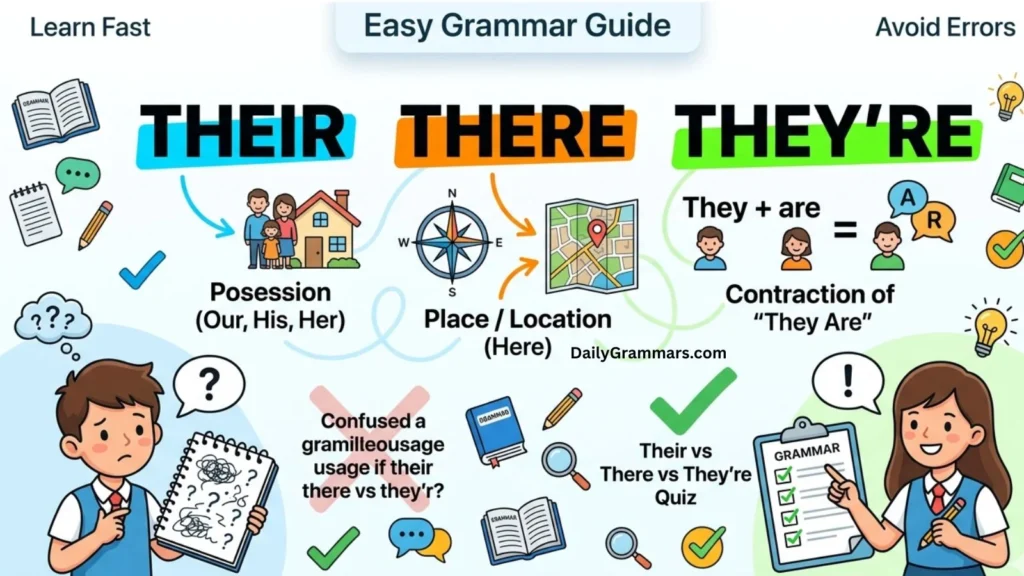
The good news is that the difference is very simple once you learn the role of each word. “Their” shows ownership, “there” points to a place or position, and “they’re” is short for “they are.” Understanding these meanings helps you write clearly and avoid common grammar mistakes.
This guide explains the quick answer, word origins, spelling differences, common errors, and real-life examples. By the end, you will know exactly when to use each word with confidence.
Their vs There vs They’re – Quick Answer
Here is the simple difference:
| Word | Meaning | Example |
|---|---|---|
| Their | Shows ownership | Their car is new. |
| There | Refers to a place | The book is over there. |
| They’re | Short form of “they are” | They’re happy today. |
Easy Trick to Remember
- Their → contains “heir” → ownership or belonging.
- There → contains “here” → place or location.
- They’re → has an apostrophe → means “they are.”
Quick Examples
- Their dog is barking.
- Put the bag over there.
- They’re coming tonight.
The Origin of Their vs There vs They’re
The confusion between these words comes from English history and pronunciation.
Their
The word “their” comes from Old Norse. Vikings influenced English many centuries ago. The word was used to show possession or ownership.
Example:
- Their house is beautiful.
There
“There” comes from Old English. It originally pointed to a location or position.
Example:
- Please sit there.
They’re
“They’re” is a contraction. It combines:
- They + are = they’re
English often uses contractions to make speech and writing faster.
Example:
- They’re ready to leave.
Why Do People Confuse Them?
These words sound almost the same when spoken. English spelling keeps old forms from history, so the spellings stayed different even though pronunciation became similar.
British English vs American English Spelling
The words “their,” “there,” and “they’re” are spelled the same in both British and American English. There is no spelling difference between the two styles.
However, writing style and punctuation habits may differ slightly.
Comparison Table
| Word | British English | American English | Meaning |
|---|---|---|---|
| Their | Their | Their | Ownership |
| There | There | There | Place |
| They’re | They’re | They’re | They are |
Example in British English
- Their flat is near the station.
Example in American English
- Their apartment is near the station.
The grammar stays the same. Only surrounding vocabulary may change.
Which Spelling Should You Use?
The correct spelling depends on the meaning of your sentence.
Use “Their” for Ownership
Use it when something belongs to people.
Examples:
- Their teacher is kind.
- Their phones are expensive.
Use “There” for Place or Position
Use it for locations or directions.
Examples:
- The keys are there.
- We went there yesterday.
Use “They’re” for “They Are”
If you can replace the word with “they are,” use “they’re.”
Examples:
- They’re studying now.
- They’re my friends.
Advice by Audience
| Audience | Best Choice |
|---|---|
| US readers | Standard grammar rules |
| UK readers | Standard grammar rules |
| Global audience | Use simple and correct forms |
No matter where your audience lives, the meanings stay the same.
Common Mistakes with Their vs There vs They’re
These mistakes happen often in casual writing.
| Incorrect Sentence | Correct Sentence |
|---|---|
| Their going home. | They’re going home. |
| Put it in their. | Put it in there. |
| There dog is cute. | Their dog is cute. |
| They’re house is big. | Their house is big. |
Why These Mistakes Happen
- The words sound alike.
- Fast typing causes errors.
- Autocorrect sometimes misses grammar mistakes.
How to Avoid Errors
- Check if ownership is involved → use “their.”
- Check if it talks about a place → use “there.”
- Replace with “they are” → use “they’re.”
Their vs There vs They’re in Everyday Examples
In Emails
- Their report was excellent.
- They’re sending the files tomorrow.
- Please leave the package there.
In News Writing
- Their team won the match.
- There was heavy rain last night.
- They’re expected to arrive soon.
On Social Media
- They’re so funny!
- Their vacation photos look amazing.
- We were there yesterday.
In Formal Writing
- Their research improved the project.
- There are many reasons for change.
- They’re responsible for the final review.
Their vs There vs They’re – Google Trends & Usage Data
Searches for “their vs there vs they’re” stay popular because students, writers, and English learners often struggle with homophones.
Countries with High Search Interest
The keyword is commonly searched in:
- United States
- United Kingdom
- Canada
- Australia
- India
- Pakistan
Why People Search for It
People usually want:
- Quick grammar help
- Homework support
- Better professional writing
- Social media accuracy
- Email correction tips
Most Common Usage Contexts
| Context | Common Word Used |
|---|---|
| Ownership | Their |
| Location | There |
| Contraction | They’re |
Grammar tools and search engines also show these corrections often because the mistakes are very common online.
Full Comparison Table
| Feature | Their | There | They’re |
|---|---|---|---|
| Part of Speech | Possessive adjective | Adverb/pronoun | Contraction |
| Main Meaning | Ownership | Place | They are |
| Apostrophe | No | No | Yes |
| Example | Their bike is red. | Sit there. | They’re excited. |
| Easy Memory Trick | Belonging | Here/place | They are |
FAQs
What is the difference between their, there, and they’re?
“Their” shows ownership, “there” refers to a place, and “they’re” means “they are.”
Is “they’re” always short for “they are”?
Yes. “They’re” is always a contraction of “they are.”
How do I remember the difference quickly?
- Their = ownership
- There = place
- They’re = they are
Is “their” singular or plural?
“Their” is usually plural, but modern English also uses it as a singular gender-neutral word.
Example:
- Someone forgot their bag.
Why do people confuse these words?
They sound the same in speech, so writers often choose the wrong spelling.
Can grammar tools catch these mistakes?
Sometimes, but not always. You should still proofread your writing carefully.
Are these words different in British English?
No. British and American English use the same spellings for these words.
Conclusion
Understanding “their vs there vs they’re” is important for clear and correct English writing. Even though these words sound alike, their meanings are completely different. “
Their” shows ownership, “there” points to a place, and “they’re” means “they are.” Learning these simple rules can improve your grammar and make your writing look more professional.
Many people make mistakes with these words because English pronunciation can be confusing. However, using small memory tricks makes the difference easier to remember. Use “their” when discussing ownership and “there” when discussing a location. Use “they’re” in place of the term if you can.
These words appear every day in emails, social media, school assignments, and business communication. Using them correctly helps readers understand your message quickly and clearly. Whether you write for work, study, or daily conversation, mastering these three words will improve your confidence and communication skills.