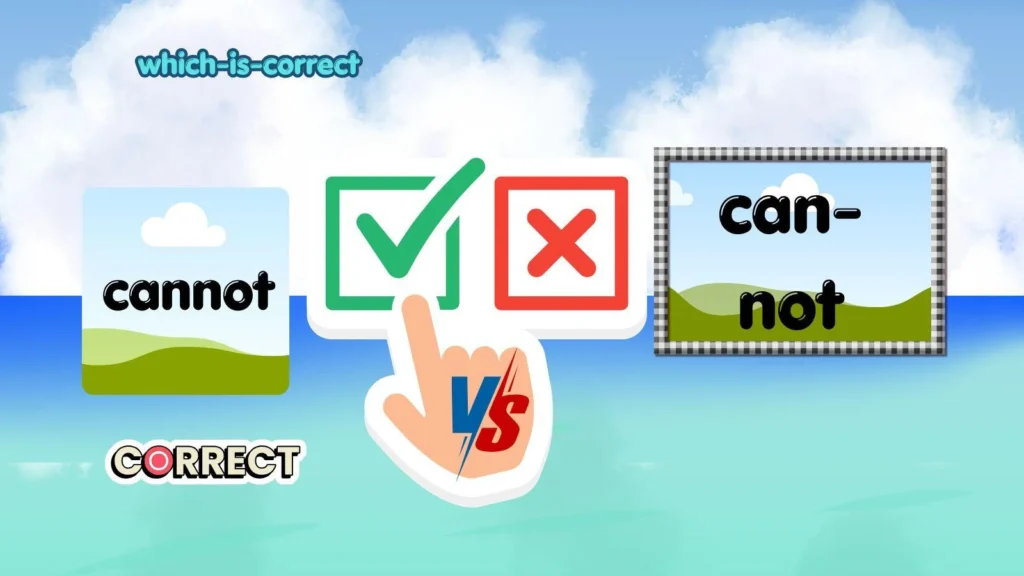
If you have ever stopped while writing a sentence because you were unsure whether to use “cannot” or “can not,” you are not alone. Both forms exist, but they are not used in exactly the same way.
The most common and standard form is “cannot”, written as one word. For example, “I cannot attend the meeting” is the normal choice in everyday English. However, “can not” can also be correct when “not” separately modifies another part of the sentence or when the writer wants to emphasize the negative.
This small spelling difference often causes confusion in emails, school assignments, business writing, and formal documents. Knowing when to use each form can make your writing clearer and more natural.
In this guide, we will explain cannot or can not, their history, British and American usage, common mistakes, everyday examples, and practical advice. You will also learn how these forms are generally used in different contexts and why “cannot” is usually the safest choice.
Seealso;Astigmatism vs Nystagmus: Clear Differences, Meaning
Cannot or Can Not – Quick Answer
“Cannot” is the standard spelling when you mean the negative form of “can.”
- I cannot swim.
- She cannot come today.
- We cannot accept your offer.
- You cannot park here.
“Can not” is sometimes correct when “not” has a separate function or when the sentence structure requires it.
For example:
- You can not only read the book but also write a review.
- We can not approve the request, but we can review it again.
In the second example, the separation can create a different grammatical structure or emphasis. However, many sentences that use “can not” would sound more natural with “cannot.”
Quick comparison
| Form | Common use | Example |
|---|---|---|
| cannot | Standard negative of “can” | I cannot help today. |
| can not | Special constructions or emphasis | You can not only read it but also discuss it. |
| can’t | Informal contraction | I can’t help today. |
Quick rule: When you simply mean “am/is/are not able to,” use “cannot.”
The Origin of Cannot or Can Not
The word “can” has a long history in English. It comes from Old English “cunnan,” meaning to know, understand, or have the ability to do something.
Over time, can developed into the modern modal verb used to express ability, possibility, permission, and related meanings.
The negative form developed from “can” + “not.” English gradually established “cannot” as a standard written form for the ordinary negative construction.
This is why we normally write:
I cannot go.
rather than:
I can not go.
The two-word form did not disappear completely. “Can not” remains possible in certain grammatical structures where “not” needs to remain separate.
The distinction is easier to understand by looking at the sentence structure rather than treating “cannot” and “can not” as completely interchangeable spellings.
British English vs American English Spelling
There is no major British-versus-American spelling difference between “cannot.” Both British and American English commonly use “cannot” as the standard negative form of “can.”
For example:
- British English: I cannot attend.
- American English: I cannot attend.
The same applies to formal writing in both varieties.
Comparison table
| Meaning | British English | American English |
|---|---|---|
| Negative of “can” | cannot | cannot |
| Informal contraction | can’t | can’t |
| Special construction | can not | can not |
| Formal negative | cannot | cannot |
The important difference is therefore grammatical context, not national spelling rules.
Examples
Standard:
- She cannot drive.
- They cannot stay.
- I cannot remember his name.
Possible separate construction:
- He can not only sing but also dance.
- You can not only save money but also reduce waste.
In these examples, “not only” is a separate grammatical construction, so “can not” naturally appears as two words.
Which Spelling Should You Use?
For most writers, the answer is simple: use “cannot” when forming the ordinary negative of “can.”
For American English
Use “cannot” in standard and formal writing.
I cannot attend the meeting.
For British English
Use “cannot” in the same situation.
I cannot attend the meeting.
For international English
“Cannot” is usually the clearest choice because it is widely recognized and standard across English varieties.
For informal writing
You can often use “can’t.”
I can’t come today.
However, contractions are generally less formal than “cannot.”
Simple rule to remember
If you can replace the phrase with “am/is/are unable to,” use “cannot.”
- I cannot swim.
- I am unable to swim.
That is a normal negative construction.
Common Mistakes with Cannot or Can Not
Mistake 1: Using “can not” as the default negative
❌ I can not attend the meeting.
✅ I cannot attend the meeting.
When “can” simply means ability or possibility and “not” makes it negative, cannot is normally preferred.
Mistake 2: Assuming “cannot” is always wrong
Some writers think “can not” is the only grammatically correct form because the words are technically “can” + “not.”
That is incorrect. “Cannot” is an established standard spelling.
Mistake 3: Confusing “cannot” with “can’t”
“Can’t” is a contraction of “cannot.”
- Formal: I cannot attend.
- Informal: I can’t attend.
Mistake 4: Removing “not” from “not only”
Consider:
She can not only sing but also dance.
Here, “not only” works together as a grammatical expression. Writing “cannot only sing” can change the intended meaning.
Mistake 5: Using “can not” simply because it looks logical
English spelling does not always follow simple word-by-word logic. “Cannot” has become the conventional spelling for the ordinary negative form.
Cannot or Can Not in Everyday Examples
In emails
Formal:
I cannot attend the meeting on Friday.
Less formal:
I can’t attend the meeting on Friday.
For professional emails, “cannot” is a safe choice.
In news writing
News articles commonly use “cannot” when reporting a person’s inability or a restriction.
The company cannot confirm the report.
On social media
Informal writing often uses “can’t.”
I can’t believe it happened!
This is natural and conversational.
In formal writing
Use “cannot” in essays, reports, applications, and professional documents.
The results cannot be considered conclusive.
With “not only”
The two-word form can be appropriate:
The system can not only reduce costs but also improve efficiency.
Here, “not only” is a unit, so separating “can” and “not” is natural.
Cannot or Can Not – Google Trends & Usage Data
Search interest for “cannot or can not” reflects a common English-language grammar and spelling question. People typically search this phrase when they encounter both forms and want to know whether they are interchangeable.
In actual writing, “cannot” is much more established as the standard negative form of “can.” “Can not” appears in particular grammatical constructions, especially structures involving “not only.”
Usage can also vary by context:
- Formal writing: “cannot” is common.
- Business communication: “cannot” is common.
- Casual conversation: “can’t” is very common.
- Special constructions: “can not” can be appropriate.
- English-learning searches: both forms may appear because learners are comparing them.
Google Trends measures search interest, not the actual frequency of words in written English. Therefore, search popularity should not be treated as a direct measurement of grammatical correctness.
Cannot vs Can Not: Comparison Table
| Feature | Cannot | Can Not |
|---|---|---|
| Number of words | One | Two |
| Standard negative of “can” | Yes | Usually no |
| Formal writing | Very common | Context-dependent |
| British English | Standard | Used in special constructions |
| American English | Standard | Used in special constructions |
| Informal alternative | Can’t | Can’t |
| Example | I cannot go. | You can not only go but also help. |
FAQs About Cannot or Can Not
1. Is “cannot” one word?
Yes. “Cannot” is normally written as one word when it is the negative form of “can.”
2. Is “can not” grammatically correct?
Yes, but it has more limited uses. It can appear when “not” functions separately, especially in constructions such as “can not only…but also…”
3. Which is more common: “cannot” or “can not”?
“Cannot” is the standard form for ordinary negative statements.
4. Is “cannot” more formal than “can’t”?
Generally, yes. “Can’t” is a contraction and is more common in conversational or informal writing. “Cannot” is often preferred in formal writing.
5. Should I use “cannot” in an essay?
RELATED;Inner vs Outer: Meaning, Differences, and Easy Usage Guide
Yes. If you mean that someone is unable to do something, “cannot” is a standard choice for an essay.
6. Do British people write “cannot”?
Yes. “Cannot” is standard in British English as well as American English.
7. Is “can’t” the same as “cannot”?
Yes, in ordinary negative constructions, “can’t” is the contraction of “cannot.”
Conclusion
When deciding between “cannot or can not,” remember one simple rule: “cannot” is the standard form for the ordinary negative of “can.” Use it when you mean that someone is unable to do something, something is impossible, or an action is not permitted.
For example, “I cannot attend the meeting” is standard and natural. The same applies in British English, American English, business writing, academic work, and most formal situations.
“Can not” is not simply an incorrect version of “cannot.” It can be correct when “not” has a separate grammatical role. A common example is “can not only…but also…” In informal conversation, “can’t” is also a natural alternative.
If you are unsure which form to choose, “cannot” is usually the safest option for a normal negative statement. Understanding this small distinction will help you write clearer emails, essays, reports, and everyday English.