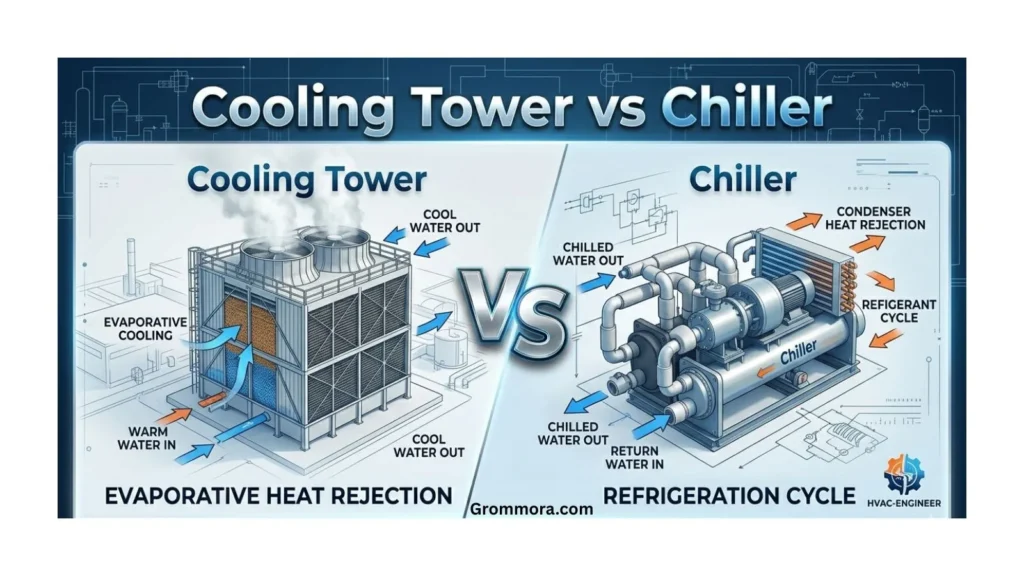
When people search for cooling tower vs chiller, they are usually trying to solve a simple but important confusion: which one cools water, and which one cools air or systems directly? Both are used in HVAC (Heating, Ventilation, and Air Conditioning) systems, but they do very different jobs.
This confusion often happens in buildings, factories, hospitals, and data centers where both systems work together. A chiller cools water for air conditioning, while a cooling tower removes heat from that water. But many people mix them up because both deal with “cooling” and are often installed side by side.
|See more Veil or Vail
Understanding the difference is important for engineers, students, technicians, and even building owners. It helps in system design, maintenance, and energy saving decisions.
In this article, you will get a clear and simple explanation of cooling tower vs chiller, how they work, where they are used, and how they compare. You will also see real examples, common mistakes, and easy FAQs to clear all confusion once and for all.
Cooling Tower vs Chiller – Quick Answer
A chiller removes heat from water and makes it cold. That cold water is used to cool buildings or machines.
A cooling tower removes heat from the warm water coming back from the chiller and releases that heat into the air.
Simple example:
- Chiller = makes cold water
- Cooling tower = throws heat away from water
They work together in large cooling systems.
The Origin of Cooling Tower vs Chiller
The terms come from industrial cooling systems developed during the early growth of air conditioning in the 20th century.
- Chiller comes from the word “chill,” meaning to make something cold.
- Cooling tower comes from its tall tower structure that allows heat to escape into the air using evaporation.
These systems became common in large buildings, factories, and power plants as cooling needs increased.
Over time, both terms became standard in HVAC engineering worldwide.
Cooling Tower vs Chiller – British English vs American Usage
In this case, there is no major spelling difference between British and American English.
However, usage can vary slightly:
- US: “chiller system,” “cooling tower system”
- UK/Commonwealth: same terms, but sometimes more formal HVAC wording is used
Comparison Table
| Feature | Chiller | Cooling Tower |
|---|---|---|
| Main Function | Cools water | Removes heat from water |
| Process Type | Refrigeration cycle | Heat rejection |
| Energy Use | High electricity use | Uses fan + evaporation |
| Location | Inside plant room | Outside building |
| Output | Chilled water | Cooled water return |
Which One Should You Use?
You don’t choose one over the other—they work together.
- Use a chiller system if you need cold water for air conditioning.
- Use a cooling tower if your system produces heat that must be removed.
Based on use:
- Homes → usually no cooling tower or chiller
- Offices → chiller + cooling tower combo
- Factories → large-scale chiller systems
- Data centers → high-capacity cooling systems
Common Mistakes with Cooling Tower vs Chiller
Here are simple mistakes people make:
- Thinking a cooling tower produces cold air ❌
- Thinking a chiller releases heat into the air ❌
- Mixing both systems as the same ❌
- Using the terms interchangeably in HVAC design ❌
Correct understanding:
- Chiller = creates cooling effect
- Cooling tower = removes heat from system
Cooling Tower vs Chiller in Everyday Examples
- Emails (engineering team):
“Check the chiller load and cooling tower efficiency before summer peak.” - News/report:
“New hospital uses advanced chiller and cooling tower system for energy savings.” - Social media (HVAC post):
“Chiller does the cooling. Cooling tower dumps the heat. Simple HVAC logic!” - Technical writing:
“The system uses a water-cooled chiller paired with a cooling tower.”
Cooling Tower vs Chiller – Google Trends & Usage Data
Search interest shows:
- High searches in hot climate countries
- Strong demand in engineering and construction sectors
- Common queries from students studying HVAC systems
Most users search this keyword when:
- Learning HVAC basics
- Buying industrial cooling systems
- Comparing energy efficiency options
FAQs – Cooling Tower vs Chiller
Can a chiller work without a cooling tower?
Yes, an air-cooled chiller can work without a cooling tower, but water-cooled chillers need one.
Is a chiller the same thing as a cooling tower?
No, a chiller cools water, while a cooling tower removes heat from that water.
Why are we demolishing cooling towers?
Cooling towers are removed when systems are upgraded to more efficient or air-cooled technologies.
What are the three types of cooling towers?
They are natural draft, mechanical draft, and hybrid cooling towers.
Where does water go after cooling tower?
The cooled water returns to the chiller to be reused in the cooling cycle.
What are the three types of chillers?
The main types are air-cooled chillers, water-cooled chillers, and evaporative chillers.
Conclusion (150–200 words)
Understanding cooling tower vs chiller is important for anyone working with HVAC systems or learning about building cooling technology. Both systems are closely connected but have very different roles. A chiller is responsible for producing chilled water that cools indoor spaces. On the other hand, a cooling tower removes heat from that water and releases it into the atmosphere.
Many people confuse these two systems because they are often installed together and both deal with temperature control. However, once you understand their functions, the difference becomes very clear and simple.
In real-world applications, both systems work as a team. The chiller does the cooling job, while the cooling tower handles heat rejection. Without one, the other cannot perform efficiently in large-scale HVAC systems.
Whether you are a student, engineer, or building owner, knowing this difference helps you make better decisions about energy use, maintenance, and system design. In short, chiller cools, cooling tower rejects heat—and together they keep buildings comfortable and systems efficient.