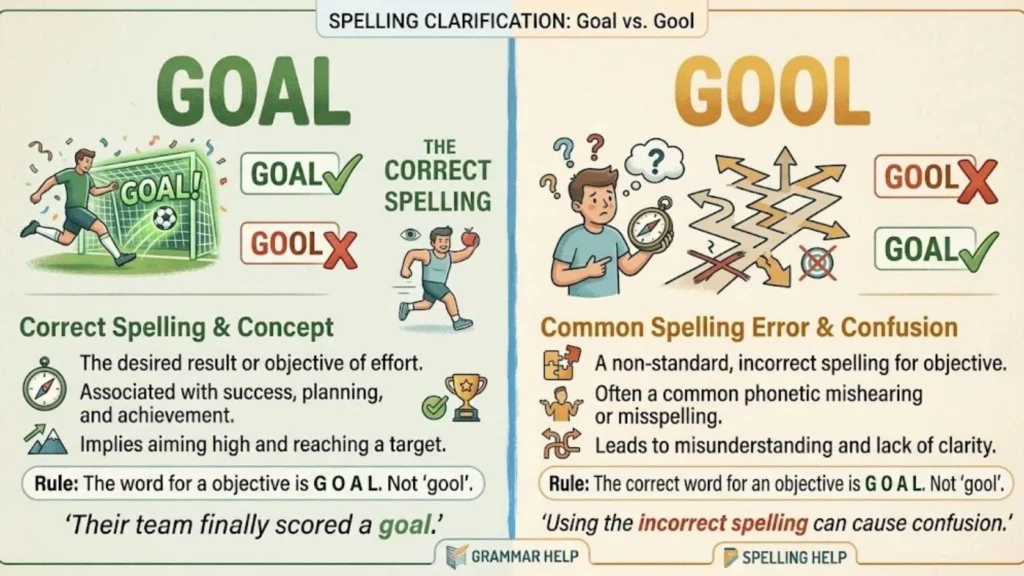
Have you ever wondered whether to write “gool” or “goal”? Many people search for these words because they sound similar when spoken quickly. However, only one is the correct spelling of the common English word used in sports and everyday life.
The correct spelling is goal. It can mean a point scored in a game, something a person wants to achieve, or a target they want to reach. The word “gool” is usually a spelling mistake when someone intends to write “goal.”
This confusion often happens when people type quickly, learn English as a second language, or write words based on how they sound. It can also occur in online searches, text messages, school assignments, and social media posts.
Knowing the difference helps you write clearly and avoid common spelling errors. Whether you are talking about football, personal success, education, or work, using the right word makes your message easier to understand.
RELATED:Inner vs Outer: Meaning, Differences, and Easy Usage Guide
Gool or Goal – Quick Answer
Goal is the correct spelling. “Gool” is generally a misspelling of “goal” in standard English.
Examples:
- Correct: My goal is to become a doctor.
- Incorrect: My gool is to become a doctor.
- Correct: The player scored a goal.
- Incorrect: The player scored a gool.
The word “goal” has several common meanings:
- Sports: A point scored in a game, such as football or hockey.
- Personal plans: Something you want to achieve.
- Work and education: A result you want to reach within a set time.
- General use: A target or desired outcome.
Remember this simple rule: whenever you mean a target, achievement, or sports score, use goal.
The Origin of Gool or Goal
The word “goal” has a long history in the English language. It developed from older forms of English and became associated with boundaries, finishing points, and targets.
The word is commonly linked to the Middle English word gol, which referred to a boundary or limit. Over time, its meaning developed to include the endpoint of a race or game and, later, a desired result.
Today, “goal” is widely used in sports, business, education, and personal development.
For example:
- A football player wants to score a goal.
- A student sets a goal to pass an exam.
- A business sets a goal to increase sales.
- A person creates a goal to save money.
Why Do People Write “Gool”?
People may write “gool” because they mishear the word or confuse its vowel sounds. In some accents, the pronunciation of “goal” may sound close to “gool.”
However, pronunciation does not change the standard spelling. The accepted English spelling remains “goal.”
British English vs American English Spelling
There is no spelling difference between British and American English for this word.
Both varieties use goal. Unlike words such as “colour” and “color,” this word follows the same spelling rule in both countries.
| Context | British English | American English |
|---|---|---|
| Sports score | goal | goal |
| Personal target | goal | goal |
| Work objective | goal | goal |
| Education target | goal | goal |
| Plural form | goals | goals |
| Past-tense phrase | scored a goal | scored a goal |
Examples in British English
- Our team scored three goals.
- My goal is to improve my English.
- The company has set new goals for the year.
Examples in American English
- The team scored the winning goal.
- My goal is to finish college.
- We need clear goals for this project.
The spelling stays the same in both varieties. Only pronunciation, accent, and some surrounding vocabulary may differ.
Which Spelling Should You Use?
You should use goal in all standard English writing, regardless of your location or audience.
For American Readers
Use “goal” in schoolwork, emails, business documents, sports reports, and everyday conversations.
Example: “My goal is to get a better job.”
For British Readers
Use “goal” in the same situations. British English does not use “gool” as a standard alternative.
Example: “The striker scored the winning goal.”
For Commonwealth Countries
In countries such as Pakistan, India, Australia, and Canada, “goal” is also the standard spelling.
Example: “My goal is to improve my writing skills.”
For International Communication
If you write for a global audience, choose “goal.” It is widely understood and accepted across English-speaking countries.
Professional advice: Always use “goal” in formal writing, educational content, website articles, reports, and business communication. Avoid “gool” unless you are quoting a source that intentionally uses that spelling.
Common Mistakes with Gool or Goal
Here are some frequent mistakes and how to correct them.
1. Writing “Gool” Instead of “Goal”
Incorrect: My gool is to learn English.
Correct: My goal is to learn English.
2. Using the Wrong Spelling in Sports
Incorrect: The player scored a gool.
Correct: The player scored a goal.
3. Misspelling the Plural
Incorrect: Our team scored two gools.
Correct: Our team scored two goals.
4. Using the Wrong Spelling in Business
Incorrect: Our main gool is to grow the company.
Correct: Our main goal is to grow the company.
5. Confusing a Goal with a Plan
A goal is the result you want to achieve. A plan is the set of steps you take to reach it.
Example:
- Goal: Pass the final exam.
- Plan: Study for two hours every day.
Both words are correct, but they have different meanings.
Tips to Remember the Correct Spelling
- Remember that “goal” contains the letters G-O-A-L.
- Connect the word with a football goal or a personal target.
- Use spell-check tools when writing important documents.
- Read your work again before publishing it.
Gool or Goal in Everyday Examples
The word “goal” appears in many areas of daily life. Here are examples that show how to use it correctly.
1. In Emails
Correct example:
“Hello Sarah,
My goal for this month is to complete the project before the deadline. I will share an update when the work is finished.
Best regards.”
Using “goal” makes the message clear and professional.
2. In News Reports
Correct example:
“The striker scored a late goal to help his team win the match.”
Sports news often uses “goal” to describe a score in football, hockey, and other sports.
3. On Social Media
Correct example:
“My goal this year is to read 20 books and learn a new skill.”
People often share personal goals, fitness targets, and career plans online.
4. In Formal Writing
Correct example:
“The primary goal of this study is to examine how students learn new languages.”
In academic writing, “goal” refers to the intended outcome of a project, study, or research activity.
5. In Education
Correct example:
“My goal is to improve my mathematics grade this term.”
Students and teachers use the word to describe learning targets.
6. In Business
Correct example:
“The company’s goal is to provide better customer service.”
Businesses use goals to set priorities, measure progress, and plan future growth.
Gool or Goal – Google Trends & Usage Data
People may search for “gool or goal” when they are unsure about spelling, pronunciation, or the correct word to use. The search may also come from students, English learners, sports fans, and people writing online content.
However, exact Google Trends figures and country-by-country rankings require current data. Without a verified Trends report, it would be misleading to claim specific search volumes or popularity percentages.
Where Is “Goal” Commonly Used?
The word “goal” is widely used in English-speaking countries and international English communication.
| Country or region | Common usage |
|---|---|
| United States | Sports, education, business, personal targets |
| United Kingdom | Football, education, work, personal targets |
| Pakistan | English learning, sports, education, careers |
| India | Education, business, sports, personal development |
| Australia | Sports, work, education, personal plans |
| Canada | Sports, business, school, personal development |
These examples describe common language contexts, not measured search rankings.
Why Might People Search for “Gool or Goal”?
There are several possible reasons:
- They want to check the correct spelling.
- They have heard the word pronounced differently.
- They are learning English.
- They want to write a sports report or social media post.
- They need the correct spelling for school or work.
Which Word Is More Common?
“Goal” is the standard English word. “Gool” is generally an error when used with the same intended meaning.
For accurate search-volume comparisons, use Google Trends to compare both terms and select a country and time range. Keep in mind that search interest does not always equal the number of people who use a word correctly.
Comparison Table: Gool vs Goal
| Feature | Gool | Goal |
|---|---|---|
| Standard English spelling | No | Yes |
| Common dictionary word for a target | No | Yes |
| Used for sports scores | Incorrect spelling | Correct |
| Used for personal aims | Incorrect spelling | Correct |
| Used in formal writing | Avoid | Recommended |
| British English spelling | Not standard | Correct |
| American English spelling | Not standard | Correct |
| Example | My gool is to win. | My goal is to win. |
The table shows that “goal” is the correct choice in standard English for the meanings discussed in this article.
Frequently Asked Questions (FAQs)
1. Is it “gool” or “goal”?
“Goal” is correct. “Gool” is usually a spelling mistake when you mean a target, achievement, or sports score.
Seealso:Todays or Today’s: Which Is Correct? A Simple Grammar Guide
2. What does “goal” mean?
A goal is something you want to achieve. In sports, it can also mean a point scored by getting the ball or puck into the scoring area.
3. Is “gool” a real English word?
“Gool” is not the standard spelling of the common word “goal.” It may appear as a name, a nonstandard form, or a deliberate spelling in a specific context, but it should not replace “goal” in ordinary writing.
4. Is “goal” spelled differently in British and American English?
No. Both British and American English use “goal.” There is no regional spelling difference.
5. What is the plural of “goal”?
The plural is “goals.”
Example: “Our team has two goals for the season.”
6. How do you use “goal” in a sentence?
You can write, “My goal is to learn a new language.” In sports, you can write, “The player scored a goal.”
7. Why do people confuse “gool” and “goal”?
The words may sound similar to some speakers. People may also type quickly or spell the word according to how they hear it. Remembering the correct spelling helps prevent this error.
8. Should I use “gool” in an essay or email?
No. Use “goal” in essays, emails, reports, and professional documents. Use “gool” only when a specific name or quoted text requires it.
Conclusion
When choosing between “gool” and “goal,” the correct answer is simple: use “goal.” It is the standard English spelling for a target, an ambition, a desired result, or a point scored in many sports.
The word has the same spelling in British English, American English, and other major varieties of English. You do not need to change it based on your audience or location.
Remember the examples in this guide. You can write, “My goal is to improve my English,” or “The player scored the winning goal.” Both sentences use the word correctly.
If you are writing an email, school assignment, business report, website article, or social media post, choosing “goal” will help your writing look clear and professional. Avoid “gool” when you mean the common English word.
The easiest way to remember the rule is to connect “goal” with a target you want to reach. Whenever you discuss an aim, a plan’s desired result, or a sports score, choose “goal.” This small spelling choice can make your writing more accurate and easier to understand.