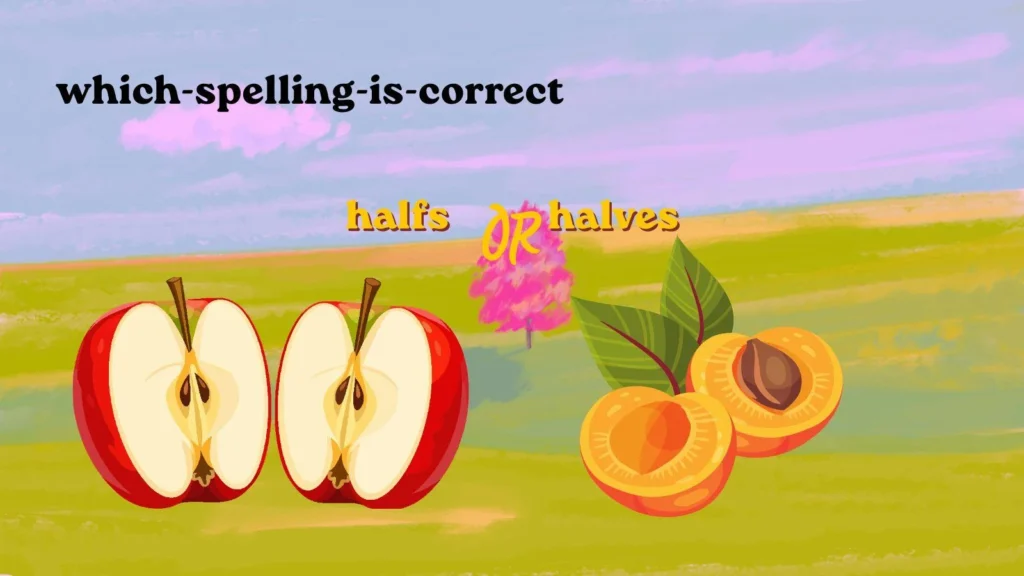
If you have ever written “halfs” and wondered whether it should be “halves,” you are not alone. This is a common English spelling question because many English words change their spelling when they become plural. The confusion is especially easy to understand because the singular word is half, but its standard plural form is halves.
The quick answer is simple: “halves” is the correct plural form of “half.” The word “halfs” is generally considered incorrect in standard English.
For example, you should write, “Cut the apple into two halves,” not “Cut the apple into two halfs.” The spelling changes from f to v before adding -es.
This article explains why this happens, where the word comes from, and how to use half and halves correctly. It also covers British and American English, common mistakes, everyday examples, usage patterns, and frequently asked questions. By the end, you will know exactly when to use each form.
Seealso;211+Their vs There vs They’re: Fix This Mistake Fast
Halfs or Halves – Quick Answer
Halves is the correct plural of half.
- Singular: half
- Plural: halves
Examples:
- I ate half of the sandwich.
- We divided the sandwich into two halves.
- The two halves were equal.
- She gave me half of her cookie.
- Cut the orange into halves.
“Halfs” is not the standard plural spelling.
The spelling changes because half follows an irregular plural pattern found in several English words ending in -f or -fe.
| Singular | Correct plural |
|---|---|
| half | halves |
| calf | calves |
| leaf | leaves |
| loaf | loaves |
| knife | knives |
| wife | wives |
| life | lives |
However, not every word ending in -f changes to -ves. For example:
- roof → roofs
- chief → chiefs
- belief → beliefs
So it is important to learn the plural form of each word rather than applying one rule to every word.
The Origin of Halfs or Halves
The word half has a long history in English. It comes from Old English half, meaning a side, part, or one of two equal portions.
Over time, English developed different plural patterns. The plural halves reflects an older sound and spelling change in which the f sound became a v sound in certain word forms.
This change can be seen in other common English words:
- half → halves
- wolf → wolves
- shelf → shelves
- calf → calves
- leaf → leaves
The important point is that halves is not simply “half + s.” English spelling preserves an older plural pattern.
The pronunciation changes too:
- half → /hæf/
- halves → /hævz/
The f sound in half becomes a v sound in halves.
This is one reason learners may find the spelling confusing. The plural is not formed by simply adding -s.
British English vs American English Spelling
There is no major spelling difference between British and American English for this word.
Both varieties use:
- half for one
- halves for more than one
| English variety | Singular | Plural |
|---|---|---|
| British English | half | halves |
| American English | half | halves |
| Canadian English | half | halves |
| Australian English | half | halves |
| Global standard English | half | halves |
Examples:
British English:
“The cake was divided into two halves.”
American English:
“The cake was divided into two halves.”
Both are correct.
Why Do People Write “Halfs”?
The incorrect form halfs is usually caused by applying the regular plural rule:
word + s = plural
For many English nouns, this works:
- book → books
- car → cars
- table → tables
But half has an irregular plural:
- half → halves
Therefore, “halfs” does not follow standard English spelling.
Which Spelling Should You Use?
Use half when referring to one of two equal parts or one portion.
I ate half of the pizza.
Use halves when referring to two or more halves.
We divided the pizza into two halves.
This rule applies whether you are writing for an American, British, Australian, Canadian, or international audience.
For US Readers
Use:
half → halves
For UK and Commonwealth Readers
Use:
half → halves
For Professional or Academic Writing
Always use halves as the plural.
Avoid:
The two halfs were different sizes.
Write:
The two halves were different sizes.
The same spelling applies in emails, reports, essays, websites, news articles, and formal documents.
Common Mistakes with Halfs or Halves
1. Writing “halfs” Instead of “halves”
❌ I cut the apple into two halfs.
✅ I cut the apple into two halves.
2. Using “halves” for One Part
❌ I ate one halves of the sandwich.
✅ I ate one half of the sandwich.
Half is singular.
3. Forgetting the Spelling Change
❌ Three halfs of the group arrived.
✅ Three halves of the group arrived.
4. Confusing “Half” and “Halves”
Use half for one part:
Half of the class was absent.
Use halves for multiple parts:
The class was divided into two halves.
5. Assuming Every “F” Word Uses “-ves”
Not every noun ending in f changes to ves.
For example:
- roof → roofs
- chief → chiefs
- belief → beliefs
So the plural must often be learned individually.
Halfs or Halves in Everyday Examples
The word halves appears frequently in everyday English.
In Emails
Please divide the document into two halves before sending it.
In News Writing
The match was played in two halves.
In Social Media
I ate both halves of the sandwich!
In Formal Writing
The researchers divided the participants into two halves.
In Business Writing
The payment will be made in two equal halves.
In Everyday Conversation
Cut the orange into halves.
These examples show that halves is the normal plural form in both casual and formal English.
Halfs or Halves – Comparison Table
| Word | Correct? | Meaning | Example |
|---|---|---|---|
| half | ✅ Yes | One of two equal parts | I ate half the cake. |
| halves | ✅ Yes | More than one half | The cake was cut into halves. |
| halfs | ❌ No | Incorrect plural | Avoid “halfs.” |
| one half | ✅ Yes | A single portion | One half is missing. |
| two halves | ✅ Yes | Two portions | The two halves are equal. |
Related Plural Forms
| Singular | Plural |
|---|---|
| half | halves |
| calf | calves |
| leaf | leaves |
| loaf | loaves |
| shelf | shelves |
| wolf | wolves |
| knife | knives |
| wife | wives |
These examples demonstrate why halves follows a familiar English spelling pattern.
Halfs or Halves – Google Trends & Usage Data
Search interest for “halfs or halves” generally comes from people checking whether halves is the correct plural form of half. This type of search is common among English learners, students, writers, editors, and people checking spelling before publishing text.
Google Trends can show relative search interest by country and over time, but it should not be treated as a dictionary or a measure of grammatical correctness. Search volume can also change based on education, language-learning activity, and seasonal writing needs.
The key usage fact remains consistent across major English varieties:
half → halves
The incorrect form halfs may appear online because people sometimes create regular plurals by adding -s, but its presence does not make it standard English.
For professional writing, dictionaries, educational work, and edited content, halves is the appropriate plural.
Frequently Asked Questions
Is “halfs” a correct word?
No. Halfs is not the standard plural spelling of half. The correct plural is halves.
Is “halves” the plural of “half”?
Yes. Halves is the standard plural form of half.
Why does half become halves?
English has several nouns in which an f sound changes to a v sound when forming the plural. This gives us half → halves.
Do Americans say “halves”?
Yes. Halves is the standard plural in American English.
Do British people use “halves”?
Yes. British English also uses halves.
Can I write “two halfs”?
No. Write “two halves.”
What is the difference between half and halves?
Half refers to one portion:
I ate half the pizza.
Halves refers to two or more portions:
We divided the pizza into two halves.
Is “halves” pronounced like “halfs”?
No. The pronunciation changes slightly. Half ends with an f sound, while halves has a v sound followed by a plural z sound.
Conclusion
When choosing between halfs or halves, the correct spelling is halves. Half is the singular form, while halves is its standard plural.
The spelling may seem unusual because English does not simply add -s to the word. Instead, the f changes to v, producing halves. This pattern also appears in words such as leaf → leaves, loaf → loaves, and calf → calves, although not every word ending in f follows the same pattern.
There is no British-versus-American spelling difference here. Both British and American English use half and halves in the same way. Whether you are writing an email, school assignment, news article, social media post, or professional report, halves is the form you should use for the plural.
The easiest rule to remember is simple: one half, two halves. Avoid halfs in standard English, and you will have the correct spelling every time.