Have you ever heard someone say, “He did it hisselfs,” and wondered if hisselfs is correct? You are not alone. The words hisselfs or himself often cause confusion because both forms exist, but they do not have the same status in standard English.
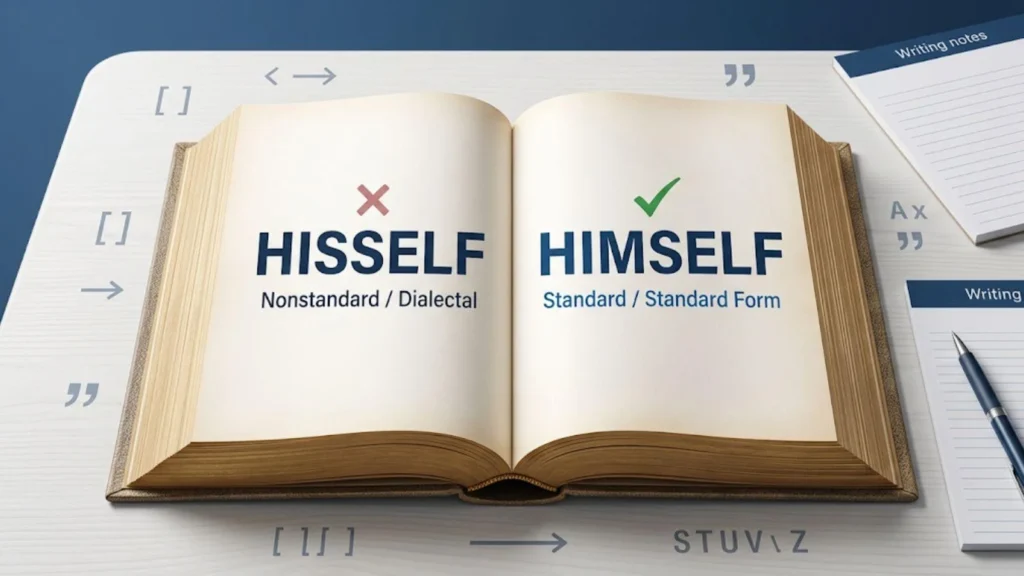
The quick answer is simple: himself is the standard English form. Hisselfs is a documented dialectal or nonstandard form of the same pronoun. It can appear in regional speech, informal language, historical writing, and fictional dialogue. Major dictionaries recognize hisselfs but label it nonstandard or dialectal.
People often search for “hisselfs or himself” because hisselfss seems logical. English has forms such as myself and yourself, so “his + self” may look natural. However, standard English uses himself, based on the object form him.
This guide explains the difference, history, regional use, common mistakes, and the best choice for professional writing.
Hisselfs or Himself – Quick Answer
Himself is the correct choice in standard English.
Hisself is an old and recognized dialectal form meaning the same thing as himself. American Heritage describes it as chiefly associated with Southern and South Midland U.S. speech, while Collins labels it “not standard.”
Examples
Standard English:
- He taught himself how to cook.
- John fixed the car himself.
- He blamed himself for the mistake.
- The manager himself answered the question.
Dialectal or informal speech:
- He taught hisself how to cook.
- John fixed the car hisself.
- He blamed hisself for the mistake.
The meaning is usually clear in both forms. The important difference is standard English versus dialectal usage.
For school, business, academic, and professional writing, choose himself.
The Origin of Hisself or Himself
The history of hisself is much older than many people expect. Dictionary.com dates the form to Middle English, around 1350–1400, while Etymonline traces hisself to around the 1400s.
The form can be understood as:
his + self = hisself
This pattern makes sense because English has several reflexive pronouns that appear to contain possessive forms:
- my + self = myself
- your + self = yourself
- her + self = herself
- our + selves = ourselves
- their + selves = themselves
However, standard English uses:
- he → him → himself
rather than:
- he → his → hisself
This is an example of analogical regularization. Speakers can extend a familiar pattern to a word that behaves differently.
American Heritage explains that forms such as hisself and theirselves can result from speakers regularizing irregular patterns in the standard reflexive-pronoun system.
So hisself is not simply a random spelling mistake. It has a long history in English and continues in some dialects.
British English vs American English Spelling
The difference is not simply “American English uses hisself while British English uses himself.” That would be misleading.
In both standard British and standard American English, himself is the normal form.
Hisself has appeared in regional varieties on both sides of the Atlantic. Historical dialect sources document it in English, Scottish, and Irish dialects, while American sources particularly associate it with Southern and South Midland varieties.
| Variety or Context | Standard Form | Hisself |
|---|---|---|
| Standard American English | himself | Dialectal/nonstandard |
| Standard British English | himself | Dialectal/nonstandard |
| Academic writing | himself | Avoid |
| Business writing | himself | Avoid |
| Formal journalism | himself | Avoid |
| Regional speech | himself | May occur |
| Fictional dialogue | himself | Can be intentional |
| Historical or dialect writing | himself | May occur |
The key point is that himself is the standard form in both major varieties of English.
Which Spelling Should You Use?
For most readers, the answer is easy:
Use “himself.”
Choose himself when writing:
- School assignments
- College papers
- Business emails
- Resumes
- Reports
- Websites
- News articles
- Academic papers
- Professional documents
- Formal letters
For example:
The employee completed the project himself.
This is standard and natural.
When Can “Hisself” Be Used?
Hisself can be appropriate when you are intentionally representing a dialect or someone’s speech.
For example, a novelist might write:
“He done it hisself.”
Here, the unusual form can help represent the character’s regional or social speech. Linguistic sources document hisself as a dialect feature rather than simply treating every occurrence as a spelling error.
The important distinction is intent.
If you are trying to write standard English, use himself.
If you are deliberately reproducing dialect speech, hisself may be appropriate.
Common Mistakes with Hisself or Himself
The most common mistake is treating hisself as the standard equivalent of himself.
Mistake 1: Using “hisself” in formal writing
Incorrect for standard writing:
He completed the assignment hisself.
Better:
He completed the assignment himself.
Mistake 2: Assuming “hisself” is simply the American form
American English does not normally use hisself as its standard reflexive pronoun.
Standard American English:
He taught himself to play guitar.
Mistake 3: Changing every “himself” to “hisself”
The words have the same basic meaning, but they do not have the same register.
| Common Error | Standard Correction |
|---|---|
| He hurt hisself. | He hurt himself. |
| He taught hisself French. | He taught himself French. |
| He introduced hisself. | He introduced himself. |
| He fixed it hisself. | He fixed it himself. |
| He blamed hisself. | He blamed himself. |
Mistake 4: Calling “hisself” meaningless
It is better to say that hisself is dialectal or nonstandard, rather than claiming that it is not a real word at all. Dictionaries document the form and its history.
Hisself or Himself in Everyday Examples
Context makes the difference easy to understand.
In an Email
Use the standard form:
The manager will review the document himself.
Not usually:
The manager will review the document hisself.
Professional emails normally require standard English.
In News Writing
A news article would normally use:
The official said he would investigate the issue himself.
News writing generally uses standard edited English.
On Social Media
You may see either form:
He built that entire house himself!
A regional speaker might write:
He built that whole thing hisself!
The second example can signal informal or dialectal speech.
In Fiction
Writers sometimes use hisself deliberately:
“He carried that old truck hisself,” she said.
Here, the spelling can represent the character’s speech rather than an accidental grammar error.
In Formal Writing
Use:
The researcher completed the analysis himself.
Avoid:
The researcher completed the analysis hisself.
Hisself or Himself – Google Trends & Usage Data
Search interest should be separated from actual language frequency. Google Trends measures relative search interest, not whether a word is grammatically standard. Someone may search for hisself precisely because they are unsure whether it is correct.
Available language references show a strong difference in established usage. Google Books Ngram data, referenced by Collins, provides historical frequency information for hisself, while dictionary sources classify himself as the standard form and hisself as nonstandard or dialectal.
Regional evidence is also important. American Heritage identifies hisself particularly with Southern and South Midland U.S. speech. Other dialect sources document the form in English dialects as well.
So, when considering country and context:
| Context | Expected Usage |
|---|---|
| Standard U.S. English | himself |
| Standard U.K. English | himself |
| Professional writing | himself |
| Academic writing | himself |
| General online writing | himself |
| Southern/South Midland dialect speech | hisself may occur |
| Appalachian or regional speech | hisself may occur |
| Fictional dialect | hisself may be intentional |
| Historical texts | Both forms may be found |
The safest SEO and writing advice is therefore simple: use “himself” when your goal is standard English.
Hisself vs Himself: Comparison Table
| Feature | Himself | Hisself |
|---|---|---|
| Standard English | Yes | No |
| Meaning | Himself | Usually himself |
| Reflexive pronoun | Yes | Dialectal variant |
| Formal writing | Recommended | Avoid |
| Academic writing | Recommended | Avoid |
| Business writing | Recommended | Avoid |
| Everyday standard speech | Normal | Regional |
| Southern U.S. dialect | Normal | Documented |
| Fictional dialogue | Normal | Can show dialect |
| Historical use | Yes | Yes |
| Dictionary documented | Yes | Yes |
| Professional choice | Yes | No |
FAQs About Hisself or Himself
1. Is “hisself” a correct word?
RELATED;Digraph vs Diphthong: Simple Differences and Examples
Hisself is a documented English word form, but it is not the standard reflexive pronoun in modern formal English. Dictionaries describe it as nonstandard or dialectal.
2. Is “himself” the correct spelling?
Yes. Himself is the standard third-person singular masculine reflexive pronoun.
Example:
He taught himself to swim.
3. Why do people say “hisself”?
The form likely developed through analogy with forms such as myself, yourself, and herself. Speakers can naturally interpret the construction as his + self. Historical sources show that the form is centuries old.
4. Is “hisself” used in America?
Yes, but it is associated with particular dialects rather than standard American English. American Heritage identifies it especially with Southern and South Midland U.S. speech.
5. Is “hisselfs” British English?
It has historical and dialectal use in Britain, but himself is the standard form in modern British English. Historical English dialect sources document hisself and related spellings.
6. Can I use “hisselfs” in a story?
Yes, if you are intentionally representing a character’s dialect or speech. It can be useful for authentic dialogue, but readers may interpret it as nonstandard English.
7. Should I use “hisself” in a professional email?
No. Use himself.
The director will review the proposal himself.
This is clear, standard, and professional.
Conclusion: Hisself or Himself?
When choosing between hisself or himself, remember one simple rule: himself is the standard form.
Use himself in schoolwork, business communication, academic writing, news writing, websites, reports, and other situations where standard English is expected. For example, write, “He completed the project himself.”
Hisself is different. It is a real, historically documented form, but dictionaries classify it as dialectal or nonstandard. It has appeared in English for centuries and remains associated with some regional varieties, especially parts of the Southern and South Midland United States.
This means hisself should not simply be dismissed as a random spelling mistake. It can reflect genuine speech patterns and can be useful in fiction, historical writing, or linguistic discussion.
However, if you are unsure which form your audience expects, himself is the clear professional choice. It is understood everywhere and follows standard English grammar.