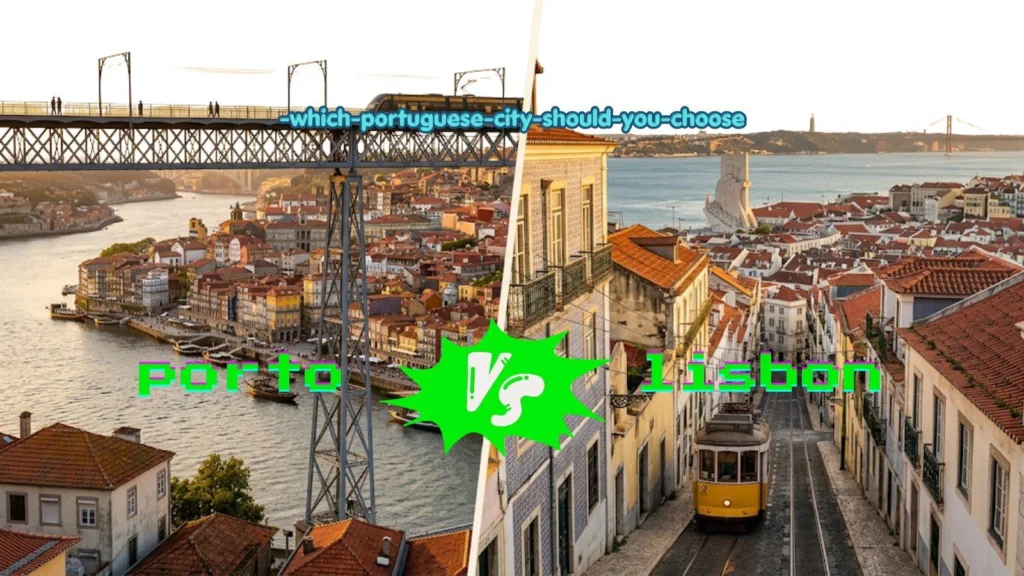
Planning a trip to Portugal can lead to one big question: Porto or Lisbon? Both cities offer historic streets, excellent food, beautiful river views, and strong Portuguese culture. Yet they give visitors very different experiences.
Lisbon is Portugal’s capital and sits beside the Tagus River near the Atlantic Ocean. Porto is a historic northern city on the Douro River and is closely connected with Port wine. Portugal’s official tourism site presents both cities as major destinations, noting their historic neighborhoods, tiled buildings, cultural activities, and riverside settings.
People search for “Porto or Lisbon” because they often have limited vacation time and want to know which city fits their travel plans. They may also wonder about cost, attractions, nightlife, food, walking, day trips, and atmosphere.
The good news is that this is not a spelling question. Porto and Lisbon are two different Portuguese cities. The right choice depends on what you want from your trip.
RELATED;Begun or Began: What’s the Difference and When to Use Each?
Porto or Lisbon – Quick Answer
Porto and Lisbon are both excellent cities, but they offer different travel experiences.
| Feature | Porto | Lisbon |
|---|---|---|
| Location | Northern Portugal | Western Portugal |
| River | Douro | Tagus |
| Known for | Port wine, historic center, Douro Valley | Capital city, viewpoints, historic neighborhoods |
| Size and feel | More compact | Larger and more spread out |
| Atmosphere | Historic and relaxed | Busy, energetic, and cosmopolitan |
| Day trips | Douro Valley, Braga, Guimarães | Sintra, Cascais, Óbidos |
| Main food and drink association | Port wine and northern cuisine | Seafood, pastries, wine, and varied cuisine |
| Best for | Short city breaks and wine-focused trips | First-time city sightseeing and wider urban experiences |
Portugal’s tourism authority describes Lisbon as a city associated with the Tagus and sea, while Porto is associated with the Douro and the Port wine produced in the surrounding region.
If you have several days, visiting both Porto and Lisbon is also a practical option.
The Origin of Porto or Lisbon
The names Porto and Lisbon have different histories.
The name Porto is connected with the Latin portus, meaning a port or harbor. The older expression Portus Cale is widely associated with the historical development of the name Portugal.
The history of Lisbon is more complicated. Scholars have proposed different explanations for the origin of the name, with theories involving pre-Roman and ancient Mediterranean languages. The exact origin remains debated.
There is also an interesting language difference. In Portuguese, the city is normally called Porto, while English has historically used both Porto and Oporto. The form “Oporto” developed partly because the Portuguese definite article o was treated as part of the name in other languages.
Today, Porto is the standard English form used by most modern travel sources.
British English vs American English Spelling
Unlike pairs such as colour/color or centre/center, Porto and Lisbon are not British-versus-American spellings.
They are the names of two separate cities.
| Term | Meaning | British English | American English |
|---|---|---|---|
| Porto | City in northern Portugal | Porto | Porto |
| Lisbon | Capital of Portugal | Lisbon | Lisbon |
| Oporto | Historical English exonym for Porto | Sometimes encountered | Sometimes encountered |
| Port wine | Wine associated with Porto | Port wine | Port wine |
The main spelling issue is therefore not British versus American English. It is the historical variation between Porto and Oporto.
For modern travel writing, Porto is usually the clearest choice.
Which Spelling Should You Use?
For most readers, use Porto.
For US audiences
Write:
“We are visiting Porto next summer.”
This is clear and modern.
For UK and Commonwealth audiences
Porto is also the normal modern choice.
You may still see Oporto in older books, historical material, or references to Port wine.
For global audiences
Use Porto because it matches the city’s current Portuguese name and avoids unnecessary confusion.
For the capital, use Lisbon in English.
In Portuguese, the city is Lisboa.
So the basic forms are:
English: Porto and Lisbon
Portuguese: Porto and Lisboa
Common Mistakes with Porto or Lisbon
Mistake 1: Treating them as different spellings
Porto and Lisbon are not two spellings of the same place.
They are two different cities.
Mistake 2: Calling Porto “Lisbon”
Porto is in northern Portugal, while Lisbon is farther south and is the country’s capital.
Mistake 3: Assuming Oporto is another city
Oporto is a historical English form referring to Porto. It is not a separate Portuguese city.
Mistake 4: Writing Lisboa in English travel content
“Lisboa” is the Portuguese name. “Lisbon” is the standard English form.
Mistake 5: Confusing Porto with Port wine
Port wine gets its name from Porto, but Porto is the city and Port is the wine.
Porto or Lisbon in Everyday Examples
Knowing how to use the names correctly makes travel writing much easier.
In an email
“We are planning to visit Porto and Lisbon during our holiday.”
In a travel article
“Porto and Lisbon offer two different ways to experience Portugal.”
On social media
“Three days in Porto was not enough!”
In formal writing
“Lisbon is the capital of Portugal, while Porto is one of the country’s major northern cities.”
In a news article
“Tourism activity continues to make both Lisbon and Porto important destinations for international visitors.”
Portugal’s tourism authority specifically highlights both cities as major destinations for visitors with limited time in Portugal.
Porto or Lisbon – Google Trends & Usage Data
Google Trends measures relative search interest, rather than providing an exact count of every search made. Search interest for “Porto” and “Lisbon” can also change according to travel seasons, holidays, flights, sporting events, and tourism patterns.
The search term Porto can have several meanings in search data. People may be searching for the city, Port wine, football, restaurants, hotels, or the Douro Valley.
Similarly, Lisbon searches can involve hotels, flights, attractions, nightlife, food, business travel, and nearby destinations such as Sintra.
Tourism data provides another useful context. A 2026 analysis published by Portugal’s investment and trade agency reported approximately 7 million international visitors for Porto and 10.4 million for Lisbon in the study it cited, while noting that Porto ranked fifth and Lisbon eighth for tourist density globally.
Portugal’s tourism authority also reported in August 2026 that Porto and Lisbon were tied in a ranking of destinations for travelers taking their first international trip, with differences noted in accommodation costs and the concentration of landmarks.
These figures should not be treated as a simple measure of which city is more suitable for an individual traveler.
Porto vs Lisbon: Side-by-Side Comparison
| Category | Porto | Lisbon |
|---|---|---|
| Country | Portugal | Portugal |
| Region | Northern Portugal | Western Portugal |
| River | Douro | Tagus |
| Capital? | No | Yes |
| Famous wine connection | Port wine | Wine regions and varied Portuguese wines |
| Historic character | Strong | Strong |
| City size | More compact | Larger |
| Major nearby trip | Douro Valley | Sintra |
| Other nearby destinations | Braga, Guimarães | Cascais, Óbidos |
| English name | Porto | Lisbon |
| Portuguese name | Porto | Lisboa |
| Historical English variation | Oporto | Lisbon |
Porto or Lisbon for Food?
Both cities offer strong food traditions, but the experience can differ.
Porto is closely associated with northern Portuguese cuisine and Port wine. The Douro region surrounding Porto is also important to the production of Port.
Lisbon offers a broad selection of Portuguese and international food. Its coastal location also makes seafood an important part of the city’s food culture.
If food is your main reason for visiting, look at specific restaurants, neighborhoods, and regional dishes rather than choosing only by city name.
Porto or Lisbon for History?
Both cities have long histories.
Lisbon has major historic areas such as Alfama, Baixa, and Belém. The official tourism site highlights landmarks including São Jorge Castle, the Santa Justa Lift, Praça do Comércio, and traditional neighborhoods.
Porto is known for its historic center, Douro River setting, and connection with the northern Portuguese wine region. Portugal’s tourism authority notes that Porto’s historic center has World Heritage status.
Porto or Lisbon for a Short Trip?
For a short trip, both can work well.
Porto’s compact character can make it convenient for travelers who want to explore historic areas, riverside scenery, food, and wine within a limited area.
Lisbon offers a larger collection of neighborhoods, attractions, viewpoints, museums, and nearby destinations.
The best choice depends on whether you want a more concentrated city experience or a broader capital-city itinerary.
FAQs About Porto or Lisbon
1. Is Porto the same as Lisbon?
No. Porto and Lisbon are two different cities in Portugal. Lisbon is the capital, while Porto is a major city in northern Portugal.
2. Is Porto bigger than Lisbon?
No. Lisbon is the larger urban destination and attracts a larger volume of international visitors in the tourism data cited above.
3. Is Porto or Oporto correct?
Porto is the modern Portuguese name and the usual modern English form. “Oporto” is an older English exonym that you may still encounter.
4. Is Lisbon called Lisboa?
Yes. Lisboa is the Portuguese name for Lisbon.
5. Is Porto cheaper than Lisbon?
Accommodation can be cheaper in Porto in some comparisons, but prices vary by season, neighborhood, hotel, and demand. A 2026 tourism report specifically noted lower average accommodation costs in Porto in the comparison it cited.
6. Can you visit Porto and Lisbon on the same trip?
Yes. Many travelers combine the two cities because they provide different experiences of Portugal.
7. Which city is closer to the Douro Valley?
Porto is the natural city base for exploring the Douro Valley, which is strongly associated with the region’s wine production.
Conclusion
The choice between Porto or Lisbon is not about choosing between two spellings. Porto and Lisbon are two distinct Portuguese cities, each with its own history, geography, culture, and travel experience.
Porto is in northern Portugal and sits beside the Douro River. It is strongly connected with Port wine and the Douro Valley. Its historic center and relatively compact layout make it attractive for travelers interested in history, food, wine, and a concentrated city break.
Lisbon is Portugal’s capital and sits beside the Tagus River. It offers historic neighborhoods, major landmarks, viewpoints, cultural attractions, and access to destinations such as Sintra and Cascais.
For spelling, use Porto and Lisbon in standard English writing. “Oporto” is an older English form of Porto, while “Lisboa” is the Portuguese name for Lisbon.
If your trip allows enough time, visiting both cities can give you a broader view of Portugal without treating the two destinations as interchangeable.