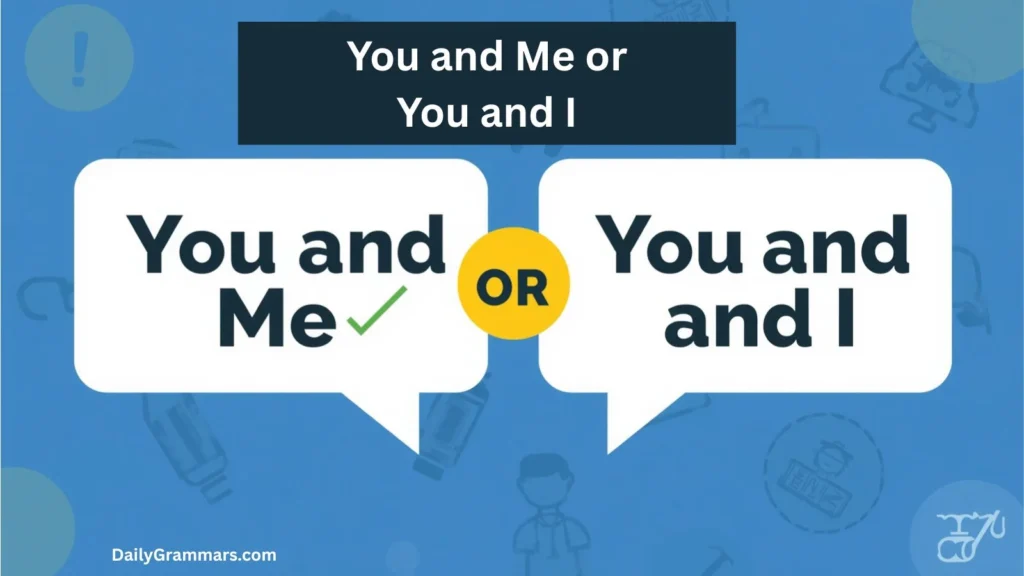
Many people get confused about “you and me” vs “you and I.” Both sound natural in daily speech, but only one is correct depending on the sentence. This grammar rule causes problems in emails, school writing, social media posts, and even professional communication.
People often search for “Both of us or you and I” because they want a quick and simple answer. They may hear someone say, “John invited you and I,” while another person says, “John invited you and me.” So which one is right?
The confusion happens because English uses different pronouns for different jobs in a sentence. “I” is a subject pronoun, while “me” is an object pronoun. Many speakers try to sound formal and accidentally use “you and I” in the wrong place.
|See also Desert or Dessert
This guide explains the difference in very simple words. You will learn when to use each phrase, common mistakes to avoid, and how British and American English treat these expressions. By the end, you will know exactly which one to use with confidence.
You and Me or You and I – Quick Answer
Use “you and I” when the phrase is the subject of the sentence.
Use “you and me” when the phrase is the object of the sentence.
Correct Examples
| Phrase | Example | Correct? |
|---|---|---|
| You and I | You and I are best friends. | ✅ |
| You and me | Sarah called you and me yesterday. | ✅ |
Easy Trick
Remove “you and” from the sentence.
- “I are best friends” ❌
- “Me are best friends” ❌
- “I am best friends” sounds closer to correct → use you and I
Another example:
- “Sarah called I” ❌
- “Sarah called me” ✅ → use you and me
The Origin of You and Me or You and I
The words “I” and “me” come from Old English pronouns used hundreds of years ago.
- I was used for the subject.
- Me was used for the object.
This grammar pattern stayed in modern English.
Why the Confusion Exists
For many years, teachers told students to avoid saying things like:
- “Me and John went to the store.” ❌
Because of this, people started overcorrecting sentences and using “you and I” everywhere, even when it was wrong.
Example:
- “Please send the email to you and I.” ❌
Correct version:
- “Please send the email to you and me.” ✅
The confusion is mostly about grammar position, not spelling.
British English vs American English Spelling
There is no major spelling difference between British and American English for “Both of us” or “you and I.” Both forms use the same grammar rules.
However, informal speech can differ slightly.
American English
Americans often use casual speech in conversation.
Example:
- “Me and you should go.”
This is common in speech but not correct in formal writing.
British English
British speakers may sound slightly more formal in professional settings.
Example:
- “You and I should discuss this later.”
Comparison Table
| Usage Style | American English | British English |
|---|---|---|
| Formal writing | You and I | You and I |
| Object form | You and me | You and me |
| Informal speech | Me and you | Me and you |
| Business emails | More casual | Slightly formal |
Which Spelling Should You Use?
Your choice depends on grammar, not country.
Use “You and I” When:
- The phrase does the action.
- It is the subject of the sentence.
Examples:
- You and I will attend the meeting.
- You and I love music.
Use “You and Me” When:
- The phrase receives the action.
- It is the object of the sentence.
Examples:
- The teacher helped you and me.
- This gift is for you and me.
Audience-Based Advice
| Audience | Best Choice |
|---|---|
| US readers | Follow grammar rules clearly |
| UK readers | Use standard grammar |
| Global audience | Keep sentences simple and formal |
| Social media | Casual speech is acceptable |
| Professional writing | Always use correct grammar |
Common Mistakes with You and Me or You and I
Many grammar mistakes happen because people try to sound smarter or more formal.
Common Errors
| Incorrect Sentence | Correct Sentence |
|---|---|
| She invited you and I. | She invited you and me. |
| Me and you are late. | You and I are late. |
| The gift is for you and I. | The gift is for you and me. |
| You and me went shopping. | You and I went shopping. |
Biggest Grammar Tip
If the phrase receives the action, use me.
If the phrase performs the action, use I.
You and Me or You and I in Everyday Examples
Emails
- “You and I need to review the report.”
- “The manager emailed you and me.”
News Writing
- “You and I must protect the environment.”
- “The award was given to you and me.”
Social Media
- “Me and you forever ❤️”
Common but informal.
Formal Writing
- “You and I appreciate your support.”
- “The contract applies to you and me.”
You and Me or You and I – Google Trends & Usage Data
Search interest for “Both of us or you and I” stays high because many English learners and native speakers struggle with grammar rules.
Popular Countries Searching This Keyword
| Country | Common Search Intent |
|---|---|
| United States | Grammar correction |
| United Kingdom | Formal writing help |
| Canada | School assignments |
| Australia | English learning |
| India | Spoken English improvement |
Usage Context
| Context | Common Form |
|---|---|
| Formal grammar | You and I |
| Casual speech | Me and you |
| Professional emails | You and me / You and I |
| Song lyrics | Flexible grammar |
Many songs and movies use informal grammar because it sounds more natural in conversation.
Comparison Table: You and Me vs You and I
| Phrase | Grammar Role | Example | Formal? |
|---|---|---|---|
| You and I | Subject | You and I are friends. | Yes |
| You and me | Object | She invited you and me. | Yes |
| Me and you | Informal subject | Me and you should leave. | No |
FAQs:
Is it correct to say you and I or you and me?
Use “you and I” as the subject and “you and me” as the object.
Example: “You and I went shopping” vs “She called you and me.”
Do you say John and I or John and Me?
Say “John and I” when it is the subject of the sentence.
Say “John and me” when it is the object.
Is it 70 year old or 70 years old?
Use “70-year-old” before a noun and “70 years old” after a verb.
Example: “a 70-year-old man” and “He is 70 years old.”
Should I say “between you and me” or “between you and I”?
The correct phrase is “between you and me” because “between” needs an object pronoun.
Do you say Sally and Me or Sally and I?
Use “Sally and I” as the subject and “Sally and me” as the object.
Example: “Sally and I are friends.”
What are the 7 personal pronouns?
The common personal pronouns are I, you, he, she, it, we, and they.
Do you say Jim and Me or Jim and I?
Use “Jim and I” for subjects and “Jim and me” for objects.
Example: “Jim and I went home.”
Conclusion
The difference between “you and me” and “you and I” is simple once you understand the grammar rule. Use “you and I” when the phrase acts as the subject of the sentence. Use “you and me” when the phrase receives the action.
A quick test can help you choose correctly. Remove the other person from the sentence. If “I” sounds correct, use “you and I.” If “me” sounds correct, use “you and me.”
This grammar issue confuses many English speakers because informal speech often breaks formal grammar rules. Songs, movies, and social media also make the confusion more common. Still, correct usage matters in professional writing, school assignments, business emails, and formal communication.
Whether you write for American, British, or global audiences, the grammar rule stays the same. Learning this small difference can make your English sound clearer, smarter, and more professional every day.