Have you ever wondered whether to write dose or doze? These two words look almost the same, but they have very different meanings. One is linked to medicine and the amount of something you take. The other describes sleeping lightly or taking a short nap. Using the wrong word can change the meaning of your sentence and confuse your readers.
Many people search for “dose or doze” because the words sound alike. They also differ by just one letter, which makes them easy to mix up when writing emails, school assignments, messages, or professional documents.
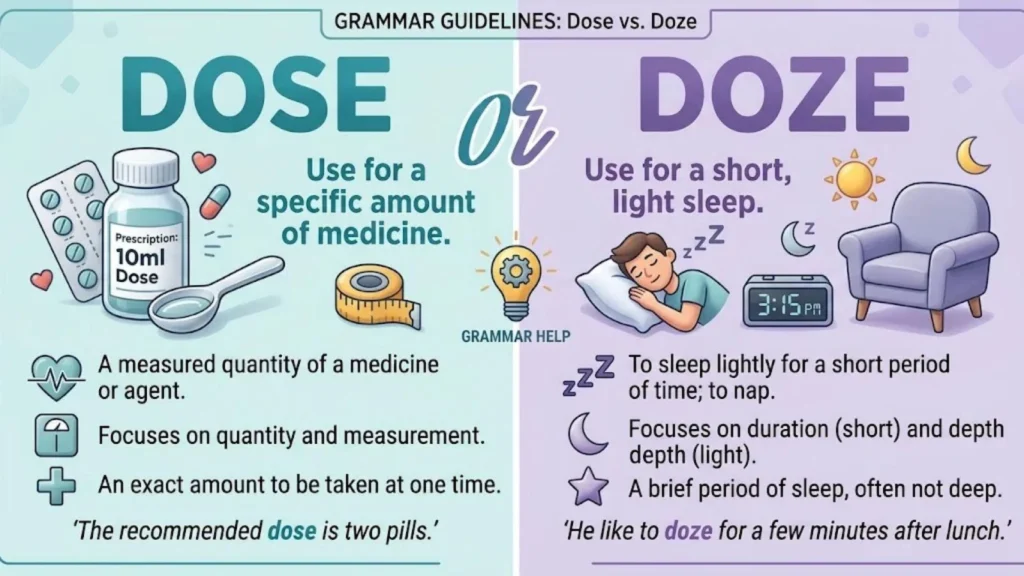
The good news is that learning the difference is simple. A dose is a measured amount of medicine or another substance. A doze is a short period of light sleep.
In this guide, you will learn the meaning, spelling, origin, and correct use of both words. You will also see simple examples, common mistakes, and helpful tips to remember which word to choose. By the end, you will know exactly when to use dose and when to use doze.
Dose or Doze – Quick Answer
The correct word depends on what you want to say. Both dose and doze are correct English words, but they have different meanings.
- Dose: A measured amount of medicine, a drug, or another substance.
- Doze: To sleep lightly or take a short nap.
Examples of Dose
- The doctor gave me a dose of medicine.
- Take one dose of the treatment each morning.
- The nurse checked the correct dose before giving the medicine.
Examples of Doze
- I like to doze after lunch.
- He began to doze during the long journey.
- She took a short doze on the sofa.
Dose vs Doze Comparison Table
| Word | Meaning | Example |
|---|---|---|
| Dose | A measured amount of medicine | Take one dose daily. |
| Doze | A short, light sleep | I had a quick doze. |
| Dosed | Gave or took a measured amount | The nurse dosed the patient. |
| Dozed | Slept lightly | He dozed on the bus. |
| Dosing | Giving measured amounts | Follow the dosing instructions. |
| Dozing | Sleeping lightly | The baby is dozing. |
Easy memory trick: Dose has an S like syrup. Doze has a Z like zzz, the common symbol for sleep.
The Origin of Dose or Doze
The words dose and doze have different histories. Although they sound similar, they come from different language roots.
Origin of Dose
The word dose comes from the Greek word dosis, meaning something given or a giving. It passed through Latin and French before becoming part of English.
Over time, dose became linked to the measured amount of medicine given to a person. Today, it is widely used in healthcare, science, and everyday language.
Examples include:
- A dose of medicine.
- A daily dose of vitamins.
- A small dose of good news.
The word can also describe a measured amount of something that is not medicine.
Origin of Doze
The word doze has a different history. It appeared in English around the 17th century and is linked to words describing light sleep or drowsiness.
It means to sleep for a short time without entering a deep sleep.
Examples include:
- Dozing in a chair.
- Dozing on a train.
- Taking a short doze after work.
The words developed separately. Their similar sounds and spellings are the main reasons people confuse them.
British English vs American English Spelling
There is no spelling difference between British and American English for dose and doze.
Both varieties use the same spelling and meaning. The words do not change when writing for readers in the United States, the United Kingdom, Canada, or Australia.
| Word | British English | American English | Meaning |
|---|---|---|---|
| Dose | Dose | Dose | Measured amount |
| Doze | Doze | Doze | Light sleep |
| Dosed | Dosed | Dosed | Gave or took a dose |
| Dozed | Dozed | Dozed | Slept lightly |
| Dosing | Dosing | Dosing | Giving measured amounts |
| Dozing | Dozing | Dozing | Sleeping lightly |
British English Examples
- The doctor prescribed a dose of medicine.
- I often doze while watching television.
- She took a short doze after lunch.
American English Examples
- Take the recommended dose of medication.
- He started to doze during the movie.
- I had a quick doze on the flight.
Important tip: Neither word has a British or American spelling variation. Choose the word based on its meaning, not your location.
Which Spelling Should You Use?
Choosing between dose and doze is easy when you understand your sentence.
For American Readers
Use dose when talking about medicine, vitamins, or a measured amount.
Example: The doctor recommended a lower dose.
Use doze when talking about light sleep.
Example: I sometimes doze after lunch.
For British Readers
British English follows the same spelling rules.
Examples:
- Take the correct dose of medicine.
- I had a short doze on the sofa.
For Canadian and Australian Readers
Both countries also use dose and doze with the same meanings and spellings.
For Global English
If you write for an international audience, use these simple rules:
- Write dose for medicine or a measured amount.
- Write doze for a short sleep.
- Check the sentence before publishing.
- Use clear examples to avoid confusion.
There is no need to change either spelling for a particular English-speaking country.
Common Mistakes with Dose or Doze
Many writers confuse these words because they sound alike. Here are some common mistakes and their corrections.
| Incorrect Sentence | Correct Sentence | Explanation |
|---|---|---|
| I need a doze of medicine. | I need a dose of medicine. | Dose means an amount of medicine. |
| I want to take a dose after lunch. | I want to take a doze after lunch. | Doze means a short sleep. |
| The patient received a doze. | The patient received a dose. | Dose is used for medication. |
| He took a dose on the sofa. | He took a doze on the sofa. | Doze describes light sleep. |
| She is doseing. | She is dozing. | Dozing means sleeping lightly. |
Mistake 1: Using Doze for Medicine
Incorrect: The doctor gave him a doze of medicine.
Correct: The doctor gave him a dose of medicine.
Mistake 2: Using Dose for Sleep
Incorrect: I had a short dose after lunch.
Correct: I had a short doze after lunch.
Mistake 3: Confusing Their Past Forms
Remember:
- Dosed is the past form of dose.
- Dozed is the past form of doze.
Examples:
- The nurse dosed the patient carefully.
- The passenger dozed during the flight.
Mistake 4: Mixing Their Present Forms
Remember these forms:
- Dose, dosed, dosing.
- Doze, dozed, dozing.
Learning these patterns will help you avoid spelling errors.
Dose or Doze in Everyday Examples
Both words appear in daily conversations, emails, social media, news, and professional writing.
1. In Emails
Dose is common in healthcare and workplace communication.
Example:
“Please follow the doctor’s instructions and take the recommended dose.”
Doze can be used in casual emails.
Example:
“I was so tired after the meeting that I almost started to doze.”
2. In News
Dose often appears in health and medical reports.
Example:
“The health department announced a new vaccination dose.”
Doze may appear in lifestyle or travel stories.
Example:
“Passengers tried to doze during the long overnight journey.”
3. On Social Media
People use both words in informal posts.
Dose examples:
- “A daily dose of happiness makes life better!”
- “Remember to follow your medicine schedule.”
Doze examples:
- “Just need a quick doze before dinner.”
- “I always doze during long car rides.”
4. In Formal Writing
Dose is often used in medical reports, research papers, and health instructions.
Example: “The patient received the prescribed dose under medical supervision.”
Doze is used in descriptions of sleep and behavior.
Example: “The subject appeared to doze briefly during the observation period.”
5. In Everyday Conversation
- “Did you take your dose of medicine?”
- “I need to doze for a few minutes.”
- “The doctor changed the dose.”
- “He began to doze during the film.”
These examples show how context helps you choose the correct word.
Dose or Doze – Google Trends & Usage Data
People search for dose or doze because the words sound similar and have different meanings. Students, English learners, writers, and healthcare readers may look up the difference when they are unsure which spelling to use.
Which Word Is More Popular?
Dose is generally used more often in medical, scientific, and health-related contexts. It appears in discussions about medication, vaccines, vitamins, and treatment.
Doze is used in everyday conversations about sleep, tiredness, naps, and relaxation.
Their popularity can change depending on the topic and search context.
Usage by Country
| Country | Dose Usage | Doze Usage |
|---|---|---|
| United States | Medicine and healthcare | Sleep and relaxation |
| United Kingdom | Medical instructions | Everyday conversation |
| Canada | Healthcare and medicine | Travel and daily life |
| Australia | Medical and health topics | Sleep and rest |
| Pakistan | Medicine and education | English learning and daily conversation |
| India | Healthcare and education | Sleep-related conversations |
How to Check Google Trends
You can compare both words using Google Trends.
Visit: https://trends.google.com/trends/
Follow these steps:
- Search for “dose.”
- Add “doze” as a comparison.
- Select your country or worldwide results.
- Choose a time range.
- Review interest over time and related searches.
Note: Google Trends shows relative search interest, not exact search volumes. The results can change by country, time period, and search category. No specific ranking or numerical trend claim is made here.
Frequently Asked Questions (FAQs)
1. What is the difference between dose and doze?
Dose means a measured amount of medicine or another substance. Doze means to sleep lightly or take a short nap.
2. Is it dose or doze of medicine?
The correct word is dose.
Example: The doctor prescribed a dose of medicine.
Seealso:Inner vs Outer: Meaning, Differences, and Easy Usage Guide
3. Is it a dose or a doze after lunch?
The correct word is doze if you mean a short sleep.
Example: I took a short doze after lunch.
4. Is doze a real English word?
Yes. Doze is a correct English word. It means to sleep lightly or briefly.
Example: The old man began to doze in his chair.
5. What is the past tense of dose?
The past tense of dose is dosed.
Example: The nurse dosed the patient according to the instructions.
6. What is the past tense of doze?
The past tense of doze is dozed.
Example: She dozed during the long journey.
7. Are dose and doze pronounced the same?
No. They have similar sounds, but their final sounds are different. Dose ends with an /s/ sound, while doze ends with a /z/ sound.
8. Is dose or doze used in British and American English?
Both words are used in British and American English. Their spellings and meanings remain the same in both varieties.
Conclusion
Understanding the difference between dose or doze is simple once you learn what each word means. Although they look and sound similar, they are not interchangeable. Dose refers to a measured amount of medicine, a drug, or another substance. Doze means to sleep lightly or take a short nap.
Use dose when writing about medicine, healthcare, vitamins, or measured amounts. For example, “The doctor prescribed a dose of medicine.” Use doze when describing a short period of sleep. For example, “I like to doze after lunch.”
Remember that British and American English use the same spelling for both words. There is no regional spelling rule to worry about. You only need to understand the meaning of your sentence.
A simple way to remember the difference is that dose is connected with medicine, while doze is connected with sleep. Keep this rule in mind when writing emails, schoolwork, social media posts, or professional documents.
With a little practice, you can use both words correctly and avoid this common English spelling mistake.