Have you ever stopped while writing because you were unsure whether to use eying or eyeing? You are not alone. Both spellings appear in English, but one is much more common than the other.
The correct choice for most writing is eyeing. It means looking at someone or something with interest, attention, suspicion, or desire. For example, someone might be eyeing a new car or eyeing the last piece of cake.
The confusion comes from a common English spelling rule. Many verbs drop the final silent e before adding -ing. For example, we write making, not makeing. So, it may seem natural to write eying instead of eyeing.
However, the word eye is a special case. Both forms are recognized, but eyeing is the more widely used spelling. In this guide, you will learn the meaning, history, spelling rules, and examples of both forms. You will also discover which spelling works best in American English, British English, schoolwork, and professional writing.
Seealso:Inner vs Outer: Meaning, Differences, and Easy Usage Guide
Eying or Eyeing – Quick Answer
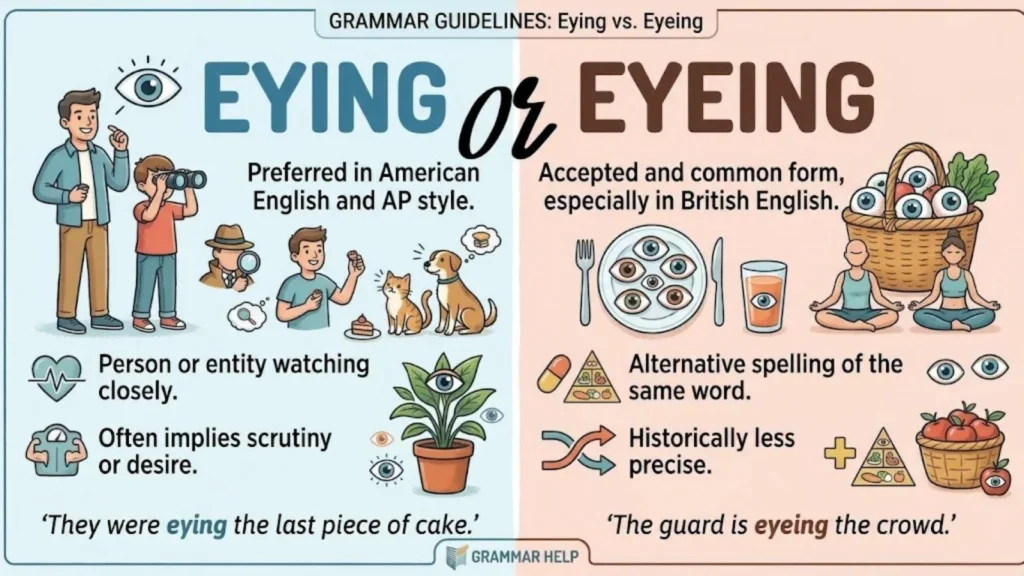
Eyeing is the preferred and most common spelling. Eying is also accepted as a less common spelling variant.
Both words have the same meaning: looking at someone or something with interest, attention, or desire.
Examples:
- She is eyeing the chocolate cake.
- He was eyeing a new sports car.
- The company is eyeing a new business opportunity.
- The dog kept eyeing the food on the table.
The spelling eying is not necessarily wrong, but many readers find eyeing more familiar.
Eying vs Eyeing: Quick Comparison
| Word | Meaning | Usage |
|---|---|---|
| Eyeing | Looking with interest or attention | Most common |
| Eying | Looking with interest or attention | Less common |
| Eye | The organ used for seeing | Base word |
| Eyed | Looked at something | Past tense |
| Eyes | Looks at something | Present tense |
Quick tip: Use eyeing in everyday writing, school assignments, business documents, and professional articles.
The Origin of Eying or Eyeing
The word eyeing comes from the noun eye. The word eye has a long history in the English language and comes from Old English ēage.
Over time, English speakers began using eye as a verb. This means to look at someone or something closely or with interest.
For example:
- She eyed the strange object.
- He is eyeing the new house.
- They are eyeing a chance to win.
When the verb eye takes the ending -ing, two spellings develop: eyeing and eying.
This happens because English has different spelling patterns. Some verbs keep their final silent e, while others drop it before adding -ing.
The spelling eyeing keeps the full base word easy to recognize. The spelling eying follows the common rule of dropping the final e.
Both forms have appeared in English, but eyeing has become the more familiar choice.
British English vs American English Spelling
British English and American English have many spelling differences.
For example:
- British English: Colour
- American English: Color
- British English: Centre
- American English: Center
However, eyeing does not have a major British and American spelling difference.
Both varieties generally prefer eyeing.
American English
In American English, eyeing is the usual spelling.
Examples:
- She is eyeing a new job.
- Investors are eyeing the stock market.
- He kept eyeing the expensive watch.
Although eying may appear in some American writing, eyeing is the safer choice.
British English
British English also commonly uses eyeing.
Examples:
- The team is eyeing a place in the final.
- She was eyeing a beautiful dress.
- The company is eyeing new markets.
Writers in the UK generally use the same spelling as American writers.
British vs American Spelling Comparison
| Word | American English | British English |
|---|---|---|
| Eyeing | Eyeing | Eyeing |
| Eying | Less common | Less common |
| Colour / Color | Color | Colour |
| Centre / Center | Center | Centre |
| Organise / Organize | Organize | Organise |
| Travelling / Traveling | Traveling | Travelling |
The key point is simple: there is no need to change eyeing when writing for British or American readers.
Which Spelling Should You Use?
The best spelling depends on your audience and the type of writing.
However, eyeing is the safest choice for almost every situation.
For American Readers
Use eyeing in American English.
It is familiar to readers and looks natural in everyday and professional writing.
Example:
“The business is eyeing a new location.”
For British and Commonwealth Readers
Use eyeing in British English, Australian English, Canadian English, and other Commonwealth writing.
Example:
“The club is eyeing a place in the championship.”
For Global Readers
If your article, website, or business content targets readers worldwide, choose eyeing.
It is widely recognized and helps avoid spelling confusion.
For School and Academic Writing
Use eyeing in essays, reports, assignments, and research papers.
It is the more familiar form and is less likely to be mistaken for a spelling error.
Professional advice: Choose eyeing and use it consistently throughout your writing.
Common Mistakes with Eying or Eyeing
Many English learners and native speakers make spelling mistakes when using eyeing and eying.
Here are some common mistakes and how to avoid them.
1. Thinking Eying Is Always Wrong
Some writers believe eying is completely incorrect. However, it is an accepted spelling variant.
Better choice: Use eyeing because it is more widely recognized.
2. Adding an Extra Letter
Incorrect: She is eyeeing the new dress.
Correct: She is eyeing the new dress.
The word needs only one e after the y.
3. Using the Wrong Verb Form
Incorrect: He is eyed the new car.
Correct: He is eyeing the new car.
Use eyeing for an action happening now.
4. Confusing Eyeing with Looking
The word eyeing does not always mean simply looking. It often suggests interest, attention, suspicion, or desire.
Example:
- She looked at the window. (General action)
- She was eyeing the expensive necklace. (Looking with interest)
5. Using Both Spellings in One Article
Avoid switching between eying and eyeing without a reason.
Choose one spelling and keep it consistent. For professional writing, eyeing is the better option.
Eying or Eyeing in Everyday Examples
The word eyeing is useful in everyday conversations, emails, news articles, and formal writing.
Here are some examples.
1. In Emails
You can use eyeing when discussing plans, products, or opportunities.
Examples:
- I am eyeing a new laptop for my office.
- We are eyeing a possible business partnership.
- She is eyeing a promotion at work.
2. In News Articles
News writers often use eyeing when discussing plans, investments, and future goals.
Examples:
- The company is eyeing expansion into new markets.
- The team is eyeing another championship.
- Investors are eyeing new opportunities.
3. On Social Media
People often use eyeing in casual posts and comments.
Examples:
- Eyeing that beautiful new phone!
- I am eyeing the last slice of pizza.
- Still eyeing those new shoes!
4. In Formal Writing
The word also works well in professional reports and business documents.
Examples:
- The organization is eyeing new investment opportunities.
- The committee is eyeing several possible changes.
- The company is eyeing international growth.
Everyday Usage Comparison
| Situation | Example |
|---|---|
| I am eyeing a new computer. | |
| News | The team is eyeing the title. |
| Social media | Eyeing that new dress! |
| Business | We are eyeing a new market. |
| School | The student was eyeing the book. |
| Conversation | He is eyeing my sandwich. |
These examples show that eyeing works in both casual and professional situations.
Eying or Eyeing – Google Trends & Usage Data
People search for eying or eyeing because they want to know which spelling is correct.
The two spellings have the same meaning, but eyeing is the more common choice in modern written English.
Which Spelling Is More Popular?
In everyday writing, books, news articles, and online content, eyeing is generally preferred.
It is widely used in:
- The United States
- The United Kingdom
- Canada
- Australia
- India
- Other English-speaking regions
The spelling eying is much less common and may appear when writers follow the usual rule of dropping a silent final e before adding -ing.
What Does Google Trends Tell Us?
Google Trends can help writers compare search interest for different words and phrases.
However, there is an important point: Google Trends does not provide exact search counts. It uses a relative scale from 0 to 100. Low-volume searches may also show no visible data. Trends Help+1
Google also explains that spelling variations and misspellings may not receive results when entered as separate search terms. Therefore, a direct comparison may not show the full picture. Trends Help
For an accurate comparison, writers should:
- Open Google Trends.
- Search for “eyeing” and “eying” separately.
- Select the same time period.
- Compare the United States, United Kingdom, Canada, and Australia.
- Check the results before making claims about search popularity.
SEO advice: Use eyeing in your main title, headings, and article text. You can also mention eying naturally to answer readers searching for the alternative spelling.
Comparison Table: Eying vs Eyeing
| Feature | Eying | Eyeing |
|---|---|---|
| Correct spelling | Accepted variant | Yes |
| Meaning | Looking with interest | Looking with interest |
| Pronunciation | Same | Same |
| Popularity | Less common | More common |
| American English | Less common | Preferred |
| British English | Less common | Preferred |
| Formal writing | Less preferred | Recommended |
| Everyday writing | Rare | Common |
| SEO choice | Secondary keyword | Main keyword |
| Best option | Alternative | Preferred |
The table shows that both forms have the same meaning. However, eyeing is the better spelling for most readers and writing situations.
FAQs About Eying or Eyeing
1. Is It Eying or Eyeing?
Eyeing is the preferred spelling. Eying is also an accepted but less common variant. Use eyeing in most writing.
2. Is Eying a Real Word?
Yes. Eying is a recognized spelling variant of eyeing. Both words mean looking at someone or something with interest or attention.
3. Why Is Eyeing Spelled with Two Es?
The word eyeing keeps the original spelling of the word eye. This makes the base word easy to recognize. English spelling patterns allow some words to keep their final letters when adding -ing.
4. Is Eyeing American or British English?
Eyeing is used in both American and British English. It is also common in Canadian and Australian English.
5. What Does Eyeing Mean?
Eyeing means looking at someone or something with interest, attention, suspicion, or desire.
Example: “The child was eyeing the birthday cake.”
6. Is Eyeing Correct in Formal Writing?
Yes. Eyeing is suitable for formal writing, business reports, academic work, and professional emails.
7. Does Eying Mean Something Different from Eyeing?
No. Both spellings have the same meaning and pronunciation. The main difference is how commonly they are used.
8. Which Spelling Is Better for SEO?
Eyeing is the better primary spelling for SEO content because it is the more familiar and widely used form. You can include eying as a secondary keyword to cover spelling questions.
Conclusion
Choosing between eying or eyeing can be confusing, but the answer is simple. Eyeing is the preferred spelling, while eying is an accepted but less common variant. Both words have the same meaning and pronunciation.
The word comes from eye and describes looking at someone or something with interest, attention, suspicion, or desire. You can use it when talking about a person looking at a product, a company planning to enter a new market, or a team hoping to win a competition.
There is no major spelling difference between British and American English. Both varieties generally use eyeing. This makes it a safe choice for readers around the world.
For school assignments, business emails, websites, news articles, and professional documents, it is best to choose eyeing. It is easy to recognize and looks natural in modern English.
Remember this simple tip: when you are unsure, write eyeing. It is the spelling most readers will expect. Once you understand this small spelling difference, you can write with greater confidence and avoid unnecessary mistakes.