Have you ever wanted to praise someone for doing a great job but wondered whether to write “cudos” or “kudos”? You are not alone. Many people make this spelling mistake in emails, social media posts, schoolwork, and professional messages.
The correct spelling is kudos. It is a word used to show praise, respect, or admiration for someone’s work or success. For example, you might say, “Kudos to you for finishing the project on time!”
The spelling “cudos” is a common mistake, not the standard English form. Both words may sound similar when spoken, which can make the correct spelling harder to remember. People may also confuse the word with other expressions of praise, such as “congratulations” or “well done.”
Understanding the difference helps you write more clearly and sound more professional. Whether you are writing a work email, a school assignment, a news article, or a casual message to a friend, using the correct word matters.
In this guide, you will learn the meaning, origin, spelling rules, and everyday uses of “kudos.” You will also discover common mistakes and practical tips to help you remember the right spelling.
Cudos or Kudos – Quick Answer
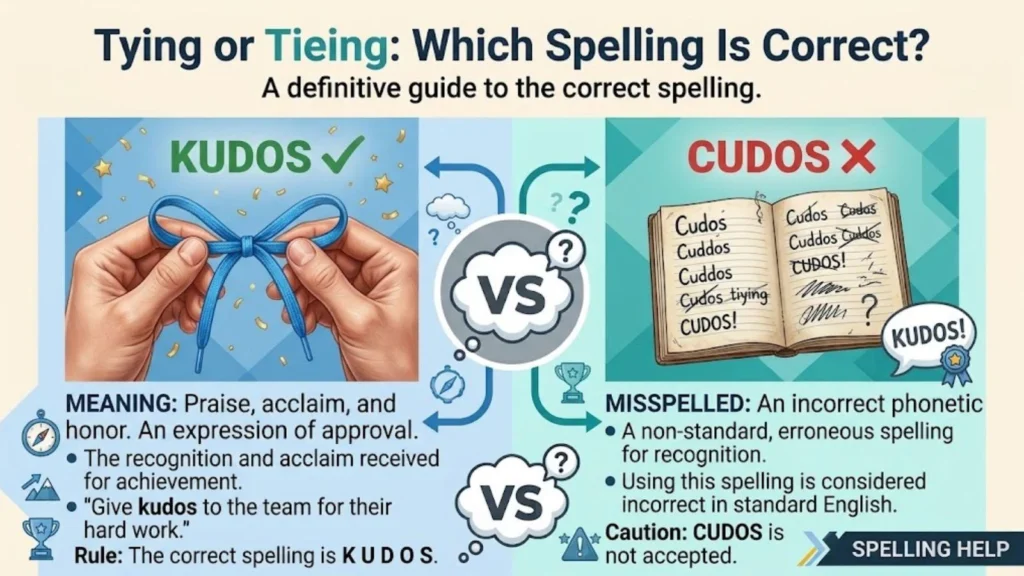
Kudos is correct. Cudos is a misspelling.
The word “kudos” means praise, credit, or recognition for an achievement.
Examples:
- Correct: Kudos to Sarah for winning the competition.
- Incorrect: Cudos to Sarah for winning the competition.
- Correct: The team deserves kudos for its hard work.
- Incorrect: The team deserves cudos for its hard work.
Use “kudos” when you want to recognize someone’s effort, skill, or success.
The Origin of Kudos
The word “kudos” comes from the ancient Greek word kydos, which means glory, fame, or honor. It was used to express the respect or recognition someone earned through an achievement.
American Heritage Dictionary
+1
The word entered English in the 19th century. At first, it appeared mainly in academic settings. Later, it became more common in newspapers and everyday conversation.
Why do people write “cudos” instead of “kudos”? The main reason is that the words sound similar. When people hear a word without seeing it written, they may guess the spelling based on familiar English sounds.
The confusion also comes from the final letter s. Many English nouns use “s” to form a plural, so some people assume that “kudos” must be plural. This has also led to the use of “kudo” as a singular noun in modern English, although traditional usage treats “kudos” as singular.
Canada.ca
+1
Remember that the original spelling is kudos, beginning with the letter K. There is no standard English spelling rule that changes it to “cudos.”
British English vs American English Spelling
British English and American English use the same spelling: kudos.
Unlike words such as “colour” and “color,” this word does not have separate British and American spellings. The main differences are in pronunciation and usage, not spelling.
| Feature | British English | American English |
|---|---|---|
| Correct spelling | Kudos | Kudos |
| Incorrect spelling | Cudos | Cudos |
| Meaning | Praise or recognition | Praise or recognition |
| Common pronunciation | Often “KYOO-doss” | Often “KOO-dohz” |
| Formal usage | Kudos is traditionally singular | Kudos is commonly used as praise; plural-like usage also occurs |
| Example | Kudos to the team for its success. | Kudos to the team for its success. |
Pronunciation varies among speakers, so these examples are general guides rather than strict rules.
Dictionary.com
+1
Examples in British and American English
British English:
- Kudos to the students for their excellent results.
- She earned kudos for her leadership.
- The company received kudos for its service.
American English:
- Kudos to everyone who helped with the event.
- He deserves kudos for solving the problem.
- The team received kudos from its manager.
All these examples use the same correct spelling. You do not need to change “kudos” when writing for a British or American audience.
Which Spelling Should You Use?
The answer is simple: use kudos in every English-speaking country.
Your audience may affect your choice of tone, but it does not affect the spelling of this word.
For a US audience
Use “kudos” in emails, workplace messages, articles, and casual conversations.
Example: “Kudos to the marketing team for reaching its target.”
For a UK or Commonwealth audience
Use “kudos” in the same way. It is suitable for professional communication, academic writing, and everyday speech.
Example: “Kudos to the volunteers for their hard work.”
For a global audience
Use “kudos” when you want to praise someone’s effort or achievement. The word is widely understood in English, though a phrase such as “well done” or “congratulations” may be clearer for readers with limited English skills.
Example: “Kudos to everyone who contributed to the project.”
Professional writing advice
In a formal email, “kudos” is generally acceptable, but “I appreciate your work” or “Congratulations on your achievement” may sound more precise.
For example:
- Casual: “Kudos on a job well done!”
- Professional: “Congratulations on completing the project successfully.”
- Formal recognition: “Your contribution to this project is greatly appreciated.”
Choose the phrase that best matches your relationship with the reader and the situation.
Common Mistakes with Cudos or Kudos
People often make spelling and grammar mistakes when using this word. Here are the most common errors and how to correct them.
| Common mistake | Correct form | Explanation |
|---|---|---|
| Cudos to you! | Kudos to you! | The correct word begins with K. |
| Many cudos | Much kudos | Use the standard spelling; “much kudos” treats it as a mass noun. |
| A cudos for your work | Kudos for your work | Do not add an article before “kudos” in this construction. |
| He deserves a kudos. | He deserves kudos. | The standard form does not need “a.” |
| Kudo’s to the winner | Kudos to the winner | No apostrophe is needed. |
| Kudo’s for your success | Kudos for your success | “Kudo’s” is not the correct spelling for praise. |
Mistake 1: Writing “Cudos”
This is the most common confusion in the keyword “cudos or kudos.”
Incorrect: “Cudos to my teacher for helping me.”
Correct: “Kudos to my teacher for helping me.”
Tip: Remember that “kudos” begins with K, just like “kindness” and “knowledge.”
Mistake 2: Using an Apostrophe
An apostrophe does not belong in the ordinary expression of praise.
Incorrect: “Kudo’s to the whole team!”
Correct: “Kudos to the whole team!”
Mistake 3: Treating “Kudos” Like a Regular Plural
Traditionally, “kudos” is a singular noun, even though it ends in S. Some modern speakers use it in plural-like ways, but formal writing is clearer when you treat it as a singular mass noun.
American Heritage Dictionary
+1
Instead of writing “The kudos are impressive,” you can write:
“The praise is impressive.”
Or:
“The recognition is well deserved.”
Mistake 4: Using “A Kudos”
Avoid adding “a” directly before “kudos” when following traditional usage.
Incorrect: “She received a kudos for her work.”
Better: “She received kudos for her work.”
You can also say, “She received an award for her work.”
Mistake 5: Using It in the Wrong Context
“Kudos” is a word of praise. It is not a synonym for every kind of feedback.
For example, “Kudos for your excellent presentation” expresses approval. If you want to point out a problem, use words such as “feedback,” “criticism,” or “suggestion” instead.
Kudos in Everyday Examples
The word “kudos” works in many settings, from casual chats to professional communication. Here are examples you can use in daily life.
1. In Emails
Use “kudos” to recognize someone’s work or thank a team for an achievement.
Hi Team,
Kudos to everyone for the hard work and teamwork that made this project a success. Your effort and commitment are greatly appreciated.
Best regards,
[Your Name]
This message is friendly and professional. It works well when you want to recognize a group’s effort.
2. In News Articles
News writers may use “kudos” to describe praise received by a person, team, or organization.
Examples:
- The school earned kudos for improving student performance.
- The local team received kudos after winning the final.
- The organization won kudos for its community service.
In formal news writing, the word can add a concise and positive tone.
3. On Social Media
“Kudos” is popular in casual praise because it is short and easy to understand.
Examples:
- Kudos to my friend for graduating!
- Huge kudos to everyone who helped today.
- Kudos to the volunteers for making the event possible.
You can also use it in a caption, comment, or congratulatory post.
4. In Formal Writing
In reports and business documents, “kudos” can work when the tone is not overly technical.
Examples:
- The department received kudos for its outstanding performance.
- The manager praised the staff for meeting the deadline.
- The project earned recognition for its high quality.
For a more formal tone, consider “recognition,” “commendation,” or “praise.”
5. In School and Academic Work
Students can use “kudos” in informal classroom discussions or messages to classmates.
Examples:
- Kudos to everyone who passed the exam.
- The teacher gave the class praise for its hard work.
- Kudos to Maria for presenting her research clearly.
For a formal academic essay, “recognition” or “praise” may be a better choice, depending on the subject.
6. In Workplace Conversations
“Kudos” is often used when colleagues want to recognize good work.
Examples:
- Kudos for completing the task ahead of schedule.
- Kudos to the support team for helping our customers.
- The manager gave kudos to the staff during the meeting.
These examples show how the word can create a positive and encouraging tone.
Cudos or Kudos – Google Trends & Usage Data
People search for “cudos or kudos” because they want to know which spelling is correct, what the word means, and how to use it properly.
The standard spelling is “kudos.” The alternative “cudos” is generally a spelling error.
Which countries use “kudos”?
“Kudos” is used in several English-speaking regions, including:
- United States: Common in workplace messages, online discussions, and news writing.
- United Kingdom: Used to express praise, respect, or admiration.
- Canada: Common in everyday English and professional communication.
- Australia and New Zealand: Used to recognize achievements and good work.
- Other English-speaking communities: Understood in many international business and online settings.
These are general usage observations, not a ranking of search volume by country.
What does Google Trends tell us?
Google Trends measures the relative popularity of search terms over a selected period and location. It does not automatically provide exact search counts.
For the keyword “cudos or kudos,” users may be searching for:
- The correct spelling.
- The definition of “kudos.”
- The difference between “cudos” and “kudos.”
- Examples of the word in sentences.
- The correct grammar and pronunciation.
I cannot verify a current Google Trends comparison for these exact terms here, so I will not claim that one country has the highest search volume or provide unsupported popularity figures.
For SEO content, the most useful approach is to answer the spelling question immediately, explain the word’s meaning, and include natural examples that match what readers want to know.
Cudos vs Kudos: Comparison Table
This table summarizes the main differences between the correct word and common variations.
| Word or phrase | Correct? | Meaning or use |
|---|---|---|
| Kudos | Yes | Praise or recognition for an achievement |
| Cudos | No | Common misspelling of “kudos” |
| Kudo | Context-dependent | A modern back-formation used by some speakers for one instance of praise |
| Kudos to you | Yes | An expression of praise |
| Many kudos | Common, but less traditional | A plural-like use of “kudos” |
| Kudos’s | Generally incorrect for ordinary praise | Unnecessary or incorrect apostrophe use |
| Praise | Yes | A general word for approval or admiration |
| Congratulations | Yes | An expression of happiness about someone’s success |
Best advice: Use “kudos” as your default choice. In formal writing, avoid “cudos” and prefer alternatives such as “praise,” “recognition,” or “congratulations” when they fit better.
Frequently Asked Questions (FAQs)
1. Is it cudos or kudos?
“Kudos” is correct. “Cudos” is a common misspelling. Use “kudos” when praising someone for their effort, success, or achievement.
2. What does kudos mean?
“Kudos” means praise, honor, or recognition for something well done. For example, “Kudos to Ali for helping the team” means Ali deserves praise for his contribution.
3. Is kudos singular or plural?
Traditionally, “kudos” is a singular noun, even though it ends in S. It is often used as a mass noun, as in “She received kudos for her work.” Some modern speakers treat it as plural or use “kudo” as a singular count noun.
4. Is cudos ever correct?
“Cudos” is not the standard spelling of the English word meaning praise. If you want to recognize someone’s achievement, write “kudos.”
5. Can I use kudos in a professional email?
Yes. “Kudos” is suitable for many workplace emails and team messages. For example, “Kudos to the team for completing the project on time.” For highly formal communication, “I appreciate your contribution” may be more appropriate.
6. Is kudos the same in British and American English?
Yes. Both British and American English use the spelling “kudos.” Pronunciation can vary, but the spelling and general meaning remain the same.
7. What is another word for kudos?
Useful alternatives include “praise,” “recognition,” “credit,” “commendation,” and “congratulations.” The best choice depends on the sentence. For example, “She received recognition for her work” is suitable for formal writing.
8. How do I remember the correct spelling of kudos?
Remember that “kudos” starts with K. You can connect it with the phrase “Keep up the good work!” Both begin with K and express a positive message.
Conclusion
When choosing between “cudos or kudos,” the correct answer is kudos. It is the standard English word for praise, honor, or recognition earned through an achievement. The spelling “cudos” is a common mistake and should be avoided in schoolwork, professional emails, articles, and everyday messages.
The word comes from Greek and entered English during the 19th century. Although its final S makes it look plural, traditional English usage treats “kudos” as a singular noun. Modern speakers sometimes use it in plural-like ways, but using the standard form is a safe choice for formal writing.
You can use “kudos” in many situations. Praise a colleague for completing a task, congratulate a friend on graduation, or recognize a team for reaching a goal. For formal documents, words such as “recognition,” “commendation,” and “appreciation” may sometimes be more precise.
The key lesson is simple: spell the word with K, choose a phrase that suits your audience, and use it when you want to recognize good work. With these tips, you can avoid the common mistake and communicate clearly and confidently.