Have you ever stopped while writing a sentence and wondered whether to use tying or tieing? You are not alone. Many people find this word confusing because English spelling rules can change when we add endings to words.
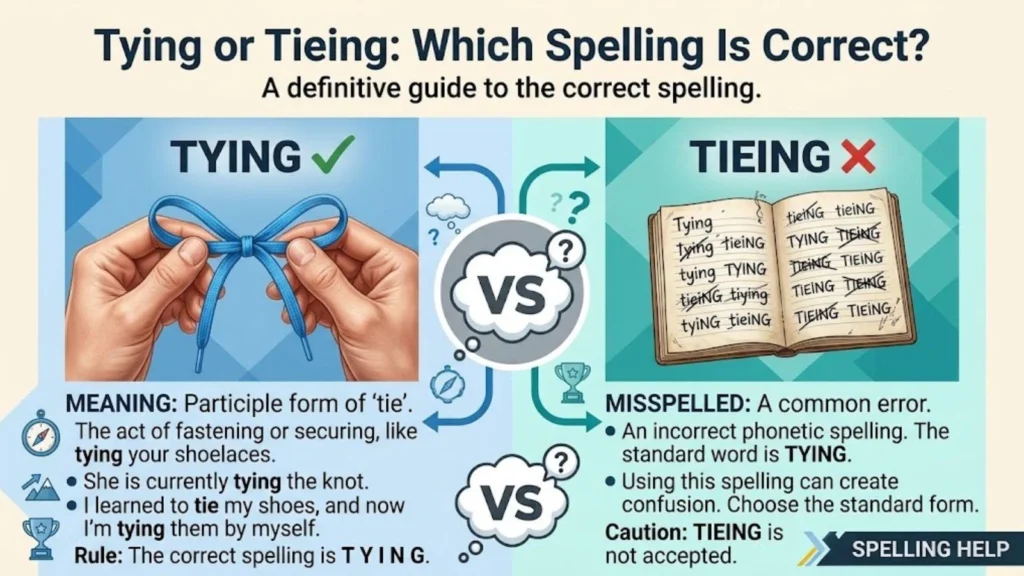
The good news is that the answer is simple: tying is the correct spelling, while tieing is generally considered incorrect. You should write “tying your shoes,” “tying a knot,” or “tying the ribbon.”
This spelling question often comes up in schoolwork, emails, social media posts, and professional writing. The confusion happens because the word “tie” ends with the letter e. Many English words keep their final e when an ending is added, while others drop it. The word “tie” follows a special pattern because its final letters change when we add -ing.
In this guide, you will learn why “tying” is correct, how the spelling rule works, and how to use the word in everyday sentences. You will also see examples, common mistakes, and answers to frequently asked questions. By the end, you will know which spelling to choose and how to avoid this mistake in your writing.
Tying or Tieing – Quick Answer
Tying is correct. Tieing is incorrect in standard modern English.
The word “tying” is the present participle of the verb “tie.” It means fastening, joining, or securing something with a knot or similar method.
Examples:
- Correct: She is tying her shoelaces.
- Correct: He is tying a ribbon around the gift.
- Correct: They are tying the boat to the dock.
- Incorrect: She is tieing her shoelaces.
Remember this simple rule: when a verb ends in -ie, change ie to y before adding -ing.
For example, “tie” becomes “tying,” and “lie” becomes “lying.”
The Origin of Tying or Tieing
The word “tying” comes from the verb “tie,” which has long been used to describe fastening things together with string, rope, or similar materials.
The verb “tie” developed from older forms of English and Germanic languages. Over time, it became a common word for joining, securing, or connecting objects.
The spelling confusion comes from the way English handles verbs that end in -ie.
When you add -ing to “tie,” you change the final ie to y and then add ing. This gives you “tying.”
The same rule applies to other verbs:
- Lie → Lying: He is lying on the sofa.
- Die → Dying: The plant is dying.
- Tie → Tying: She is tying her hair back.
Why does English use this pattern? It helps avoid awkward letter combinations and keeps the spelling of these words consistent with established English usage.
Although “tieing” may look logical at first, it is not the standard spelling. Dictionaries and professional writing use “tying.”
British English vs American English Spelling
The spelling of “tying” is the same in both British and American English.
Some English words have different spellings depending on the country. For example, British English uses “colour,” while American English uses “color.” However, “tying” does not follow this regional difference.
Both British and American writers should use “tying.”
| Word or phrase | British English | American English |
|---|---|---|
| Present participle of tie | Tying | Tying |
| Present participle of lie | Lying | Lying |
| Present participle of die | Dying | Dying |
| Past tense of tie | Tied | Tied |
| Present tense of tie | Tie | Tie |
| Incorrect spelling | Tieing | Tieing |
Why Is Tying Spelled Without the E?
English has several rules for adding -ing to verbs.
- Drop the final e: Make becomes making, and write becomes writing.
- Change ie to y: Tie becomes tying, and lie becomes lying.
- Double the final consonant in some words: Run becomes running, and sit becomes sitting.
The second rule explains why “tying” is correct. You replace the letters ie with y before adding -ing.
For example:
- Tie + ing = tying
- Lie + ing = lying
- Die + ing = dying
You do not need to memorize every English spelling rule at once. Learning these common examples will help you recognize the pattern.
Which Spelling Should You Use?
The best spelling to use is tying, regardless of your audience or location.
Here is some advice for different readers.
For American English Readers
Use “tying” in school assignments, business emails, articles, and everyday writing.
Example: “I am tying the package with a blue ribbon.”
Do not use “tieing,” even if you think it follows the usual rule for adding -ing.
For British English Readers
British English also uses “tying.” There is no regional spelling difference for this word.
Example: “She is tying her hair before going to work.”
The spelling remains the same in the United Kingdom, Australia, and other countries that commonly use British English conventions.
For Global and Professional Audiences
If you are writing for an international audience, choose “tying.” It is the accepted standard spelling in modern English.
This is especially important for:
- Website articles and blog posts
- Academic assignments
- Business communications
- News reports
- Product descriptions
- Social media content
Professional tip: If you are unsure about a spelling, check a trusted dictionary before publishing. For “tying,” you can confidently use the same spelling in almost every standard English context.
Common Mistakes with Tying or Tieing
Many people make spelling mistakes because they apply a familiar rule to the wrong word. Here are some common errors and how to correct them.
| Common mistake | Correct form | Explanation |
|---|---|---|
| Tieing a knot | Tying a knot | Change ie to y before adding -ing. |
| Lieing on the bed | Lying on the bed | “Lie” becomes “lying.” |
| Tieing my shoes | Tying my shoes | “Tying” is the standard spelling. |
| She is tieing it up | She is tying it up | Remove the incorrect spelling. |
| I am tieing a ribbon | I am tying a ribbon | Use the accepted present participle. |
Mistake 1: Keeping the Letters “ie”
Some writers keep the original letters and add -ing, producing “tieing.”
Correction: Change ie to y before adding -ing.
Mistake 2: Applying the Wrong Spelling Rule
You may know that some verbs simply drop their final e, such as “write” becoming “writing.” But “tie” follows the ie-to-y rule.
Correction: Remember the pattern “tie, tying.”
Mistake 3: Assuming British and American English Differ
Some words have regional spelling differences, but this is not one of them.
Correction: Use “tying” in both British and American English.
Mistake 4: Forgetting to Proofread
A misspelling can remain unnoticed when you write quickly or rely on autocorrect.
Correction: Read your sentence again or use a spelling checker before publishing it.
Tying or Tieing in Everyday Examples
The word “tying” appears in many everyday situations. It can describe fastening objects, connecting items, or making a knot.
Here are examples of how to use it in different types of writing.
1. In Emails
Use “tying” when discussing tasks that involve fastening or securing something.
Example:
Hi Team,
I am tying the packages with labels before sending them to our customers. Please let me know if any additional items need to be prepared.
Best regards
2. In News Reports
News writing may use “tying” to describe connections, events, or physical actions.
Example: “The workers were tying safety ropes before starting the repair work.”
Another example: “The investigation is tying several events together.”
In the second sentence, “tying” is used figuratively to describe connecting related facts.
3. On Social Media
People often use “tying” in casual posts about daily activities.
Examples:
- “Finally tying up my running shoes and heading out!”
- “Tying the perfect bow on this birthday gift.”
- “Busy day tying everything together before the big event.”
4. In Formal Writing
Use “tying” in reports, essays, and professional documents when describing an ongoing action.
Example: “The study is tying the observed changes to several environmental factors.”
Another example: “The technician is tying the cables together to keep the workspace organized.”
These examples show that “tying” works in both literal and figurative contexts.
Tying or Tieing – Google Trends & Usage Data
People search for “tying or tieing” because the spelling rule is not always obvious. The final letters of “tie” make it tempting to keep the original spelling when adding -ing.
However, “tying” is the standard spelling in both American and British English.
A live Google Trends comparison would be needed to report exact search volumes, popularity scores, or country-by-country rankings. Without current trend data, it would be misleading to claim specific numbers or name a country as the leader.
Here is how to understand the likely search intent behind these terms:
| Search term | What the searcher wants to know |
|---|---|
| Tying or tieing | Which spelling is correct? |
| How to spell tying | The correct spelling of the word |
| Tying meaning | The definition and usage |
| Tying a knot | How to describe fastening something |
| Tie + ing spelling rule | Why the spelling changes |
Why Do People Search for This Keyword?
There are three common reasons:
- Spelling confusion: People wonder whether to keep the letters ie.
- School and work: Writers want to avoid mistakes in assignments, reports, and emails.
- Search engine checks: People use Google to confirm the correct spelling before publishing content.
For SEO writers, this keyword is useful because it answers a specific spelling question. A good article should provide the correct form immediately, explain the rule, and offer examples that readers can use.
Comparison Table: Tying vs Tieing and Related Words
The following table compares the two spellings and other words that follow similar rules.
| Word | Correct spelling? | Example |
|---|---|---|
| Tying | Yes | She is tying her shoes. |
| Tieing | No, in standard modern English | Use “tying” instead. |
| Lying | Yes | He is lying on the grass. |
| Lieing | No | Use “lying” instead. |
| Dying | Yes | The dying plant needs water. |
| Dieing | No, for the usual verb “die” | Use “dying” instead. |
| Tied | Yes | He tied the rope securely. |
| Ties | Yes | She ties her shoes every morning. |
The key lesson is that verbs ending in -ie usually change those letters to y before taking the -ing ending.
FAQs About Tying or Tieing
1. Is tying or tieing correct?
“Tying” is correct. “Tieing” is not the standard spelling in modern English. Always write “tying a knot” or “tying your shoes.”
Seealso:Inner vs Outer: Meaning, Differences, and Easy Usage Guide
2. Why is tying spelled with a y?
When a verb ends in -ie, the letters ie change to y before adding -ing. That is why “tie” becomes “tying.”
3. Is tieing ever acceptable?
“Tieing” may appear as a spelling error or an unusual historical form, but it is not accepted as the standard modern spelling. Use “tying” in ordinary writing.
4. Is tying correct in British English?
Yes. British English uses “tying,” just like American English. There is no regional spelling difference for this word.
5. What is the difference between tie and tying?
“Tie” is the base verb. “Tying” describes an ongoing action or can function as a gerund.
Examples:
- “I need to tie my shoes.”
- “I am tying my shoes.”
- “Tying knots takes practice.”
6. What are some words that follow the same spelling rule?
“Lying” and “dying” follow the same pattern.
- Lie → Lying
- Die → Dying
- Tie → Tying
7. How can I remember the correct spelling?
Remember this short rule: If a verb ends in “ie,” change “ie” to “y” before adding “-ing.”
Think of “tie, tying” whenever you need to check the spelling.
Conclusion: Tying or Tieing?
When choosing between “tying or tieing,” the correct spelling is tying. This form is used in standard modern English, including British English, American English, and other English-speaking regions.
The reason is simple: verbs ending in -ie usually change those letters to y before adding -ing. This gives us “tie” becoming “tying,” “lie” becoming “lying,” and “die” becoming “dying.”
You can use “tying” in everyday conversations, school assignments, emails, news articles, and professional documents. Whether you are tying your shoes, tying a ribbon, or tying several ideas together in a report, the spelling stays the same.
If you are writing for a website or creating SEO content, using the correct form helps your article look clear and professional. Remember that this is not a British-versus-American spelling issue. Both varieties use “tying.”
The easiest way to avoid this mistake is to remember the ie-to-y rule and check your writing before publishing it. Once you learn this pattern, you will find it easier to spell similar words correctly.
Final answer: Use “tying,” not “tieing.”