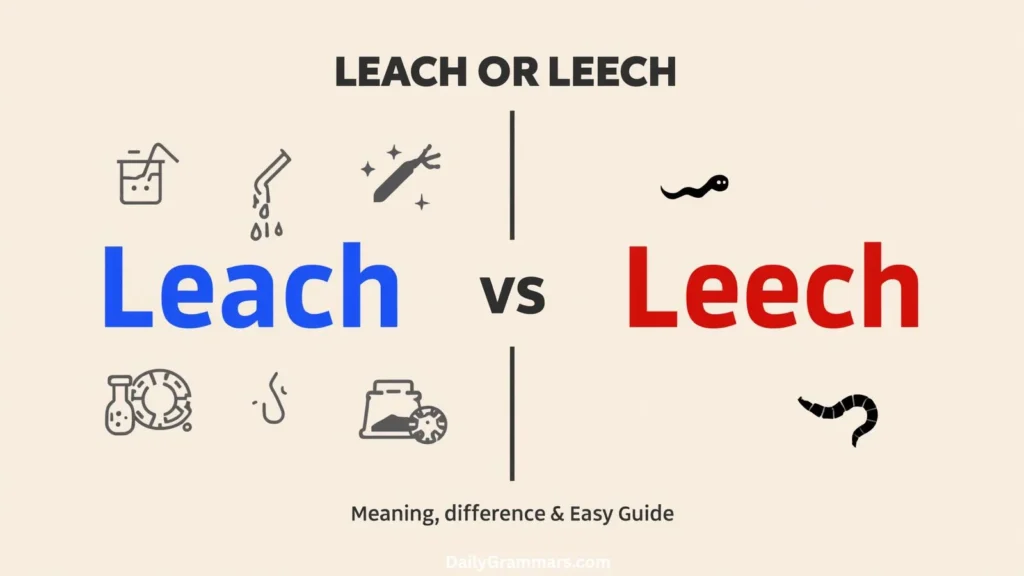
Many people search for “leach or leech” because the two words look similar and sound close. Yet they have very different meanings. One word relates to removing chemicals or liquids, while the other describes a blood-sucking worm or a person who depends on others too much.
|See more Digraph vs Diphthong
This spelling confusion often appears in school essays, emails, social media posts, science articles, and everyday writing. For example, someone may write “toxins leech into water” when the correct word should be “leach.” Others may accidentally use “leach” when talking about a parasite or an annoying person.
Understanding the difference between leach and leech helps your writing look more professional and clear. It also prevents embarrassing mistakes in formal writing, academic work, and online posts.
In this guide, you will learn the exact meanings of both words, where they came from, how British and American English treat them, and which spelling you should use in different situations.
Leach or Leech – Quick Answer
Leach is a verb that means to remove or drain something out, often through liquid.
Example:
- Chemicals can leach into the soil.
Leech is usually a noun. It refers to a worm that sucks blood or a person who takes advantage of others.
Examples:
- A leech attached itself to his leg.
- He is acting like a financial leech.
Quick Comparison Table
| Word | Meaning | Part of Speech | Example |
|---|---|---|---|
| Leach | To drain or remove through liquid | Verb | Salt can leach from the soil |
| Leech | Blood-sucking worm or dependent person | Noun | The leech fed on blood |
The Origin of Leach or Leech
The word leach comes from old English and was linked to water passing through material to remove substances. It became common in farming, chemistry, and environmental science.
The word leech has a much older medical history. In ancient times, doctors used leeches for bloodletting treatments. Because leeches attach to others and feed from them, the word later gained a negative meaning for people who rely too much on others.
The confusion exists because:
- The words sound alike
- They share similar spelling
- Both are common in English writing
Still, their meanings are completely different.
British English vs American English Spelling
Both British English and American English use the same spellings:
- Leach
- Leech
Unlike some English words, there is no regional spelling difference here. The confusion comes from meaning, not country-based spelling rules.
British vs American Usage Table
| Context | Correct Word | British English | American English |
|---|---|---|---|
| Chemicals entering water | Leach | Same | Same |
| Blood-sucking worm | Leech | Same | Same |
| Someone exploiting others | Leech | Same | Same |
| Removing minerals from soil | Leach | Same | Same |
Example Sentences
| Sentence | Correct Word |
|---|---|
| Heavy rain can ___ nutrients from soil | Leach |
| The fisherman found a ___ on his leg | Leech |
| Toxic waste may ___ into rivers | Leach |
| Stop acting like a ___ | Leech |
Which Spelling Should You Use?
The correct spelling depends on the meaning you want.
Use “Leach” When:
- Talking about chemicals
- Discussing soil or water
- Explaining draining or filtering
Examples:
- Fertilizer can leach into groundwater.
- Minerals slowly leach from rocks.
Use “Leech” When:
- Talking about the animal
- Describing a dependent person
- Referring to medical leeches
Examples:
- A leech attached to his skin.
- She called him a lazy leech.
Audience-Based Advice
| Audience | Recommended Usage |
|---|---|
| US readers | Use standard meanings |
| UK readers | Use standard meanings |
| Global audience | Keep meanings clear with examples |
Common Mistakes with Leach or Leech
Many writers mix these words because they sound similar.
Common Errors
| Incorrect | Correct |
|---|---|
| Chemicals leech into water | Chemicals leach into water |
| He is a leach on society | He is a leech on society |
| Pollution can leech through soil | Pollution can leach through soil |
| A leach bit my leg | A leech bit my leg |
Easy Memory Trick
- Leach = Liquid movement
- Leech = Living creature
This simple trick helps many writers remember the difference quickly.
Leach or Leech in Everyday Examples
In Emails
- Incorrect: Chemicals may leech into the pipes.
- Correct: Chemicals may leach into the pipes.
In News Articles
- Toxic materials can leach into drinking water.
On Social Media
- “Stop being such a leech!”
In Formal Writing
- Scientists studied how metals leach into groundwater.
In Everyday Speech
- “That guy is a total leech.”
Leach or Leech – Google Trends & Usage Data
Search data shows that many users confuse these two words. The mistake is especially common in:
- Environmental topics
- Science writing
- Social media comments
Usage by Context
| Word | Most Common Context |
|---|---|
| Leach | Science, farming, environment |
| Leech | Biology, insults, medicine |
Popularity by Country
| Country | More Common Search |
|---|---|
| United States | Leech |
| United Kingdom | Leech |
| Canada | Both |
| Australia | Both |
“Leech” is searched more often because it has both literal and slang meanings. “Leach” appears more in academic and scientific writing.
Leach vs Leech Comparison Table
| Feature | Leach | Leech |
|---|---|---|
| Meaning | Drain or remove | Blood-sucking worm |
| Word Type | Verb | Noun |
| Used in Science | Yes | Sometimes |
| Used as Insult | No | Yes |
| Related to Water | Yes | No |
| Example | Chemicals leach into soil | A leech attached to skin |
FAQs About Leach or Leech
What does it mean if someone is a leach?
Calling someone a “leach” usually means they depend on others too much for money, help, or support. The correct spelling is often “leech.”
What does “leach” mean?
“Leach” means to remove or drain substances through liquid, like chemicals leaching into soil or water.
What does it mean if someone is leeching?
“Leeching” means taking advantage of others by constantly using their money, time, or resources without giving back.
What kills leeches instantly?
Salt, vinegar, or rubbing alcohol can quickly kill or remove leeches, though careful removal is usually safer.
What is a leach in slang?
In slang, “leach” often refers to a person who unfairly depends on others. The correct slang spelling is usually “leech.”
What is a female leech called?
A female leech is simply called a female leech because leeches do not have special gender names.
Conclusion
The difference between leach and leech is simple once you understand their meanings. Leach relates to liquids removing or carrying substances away. It is common in science, farming, and environmental topics. Leech, on the other hand, refers to a blood-sucking worm or a person who unfairly depends on others.
There is no spelling difference between British and American English. Both countries use the same forms. The key is choosing the right word for the correct situation.
If you are writing about chemicals, minerals, soil, or water movement, use leach. If you are talking about parasites or describing someone who takes advantage of others, use leech.
Learning this difference improves your grammar, avoids confusion, and makes your writing more professional. A simple memory trick can help: leach is linked to liquid, while leech is linked to a living creature.