Have you ever wondered whether to write meet or meat? These two words sound exactly the same, but they have very different meanings. Choosing the wrong word can change the meaning of a sentence and make your writing confusing. The good news is that learning the difference is simple.
People often search for “meet or meat” because English has many words that share the same sound but have different spellings and meanings. These words are called homophones. They can be tricky for students, writers, and people learning English as a second language.
For example, “I want to meet my friend” means you want to see your friend. However, “I want to eat meat” means you want to eat animal flesh. Both sentences sound similar when spoken, but their meanings are not the same.
RELATED:Inner vs Outer: Meaning, Differences, and Easy Usage Guide
In this guide, you will learn the meaning, origin, spelling, and correct use of meet and meat. You will also find useful examples, common mistakes, a comparison table, and answers to frequently asked questions. By the end, you will know which word to use in emails, schoolwork, social media posts, and professional writing.
Meet or Meat – Quick Answer
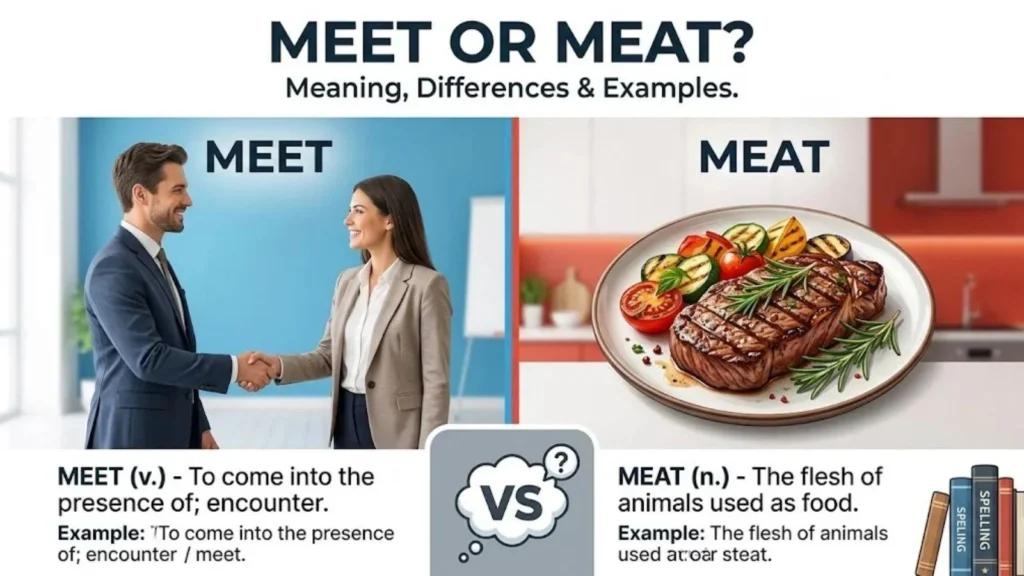
Meet means to see, greet, or come together with someone. Meat means the flesh of an animal used as food.
Examples:
- Meet: I will meet my teacher after school.
- Meat: We bought fresh meat for dinner.
- Meet: Let us meet at the park tomorrow.
- Meat: She does not eat meat.
Remember this simple rule: use meet when talking about people, appointments, or coming together. Use meat when talking about food.
Both words are spelled correctly. Neither is a British or American spelling variation of the other. They are different words with different meanings.
The Origin of Meet or Meat
The words meet and meat have a long history in the English language. Although they sound alike today, they developed from different words with different meanings.
The Origin of Meet
The word meet comes from Old English mētan, which meant to encounter, find, or come across someone or something.
Over time, the word developed its modern meanings. Today, people use meet when they talk about seeing friends, attending appointments, or coming together for a purpose.
Examples:
- I will meet you at the station.
- We need to meet before the exam.
- The team will meet on Monday.
The word can also mean to satisfy a need or requirement, as in “This product will meet our needs.”
The Origin of Meat
The word meat comes from Old English mete, which referred more broadly to food or nourishment. Over time, its meaning became more closely associated with animal flesh used as food.
Today, meat commonly refers to foods such as beef, chicken, lamb, and pork.
Examples:
- He cooked meat for lunch.
- The recipe requires one kilogram of meat.
- Some people choose not to eat meat.
Why Do Meet and Meat Sound the Same?
English pronunciation changed over many centuries. Meet and meat eventually came to share the same vowel sound in modern standard English.
Their spellings stayed different because they came from different historical words. This is why English has homophones: words that sound the same but have different spellings and meanings.
British English vs American English Spelling
There is no spelling difference between meet and meat in British and American English. Both countries use the same spelling for each word.
The difference is not regional. It is based on meaning.
| Word | British English | American English | Meaning |
|---|---|---|---|
| Meet | Meet | Meet | To see or come together with someone |
| Meat | Meat | Meat | Animal flesh used as food |
| Meeting | Meeting | Meeting | An event where people gather |
| Meaty | Meaty | Meaty | Containing a lot of meat or having a substantial quality |
Examples in British English
- I will meet you outside the station.
- We are having meat and vegetables for dinner.
- The manager arranged a meeting for Tuesday.
Examples in American English
- I will meet you outside the train station.
- We are cooking meat for dinner.
- The manager scheduled a meeting for Tuesday.
The sentences use the same spellings in both varieties of English. Some related vocabulary or expressions may differ by region, but meet and meat do not.
Which Spelling Should You Use?
Choosing between meet and meat depends on what you want to say, not where your readers live.
For American English
Use meet when referring to seeing someone or gathering.
Example: “I will meet my friends after work.”
Use meat when referring to food.
Example: “We bought meat from the grocery store.”
For British English
The same rules apply.
Example: “I will meet you near the school.”
Example: “They served meat with potatoes.”
For Global English
If you write for an international audience, choose the word that matches your meaning. Both words are understood in standard English across the world.
A useful memory trick is to associate the double e in meet with the idea of two people coming together. Think of the a in meat as part of the word you use for food.
This trick is not a spelling rule, but it can help you remember the difference.
Common Mistakes with Meet or Meat
Because meet and meat sound alike, people sometimes use the wrong word when writing. Here are common mistakes and their corrections.
| Incorrect sentence | Correct sentence | Why? |
|---|---|---|
| I will meat you tomorrow. | I will meet you tomorrow. | Meet means to see someone. |
| We ate meet for dinner. | We ate meat for dinner. | Meat is food. |
| Nice to meat you. | Nice to meet you. | This expression is used when greeting someone. |
| I need to meet for my sandwich. | I need meat for my sandwich. | Meat refers to the food ingredient. |
| Let us meat at noon. | Let us meet at noon. | Meet refers to getting together. |
| This recipe needs more meet. | This recipe needs more meat. | Meat is the correct word for the food. |
Mistake 1: Writing “Nice to Meat You”
This is a common spelling error in greetings.
Correct: “It was nice to meet you.”
The phrase describes meeting someone for the first time or enjoying an encounter.
Mistake 2: Using “Meet” When Talking About Food
Incorrect: “I bought meet for dinner.”
Correct: “I bought meat for dinner.”
Use meat when discussing food made from animal flesh.
Mistake 3: Confusing the Words in Emails
Incorrect: “Can we meat tomorrow to discuss the project?”
Correct: “Can we meet tomorrow to discuss the project?”
In professional writing, choosing the right word helps your message look clear and polished.
Meet or Meat in Everyday Examples
Both words appear in everyday conversations, emails, news stories, social media posts, and formal writing.
1. In Emails
Use meet when arranging an appointment.
Example:
“Hello, I would like to meet with you on Thursday to discuss the report. Please let me know what time works best.”
Use meat when discussing food arrangements.
Example:
“Please let me know if you would like meat or a vegetarian meal at the event.”
2. In News Articles
Meet may describe an important gathering.
Example: “World leaders will meet next week to discuss trade.”
Meat may appear in stories about food prices or farming.
Example: “Meat prices increased this month due to higher production costs.”
3. On Social Media
Examples using meet:
- “Can’t wait to meet everyone at the concert!”
- “Let’s meet for coffee this weekend.”
Examples using meat:
- “This is my favorite meat recipe.”
- “What is the best way to cook meat on a grill?”
4. In Formal Writing
Meet can describe requirements or professional gatherings.
Example: “The company must meet all safety standards.”
Meat can describe a food ingredient.
Example: “The study examined changes in meat consumption among adults.”
5. In Everyday Conversation
- “Where should we meet?”
- “What kind of meat do you prefer?”
- “I hope we can meet again soon.”
- “This dish contains no meat.”
The surrounding words usually make the intended meaning clear.
Meet or Meat – Comparison Table
Use this table as a quick reference when you are unsure which word belongs in your sentence.
| Feature | Meet | Meat |
|---|---|---|
| Part of speech | Verb; sometimes a noun in specific contexts | Noun |
| Main meaning | To see, encounter, or come together | Animal flesh used as food |
| Pronunciation | /miːt/ | /miːt/ |
| Spelling | M-E-E-T | M-E-A-T |
| Refers to people? | Yes, often | No, not in its ordinary food meaning |
| Refers to food? | No, not ordinarily | Yes |
| Example | I will meet my cousin. | I will cook meat tonight. |
| Related words | Meeting, meets, met | Meaty, meatless |
Simple Sentence Test
Ask yourself what the sentence is about.
- If it is about seeing someone, use meet.
- If it is about food, use meat.
- If it is about satisfying a condition, use meet.
- If it is about a meat-free meal, use meat.
For example, “The plan will meet our needs” uses meet because the plan satisfies a requirement. “The restaurant serves fresh meat” uses meat because it refers to food.
Meet or Meat – Google Trends and Usage Data
Meet and meat are both established English words used around the world. Their search popularity can change depending on the time, location, and reason people search for them.
However, there is no single permanent ranking that tells us which word is more popular in every country. Google Trends measures relative search interest over a selected period and location, rather than providing a complete count of all words used in everyday speech.
Search Interest in Different Countries
United States: People may search for meet in connection with appointments, events, and phrases such as “nice to meet you.” Searches for meat may relate to cooking, recipes, nutrition, and food prices.
United Kingdom: Both words are common. Searches for meet may relate to social plans or work meetings, while meat searches may focus on recipes, shopping, or food choices.
Australia and Canada: Both words are used in the same way as in other English-speaking countries. Search interest can vary according to seasonal events, food trends, and local topics.
Other countries: English learners may search for “meet or meat” to understand homophones and improve their spelling and grammar.
How to Compare Their Popularity
You can compare the two terms using the official Google Trends website:
To make a useful comparison:
- Enter “meet” and “meat” as separate search terms.
- Select your country or choose worldwide results.
- Choose a time range, such as the past 12 months.
- Compare the interest graph and related queries.
- Repeat the search with a more specific phrase, such as “meet or meat,” if you want to study spelling confusion.
Remember that meet has several meanings and meat can appear in many food-related searches. A general comparison may not show which word people use more often in a specific context.
FAQs About Meet or Meat
1. What is the difference between meet and meat?
Meet means to see, encounter, or come together with someone. Meat means animal flesh used as food. For example, “I will meet my friend” and “I will cook meat” use the words correctly.
2. Are meet and meat pronounced the same?
Yes. In standard modern English, meet and meat are homophones. They have the same pronunciation but different spellings and meanings.
3. Is “Nice to meat you” correct?
No. The correct phrase is “Nice to meet you.” It is used when greeting someone, especially for the first time.
4. Is meet or meat the correct spelling in British English?
Both spellings are correct in British English. Use meet for encounters and gatherings, and meat for food.
5. Is meet or meat the correct spelling in American English?
Both words are also correct in American English. Their meanings are the same as in British English.
6. Can meet be used as a noun?
Yes. Meet can be a noun in certain contexts, especially in sports. For example, “The school held a swimming meet.” It can also refer to an organized gathering in some varieties of English.
7. What is an easy way to remember meet vs meat?
Remember that you meet people and eat meat. The phrase “eat meat” can help you remember that meat refers to food, while meet refers to seeing or gathering with someone.
8. What does “meet the requirements” mean?
It means to satisfy or fulfill the conditions or standards that have been set. For example, “The applicant must meet the requirements for the job.”
9. Are meet and meat examples of homophones?
Yes. Homophones are words that sound alike but have different meanings and often different spellings. Meet and meat are common examples.
Conclusion: Meet or Meat
The difference between meet and meat is simple once you understand what each word means. Meet refers to seeing someone, coming together, or satisfying a requirement. Meat refers to animal flesh used as food. Although the words sound exactly the same in standard English, they have different spellings and uses.
Neither word is limited to British or American English. Both varieties use meet and meat in the same way, so you do not need to learn separate regional spelling rules for this pair.
When writing an email, greeting someone, arranging an appointment, or discussing a plan, use meet. When talking about recipes, meals, grocery shopping, or food choices, use meat. If you are unsure, read the sentence and ask whether it refers to an encounter or to food.
Remember the simple phrase “meet people, eat meat.” It is an easy way to keep these homophones straight. With practice, you will be able to choose the right word in everyday conversations, school assignments, social media posts, and professional documents.