Have you ever stopped while writing a sentence because you were unsure whether to use “observation” or “observanse”? You are not alone. Many people search for these words because English spelling can be confusing, especially when a word sounds different from how it is written.
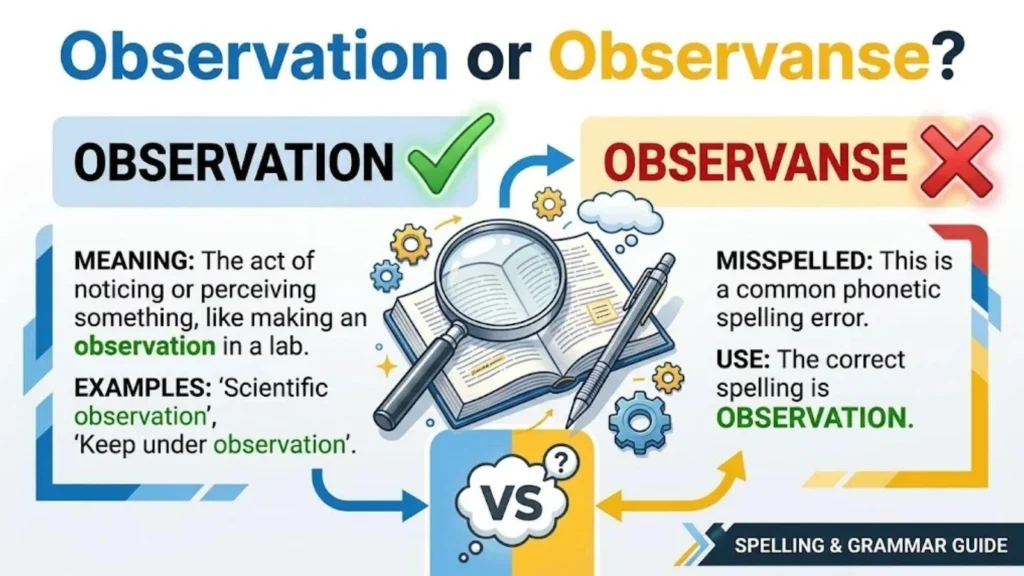
The good news is that the correct English word is observation. The word “observanse” is a misspelling. Observation means watching something carefully, noticing details, or recording what you see. It is used in schools, science, medicine, business, and everyday life.
Knowing the correct spelling helps you write better emails, school assignments, reports, and professional documents. It also helps you avoid mistakes when searching online or communicating with others. Although British and American English sometimes use different spellings, “observation” is spelled the same way in both varieties.
In this guide, you will learn the meaning of observation, its origin, common spelling mistakes, and how to use it in everyday sentences. You will also see examples, a comparison table, and answers to common questions. By the end, you will know why “observation” is correct and how to use it with confidence.
Observation or Observanse – Quick Answer
Observation is the correct spelling. Observanse is not a standard English word.
Observation means the act of watching, noticing, or studying something carefully.
Examples:
- Correct: The scientist made an important observation.
- Incorrect: The scientist made an important observanse.
- Correct: Her observation helped solve the problem.
- Incorrect: Her observanse helped solve the problem.
Remember this simple rule: Always write observation, whether you are using British English or American English.
The Origin of Observation or Observanse
The word “observation” comes from the Latin word observare, which means to watch, notice, or pay attention to something.
It entered English through Old French and Latin-based forms. Over time, it developed into the word we use today.
Observation is connected to the verb “observe.” When you observe something, you watch it carefully. An observation is what you notice or the act of watching.
For example:
- Observe: I observe the birds in the garden.
- Observation: My observation is that the birds arrive every morning.
The spelling “observanse” likely comes from confusion about how the ending sounds. English has many words with similar endings, such as “importance,” “guidance,” and “attendance.” However, these patterns do not make “observanse” correct.
The accepted spelling is “observation,” and it has remained consistent in standard English.
British English vs American English Spelling
British and American English often use different spellings. Examples include “colour” and “color,” “centre” and “center,” and “organise” and “organize.”
However, observation is spelled the same way in British and American English.
The word keeps the same letters in both varieties. There is no need to change its spelling based on your audience.
| Word or variation | British English | American English |
|---|---|---|
| Observation | Correct | Correct |
| Observanse | Incorrect | Incorrect |
| Observe | Correct | Correct |
| Observed | Correct | Correct |
| Observing | Correct | Correct |
| Observations | Correct | Correct |
Examples in both varieties:
- British English: The teacher recorded her observation.
- American English: The teacher recorded her observation.
Both sentences are correct.
The main lesson is simple: Do not apply spelling differences from other English words to “observation.” Its spelling does not change between British and American English.
Which Spelling Should You Use?
You should use “observation” in every standard English setting. Your choice does not depend on whether your readers live in the United States, the United Kingdom, Pakistan, Australia, Canada, or another English-speaking region.
For American readers: Use “observation” in schoolwork, emails, reports, and business writing.
Form British and Commonwealth readers: Use “observation” in academic work, formal letters, workplace documents, and everyday communication.
For a global audience: Use “observation” because it is widely recognized and accepted internationally.
If you are writing a scientific report, you might say, “The observation supports the results of the experiment.”
That you are writing a work email, you might say, “I would like to share an observation about the new process.”
If you are writing a school assignment, you might say, “My observation was that the plant grew faster in sunlight.”
In all three cases, the spelling remains the same.
Common Mistakes with Observation or Observanse
Many spelling mistakes happen because people write words the way they think they sound. Here are some common errors to avoid.
1. Writing Observanse
Incorrect: The student’s observanse was helpful.
Correct: The student’s observation was helpful.
Use “observation,” not “observanse.”
2. Confusing Observation With Observe
“Observe” is a verb, while “observation” is a noun.
- Correct: We observe the stars at night.
- Correct: Our observation revealed a new pattern.
Use “observe” when describing an action and “observation” when naming the act or something noticed.
3. Forgetting the Correct Ending
Incorrect: The report contains an observasion.
Correct: The report contains an observation.
Remember the spelling: o-b-s-e-r-v-a-t-i-o-n.
4. Using the Wrong Word Form
Incorrect: She observation the animals.
Correct: She observes the animals.
Correct: She makes an observation about the animals.
Choose the word form that fits the sentence.
5. Assuming British English Uses Observanse
Some English words change between British and American English. Observation does not.
Incorrect: The British spelling is observanse.
Correct: Both varieties use observation.
Observation in Everyday Examples
The word “observation” appears in many situations. Here are examples showing how to use it correctly.
In Emails
Subject: An Observation About Our Project
Hello Team,
I would like to share an observation about our latest project. The new process appears to save time and reduce errors.
Best regards,
Alex
In News
“The researchers made an important observation during the study.”
This sentence shows how the word can describe a finding or something noticed during research.
On Social Media
“My observation is that people are reading more digital books this year.”
This example uses observation to introduce a personal view based on what someone has noticed.
In Formal Writing
“The observation of changing weather patterns can help scientists understand climate trends.”
In formal writing, observation often refers to careful study, recorded details, or evidence.
In Schoolwork
“My observation was that the ice melted faster in warm water.”
This sentence is suitable for a science assignment because it describes something noticed during an experiment.
In Everyday Conversation
“One observation I made is that the shop gets busy after lunch.”
This is a natural way to share something you have noticed.
Observation or Observanse – Google Trends and Usage Data
People may search for “observation or observanse” when checking spelling, completing homework, writing a report, or learning English. The search usually reflects uncertainty about which form is correct.
However, exact search popularity can change over time and by country. Without current Google Trends data for the exact terms, it would be misleading to claim specific search volumes or country rankings.
Here is a practical overview of the word’s use:
| Context | Common usage |
|---|---|
| Education | Writing observations in assignments and experiments |
| Science | Recording results and noticing patterns |
| Healthcare | Monitoring and documenting a patient’s condition |
| Business | Sharing observations about work or performance |
| Everyday English | Describing something noticed |
| Spelling searches | Checking whether observation or observanse is correct |
The correct spelling, “observation,” is used in standard English worldwide. The misspelling “observanse” may appear in informal writing or search queries, but that does not make it an accepted alternative.
For current search-interest comparisons, use Google Trends and compare both terms over the same time period and in the same geographic region.
Comparison Table: Observation vs Observanse
| Feature | Observation | Observanse |
|---|---|---|
| Correct spelling | Yes | No |
| Standard English word | Yes | No |
| Meaning | Watching, noticing, or recording something | No standard meaning |
| Used in formal writing | Yes | No |
| Used in science and education | Yes | No |
| British English | Correct | Incorrect |
| American English | Correct | Incorrect |
| Recommended usage | Always use | Avoid |
This comparison makes the difference clear. “Observation” is the word you should use in all standard English writing.
FAQs About Observation or Observanse
1. Is observation or observanse correct?
Observation is correct. Observanse is a misspelling and should not be used in standard English.
2. What does observation mean?
Observation means watching, noticing, or studying something carefully. It can also refer to a detail or finding that someone notices.
3. Is observanse a real English word?
Observanse is not a standard English word. The correct spelling is observation.
4. Is observation British or American English?
Observation is used in both British and American English. Its spelling is identical in both varieties.
5. How do you spell observation?
The correct spelling is o-b-s-e-r-v-a-t-i-o-n.
6. What is the difference between observe and observation?
“Observe” is a verb that means to watch or notice something. “Observation” is a noun that refers to the act of observing or something noticed.
Example: “I observe the birds” and “My observation is that the birds arrive early.”
7. Can I use observation in a formal report?
Yes. Observation is common in scientific reports, business documents, medical records, academic assignments, and professional emails.
8. Why do people spell observation as observanse?
People may confuse the sound of the word with other English spelling patterns. However, the correct standard spelling remains observation.
Conclusion
When deciding between “observation or observanse,” the answer is clear: observation is the correct spelling, and observanse is incorrect. Observation means watching, noticing, or studying something carefully. It can also describe a detail, result, or finding that someone has noticed.
The word is widely used in science, education, healthcare, business, and everyday conversation. It is also spelled the same way in British and American English, so you do not need to change it for different audiences.
To avoid mistakes, remember the connection between “observe” and “observation.” You observe something, and you can then describe what you noticed as an observation. Practising this word in simple sentences can help you remember its spelling.
Whether you are writing a school assignment, sending a professional email, preparing a research report, or posting on social media, choose “observation.” Correct spelling makes your writing clearer and helps readers understand your message. When in doubt, check a trusted dictionary and remember that “observanse” is not an accepted alternative. With this simple rule, you can use the word confidently in any standard English context.