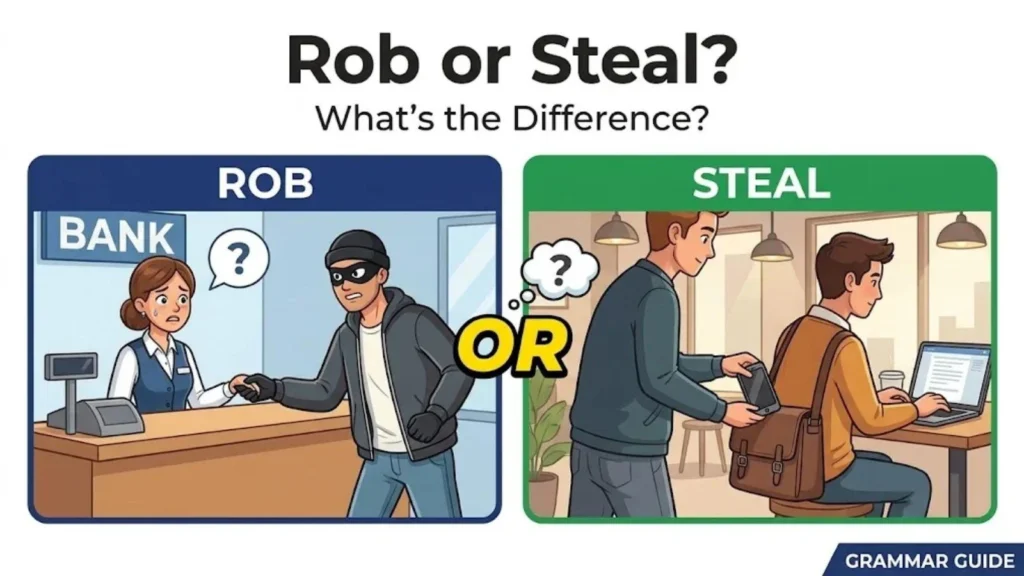
Have you ever wondered whether to use rob or steal when talking about a crime? These two words are closely related, but they do not mean exactly the same thing. Both describe taking something that does not belong to you. However, the way we use them depends on what happens and who or what is targeted.
People often search for “rob or steal” because they want to speak and write correctly. The words appear in news stories, books, school assignments, social media posts, and everyday conversations. Choosing the wrong word can change the meaning of a sentence. For example, a person can steal a wallet from a table, but someone who takes money directly from a person by force may rob that person.
The good news is that the difference is easy to learn. You do not need to memorize many difficult grammar rules. You only need to understand what each word focuses on and how it works in a sentence.
In this guide, you will learn the meaning of rob and steal, their origins, common mistakes, and examples of correct usage. You will also discover which word works best in formal writing, everyday speech, and different English-speaking countries.
Rob or Steal – Quick Answer
Rob means taking money or property from a person or place, often through force, threats, or unlawful action. Steal means taking something that belongs to someone else without permission.
Here are simple examples:
- Rob: The criminals robbed the bank.
- Rob: Someone robbed my neighbor last night.
- Steal: Someone stole my bicycle.
- Steal: He stole money from his employer.
The main difference is what receives the action.
You usually rob a person, bank, shop, or other place. You usually steal an object, money, or information.
For example:
- Correct: The thief robbed the store.
- Correct: The thief stole a laptop from the store.
- Incorrect in ordinary usage: The thief robbed a laptop.
You can also use rob in a figurative sense. For example, “The illness robbed her of her energy.” Here, rob means deprive someone of something valuable.
Remember this simple rule: You rob a person or place, but you steal a thing.
The Origin of Rob or Steal
The words rob and steal have different histories, even though their meanings overlap.
The Origin of Rob
The word rob comes through Old French rober, meaning to rob or plunder. Its deeper roots are commonly traced to Germanic languages, where related words referred to taking property or spoils.
Over time, English speakers began using rob to describe taking property from people or places unlawfully. The word became common in expressions such as “rob a bank,” “rob a traveler,” and “rob someone of an opportunity.”
Today, rob can describe both a criminal act and a figurative loss.
Examples:
- The gang robbed a jewelry store.
- The accident robbed him of his confidence.
- The decision robbed the team of its chance to win.
The Origin of Steal
The word steal comes from Old English stelan, which meant to take something secretly or without permission. It is related to similar words in other Germanic languages.
The word has kept much of its original meaning. It generally describes taking something that belongs to another person without their consent.
Examples:
- Someone stole my phone.
- The child stole a cookie from the kitchen.
- A hacker stole confidential information.
Steal also has figurative uses. For example, “She stole the show” means she attracted the most attention or impressed people the most.
Why Are Rob and Steal Different?
The words developed around related but distinct ideas. Rob often focuses on the victim or location, while steal focuses on the thing taken.
This difference explains why English speakers say “robbed the bank” but “stole the money.” Both sentences may describe the same event, but each emphasizes a different part of it.
British English vs American English Spelling
Unlike words such as colour and color, rob and steal do not have different standard British and American spellings.
Both countries use the same spellings:
- Rob
- Robs
- Robbed
- Robbing
- Steal
- Steals
- Stole
- Stolen
- Stealing
The main differences involve grammar, sentence structure, and preferred expressions rather than spelling.
Verb Forms of Rob
| Form | Example |
|---|---|
| Base form | rob |
| Third-person singular | robs |
| Past tense | robbed |
| Past participle | robbed |
| Present participle | robbing |
Examples:
- They rob banks in the film.
- He robs the store in the story.
- The shop was robbed yesterday.
- The criminals are robbing a bank in the scene.
Notice the double b in robbed and robbing.
Verb Forms of Steal
| Form | Example |
|---|---|
| Base form | steal |
| Third-person singular | steals |
| Past tense | stole |
| Past participle | stolen |
| Present participle | stealing |
Examples:
- They steal cars in the film.
- He steals money from the drawer.
- She stole my bag yesterday.
- The stolen phone was recovered.
The past tense of steal is stole, not “stealed.” Its past participle is stolen, not “stole.”
British and American Usage Comparison
| Expression | British English | American English |
|---|---|---|
| Rob a bank | Correct | Correct |
| Rob a person | Correct | Correct |
| Steal a car | Correct | Correct |
| Steal money | Correct | Correct |
| Robbed | Correct | Correct |
| Stolen | Correct | Correct |
Both varieties follow the same core rules. You can use either word confidently in British or American English when the sentence is appropriate.
Which Spelling Should You Use?
Since rob and steal have the same spelling in British and American English, your choice depends on meaning rather than location.
For American English
Use rob when the action focuses on a person or place.
Examples:
- The suspect robbed a convenience store.
- The man was accused of robbing a bank.
Use steal when the action focuses on an item.
Examples:
- Someone stole my car.
- The employee stole company documents.
For British English
The same rules apply.
Examples:
- The police are investigating a bank robbery.
- Someone stole her handbag on the train.
British English speakers also use expressions such as “rob someone of their belongings” and “steal a glance.”
For Global English
If you write for an international audience, choose the word that makes your meaning clear.
For news reports, school assignments, business documents, and general communication, use the following pattern:
- Rob a person.
- Rob a bank.
- Rob a shop.
- Steal a phone.
- Steal money.
- Steal an idea.
When describing a crime, be precise. A news report might say that someone robbed a store and stole cash from the register. This sentence uses both words correctly.
Common Mistakes with Rob or Steal
Many English learners confuse these words because both describe unlawful taking. Here are common errors and how to correct them.
Mistake 1: Saying “Robbed My Phone”
Incorrect: Someone robbed my phone.
Correct: Someone stole my phone.
Why? A phone is the object taken. The natural expression is “stole my phone.”
Mistake 2: Saying “Stole the Bank”
Incorrect: The criminals stole the bank.
Correct: The criminals robbed the bank.
Why? The bank is the place targeted. If the criminals took money from it, say they robbed the bank.
Mistake 3: Using “Stealed”
Incorrect: He stealed my wallet.
Correct: He stole my wallet.
Why? Steal is an irregular verb. Its past tense is stole.
Mistake 4: Using “Stole” Instead of “Stolen”
Incorrect: My bicycle was stole.
Correct: My bicycle was stolen.
Why? Passive sentences use the past participle. The past participle of steal is stolen.
Mistake 5: Forgetting the Double B
Incorrect: The store was robed yesterday.
Correct: The store was robbed yesterday.
Why? Robbed has two b’s. “Robed” is a different word related to wearing a robe.
Mistake 6: Assuming Rob Always Means Violence
Rob can describe a crime involving force or threats, but the exact legal meaning depends on the circumstances and local law. It can also be used figuratively.
Example: “The delay robbed us of valuable time.”
Mistake 7: Thinking Steal Always Means Hiding
Stealing may happen secretly, but it does not always have to. Someone can steal an item openly. The key idea is taking something without permission, not necessarily doing it in secret.
Rob or Steal in Everyday Examples
Understanding how these words work in daily life makes them easier to remember.
1. In Emails
Change block type or style
Move Paragraph block from position 100 up to position 99
Move Paragraph block from position 100 down to position 101
Change alignment
Change text alignment
Displays more block tools
Professional writing should be clear and factual, especially when discussing missing property or suspected wrongdoing.
Example:
“Dear Manager,
I am writing to report that my laptop was stolen from the office yesterday. Please let me know if there are any security procedures I should follow.
Kind regards,
Alex”
Here, stolen is correct because the laptop is the object taken.
Another example:
“The security team is reviewing footage after an attempt to rob the store.”
Rob is correct because the store is the target.
2. In News Reports
News articles often use both words to describe different parts of one incident.
Example:
“Police say two suspects robbed a local store and stole cash and several mobile phones.”
Robbed describes the action against the store. Stole describes the items taken.
Writers should avoid stating that someone committed a crime as a proven fact when the available information only supports an allegation. Depending on the situation, phrases such as “was accused of robbing” or “police suspect that the items were stolen” may be more accurate.
3. On Social Media
People use steal in casual and figurative ways.
Examples:
- “Someone stole my headphones!”
- “That outfit stole the show.”
- “You stole my idea!”
- “The movie stole my heart.”
Rob is less common in playful expressions, but it can still be used figuratively.
Example:
“That long meeting robbed me of my lunch break.”
4. In Formal Writing
In school assignments, reports, and official documents, choose the word that describes the action accurately.
Examples:
- “The defendant was charged with robbing a convenience store.”
- “The investigation concerned money stolen from the company.”
- “The report states that the suspect robbed the victim of cash and jewelry.”
In legal writing, the exact terms and definitions may depend on the relevant jurisdiction. Do not treat rob and steal as interchangeable legal charges.
5. In Everyday Conversation
Here are some simple examples:
- “Someone robbed the shop last night.”
- “I think someone stole my umbrella.”
- “The thief stole a wallet from the bag.”
- “The criminals robbed the travelers.”
- “That song stole my heart.”
These sentences show how rob often focuses on the person or place, while steal focuses on the item or figurative object.
Rob or Steal – Google Trends & Usage Data
People search for “rob or steal” to learn the difference between the words, improve their grammar, and choose the correct term for writing. Both words are common in everyday English, crime reports, fiction, and conversations about missing property.
However, their popularity can vary by context.
Which Word Is More Common?
Both words are widely used, but their frequency depends on the sentence and subject.
- Steal appears in many everyday situations, including missing belongings, intellectual property, and figurative expressions.
- Rob often appears in crime reporting, police statements, and descriptions of crimes against people or places.
For example, a news story may use “robbed a bank,” while a personal message may say “someone stole my wallet.”
Usage by Country
| Region | Common usage |
|---|---|
| United States | Both words are common in speech, news, and writing. |
| United Kingdom | Both words are common, with the same basic meanings. |
| Canada | Both words follow the standard English distinction. |
| Australia | Both words are used in everyday and formal English. |
| Pakistan | Both words are taught and used in English learning and communication. |
These examples describe general English usage, not measured search rankings.
How to Check Google Trends
Google Trends can help compare interest in “rob” and “steal” over time or across countries. To make a useful comparison, select the same time range and region, and check whether you are comparing search terms or broader topics.
Visit Google Trends and compare the terms “rob” and “steal.”
Keep in mind that Google Trends reports relative search interest, not the total number of searches. Without checking a specific date range and region, it would be misleading to claim that one term is definitively more popular worldwide.
Comparison Table: Rob vs Steal
| Feature | Rob | Steal |
|---|---|---|
| Main meaning | Take property from a person or place unlawfully | Take something without permission |
| Common object | A person, bank, shop, or other place | Money, a phone, a car, or another item |
| Example | They robbed the bank. | They stole the money. |
| Past tense | Robbed | Stole |
| Past participle | Robbed | Stolen |
| Present participle | Robbing | Stealing |
| British spelling | Rob | Steal |
| American spelling | Rob | Steal |
| Figurative use | Rob someone of time | Steal the show |
| Common error | “Robbed my phone” | “Stealed my phone” |
The key difference is simple: rob usually focuses on the victim or place, while steal focuses on what was taken.
FAQs About Rob or Steal
1. What Is the Main Difference Between Rob and Steal?
Rob usually describes taking property from a person or place. Steal describes taking something that belongs to someone else without permission.
Example: “They robbed the bank and stole the cash.”
2. Is It Correct to Say “Someone Robbed Me”?
Yes. “Someone robbed me” is correct when someone unlawfully took your property from you. The circumstances determine whether the act meets the legal definition of robbery.
3. Do You Rob a House or Steal From a House?
Both expressions can be correct, but they emphasize different things.
- “They robbed the house” describes the house as the target.
- “They stole jewelry from the house” identifies the items taken.
4. Is “Robbed My Phone” Correct?
In ordinary English, say “Someone stole my phone.” You can also say “Someone robbed me of my phone,” which focuses on the person who lost the property.
5. What Is the Past Tense of Steal?
The past tense of steal is stole.
Example: “She stole my pen yesterday.”
Its past participle is stolen.
Example: “My pen was stolen yesterday.”
6. Is Robbed British or American English?
Robbed is standard in both British and American English. There is no regional spelling difference between the two varieties.
7. Can Rob and Steal Be Used in the Same Sentence?
Yes. They can describe different parts of the same event.
Example: “The criminals robbed the store and stole several watches.”
8. Does Steal Always Mean Taking Something Secretly?
No. Steal means taking something without permission. The act can happen secretly or openly.
9. What Does “Rob Someone of Something” Mean?
It means depriving someone of something valuable, either literally or figuratively.
Example: “The illness robbed him of his strength.”
10. Which Word Should I Use in Formal Writing?
Use rob when the focus is on a person or place being targeted. Use steal when the focus is on the property taken. In legal documents, follow the terminology used by the relevant law or authority.
Conclusion: Rob or Steal?
Choosing between rob and steal becomes easy once you understand what each word describes. Although both words involve taking something unlawfully, they serve different purposes in a sentence. Rob usually focuses on the person or place targeted, while steal focuses on the thing taken.
For example, you can say, “The criminals robbed the bank and stole the money.” This sentence shows the difference clearly. The bank is the target, and the money is the property taken.
Remember the correct verb forms, too. Rob becomes robbed in the past tense, while steal becomes stole. When using the past participle, say robbed and stolen. Avoid errors such as “stealed” or “robbed my phone” when you mean “stole my phone.”
The spelling rules are the same in British and American English, so you do not need to choose a regional version. Instead, focus on meaning, grammar, and context. Whether you are writing an email, completing a school assignment, reporting an incident, or speaking with friends, the right word makes your message clearer and more professional.
The easiest rule to remember is this: rob a person or place, and steal a thing.